
Lightning Network Splicing Guide: Complete Bitcoin Banking Tutorial
Lightning Network splicing lets users add or remove bitcoin from channels without closing them, reducing fees and maintaining uptime.
.png)
Buy Bitcoin with Zero Fees with Rhino
The most secure way to stack sats. Simple, fast, and zero trading fees.
Lightning Network splicing allows users to add or remove funds from an existing payment channel without closing and reopening it. This capability makes channel management more efficient by eliminating the need for separate on-chain transactions to adjust channel capacity.
Key Summary: Lightning Network splicing is a protocol upgrade that enables users to resize payment channels dynamically, adding or removing bitcoin while keeping the channel operational and preserving existing routing connections.
Key Takeaways:
- Splicing allows channel capacity adjustments without closing channels
- Reduces on-chain transaction fees compared to channel reopening
- Maintains channel uptime and routing relationships during resizing
- Supports both splice-in (adding funds) and splice-out (removing funds) operations
What Is Lightning Network Splicing?
Lightning Network splicing is a technique that modifies an existing payment channel's capacity without disrupting its operation. Rather than closing a channel, waiting for on-chain confirmation, and opening a new channel with different capacity, splicing updates the channel in a single on-chain transaction while keeping it active.
Two types of splicing operations exist. Splice-in operations add bitcoin to an existing channel, increasing its capacity for larger payments or improved routing. Splice-out operations remove bitcoin from a channel, reducing capacity while extracting funds to an on-chain address.
This technology builds on the broader Lightning Network infrastructure that enables instant bitcoin payments with minimal fees. For users exploring Lightning Network banking capabilities, splicing represents an important advancement in channel management efficiency.
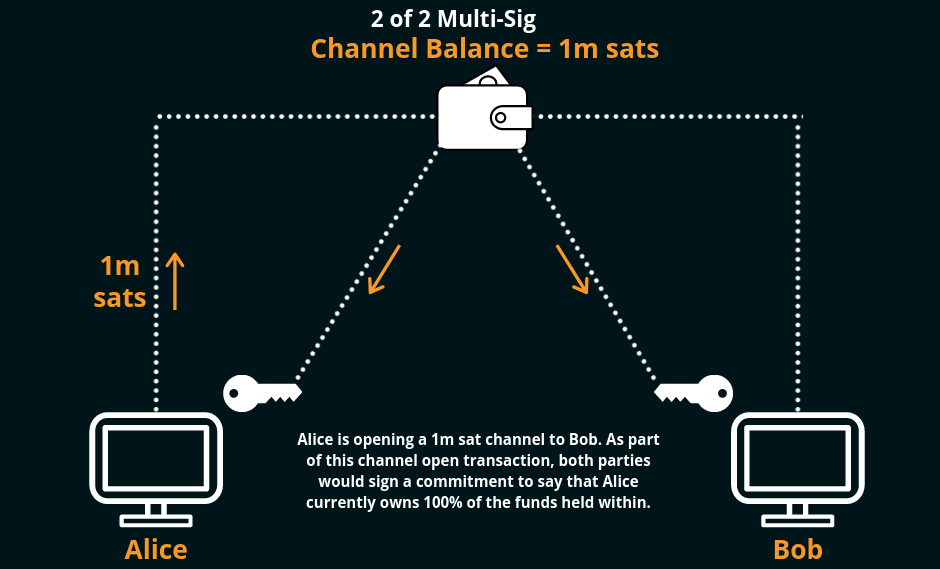
Payment Channel: A bilateral agreement between two Lightning Network nodes that enables unlimited off-chain transactions between them until either party closes the channel. Channels require an initial on-chain transaction to establish and typically another to close. Learn more from Lightning Network documentation
A Payment Channel is a 2-of-2 Multisign Agreement Between 2 Lightning Nodes
How Does Splicing Work?
Splicing operates by creating a new channel state that references additional bitcoin inputs or outputs. The process requires cooperation from both channel participants, who must agree to the capacity adjustment and sign the updated channel transaction.
During a splice operation, the existing channel continues processing payments. The splice transaction spends the current channel funding output and creates a new funding output with adjusted capacity. Once the splice transaction confirms on-chain, the channel operates with its new capacity while preserving its channel ID and routing relationships.
The splicing process involves these steps:
- Both channel parties negotiate the splice parameters and amount
- A splice transaction is constructed referencing the existing channel and new inputs or outputs
- Both parties sign the splice transaction and updated channel state
- The splice transaction broadcasts to the Bitcoin network for mining confirmation
- After confirmation, the channel operates with adjusted capacity
The technical implementation uses a commitment transaction format that allows spending from both the old and new funding outputs during the transition period. This ensures the channel remains secure even if one party attempts to broadcast an outdated state.
Why Is Splicing Important for Lightning Users?
Splicing solves several practical problems that Lightning Network users encounter. Without splicing, adjusting channel capacity requires closing the channel, paying on-chain fees, waiting for confirmations, and opening a new channel with additional fees and confirmation delays.
For node operators managing multiple channels, splicing dramatically reduces operational costs. Instead of paying two on-chain transaction fees (one to close, one to open), operators pay a single fee for the splice transaction. This efficiency becomes significant when managing dozens of channels requiring periodic rebalancing.
Channel uptime remains another critical benefit. Traditional channel closure interrupts routing capabilities and breaks established payment paths. Merchants accepting Lightning payments or routing nodes providing liquidity lose revenue during this downtime. Splicing eliminates these interruptions by maintaining channel continuity.
Key advantages splicing provides:
- Reduced on-chain transaction fees through consolidated operations
- Continuous channel availability without routing interruptions
- Preserved channel history and established routing relationships
- Simplified liquidity management for node operators
- Improved capital efficiency by avoiding locked funds during channel transitions
What Are Splice-In and Splice-Out Operations?
Splice-in and splice-out operations serve different purposes for Lightning Network users. Understanding when to use each type helps optimize channel management and liquidity allocation.
Splice-In Operations
A splice-in adds bitcoin to an existing channel, increasing its capacity. Users perform splice-ins when they need to send larger payments, improve routing capacity, or allocate more funds to a particularly useful channel without opening additional channels.
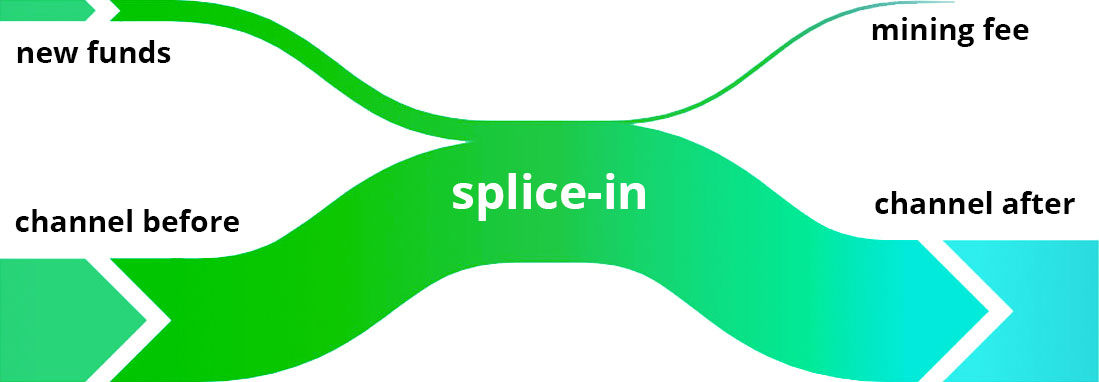
The splice-in transaction includes inputs from the user's on-chain wallet alongside the existing channel funding output. The resulting channel has capacity equal to the original balance plus the newly added funds. This operation proves especially valuable for merchants who receive many small Lightning payments and need to maintain sufficient inbound capacity.
A Graph Visualizing a Splice-in Operation
Splice-Out Operations
A splice-out removes bitcoin from a channel to an on-chain address. Users perform splice-outs when they need to reduce channel capacity, withdraw funds to cold storage, or reallocate liquidity to other channels or purposes.
The splice-out transaction sends a portion of the channel funds to a specified Bitcoin address while maintaining a smaller channel with the remaining balance. This allows users to access their Lightning funds without completely closing the channel and losing the routing relationship.
Comparison: Splice-In vs Splice-Out
Splice-In
- Purpose: Increase channel capacity and outbound liquidity
- Common uses: Preparing for large payments, improving routing capacity, merchant inbound capacity
- Best for: Users who need more sending capacity or node operators expanding routing services
Splice-Out
- Purpose: Reduce channel capacity and withdraw funds on-chain
- Common uses: Moving funds to cold storage, reducing exposure, reallocating liquidity
- Best for: Users extracting profits, reducing channel commitment, or consolidating funds
How Does Splicing Compare to Channel Management Alternatives?
Lightning Network users have several options for managing channel capacity. Each approach involves different tradeoffs in cost, complexity, and downtime.
Traditional Channel Closure and Reopening
Before splicing became available, users adjusted capacity by closing channels and opening new ones. This method requires two on-chain transactions (one cooperative close, one channel open) plus waiting time between operations. Transaction fees during periods of high Bitcoin network congestion can make this approach expensive, potentially costing $10–50 or more depending on fee rates.
Opening Additional Channels
Some users maintain multiple channels to different nodes rather than resizing existing channels. While this provides redundancy and routing options, it fragments liquidity across channels and increases management complexity. Each channel requires its own on-chain opening transaction and locks funds that cannot be used in other channels without additional rebalancing.
Submarine Swaps
Submarine swaps exchange on-chain bitcoin for Lightning capacity through intermediary services. These trustless atomic swaps allow users to add inbound capacity without direct channel operations. However, submarine swaps typically charge 0.5% to 2% fees and work better for smaller amounts. For comprehensive channel resizing, splicing proves more cost-effective.
Submarine Swap: A trustless exchange between on-chain bitcoin and Lightning Network bitcoin, allowing users to move funds between layers without counterparty risk through hash time-locked contracts (HTLCs).
Users exploring differences between Bitcoin wallets and Lightning wallets should understand that splicing-capable wallets provide more flexible fund management across both layers.
What Wallet and Node Software Supports Splicing?
Splicing implementation varies across Lightning Network software. As of early 2025, several major implementations have added splicing support, though the feature continues rolling out across the ecosystem.
Core Lightning (CLN) implemented splicing support in version 23.08, released in August 2023. This implementation includes both splice-in and splice-out capabilities with active channel maintenance during the splicing process. Phoenix wallet, built on Eclair, has supported automated splicing since 2023, using the technique to manage channel capacity transparently for users.
Lightning Network Daemon (LND), one of the most widely deployed node implementations, has splicing development in progress but has not released production-ready support as of early 2025. Once LND completes implementation, splicing adoption will accelerate significantly given LND's large user base.
Current splicing support status:
- Core Lightning (CLN): Full support for splice-in and splice-out operations since v23.08
- Eclair: Splicing support with automated implementation in Phoenix wallet
- LND: Development in progress, not yet production-ready
- Rust-Lightning: Partial implementation, ongoing development
Users should verify their specific wallet or node software documentation for current splicing capabilities. The feature requires both channel participants to run splicing-compatible software, so adoption depends on network-wide implementation progress.
What Are the Costs and Risks of Splicing?
Splicing involves on-chain transaction fees similar to any Bitcoin transaction. The splice transaction size depends on the number of inputs and outputs, typically ranging from 150 to 400 bytes. At Bitcoin network fee rates of 10 sats/vbyte (as of early 2025), a typical splice might cost $5–15 in transaction fees.
These costs compare favorably to closing and reopening channels, which requires two separate transactions totaling 300 to 500 bytes combined. The fee savings become more significant during high-fee periods when on-chain block space becomes expensive.
Technical Risks and Considerations
Splicing introduces some technical complexity. During the splice transaction confirmation period, the channel enters a temporary state where both the old and new funding outputs exist. If one party broadcasts an old channel state attempting theft, the other party must use the correct commitment transaction corresponding to the current funding output.
This dual-state period typically lasts 10 minutes to several hours depending on transaction confirmation speed. Well-implemented Lightning software handles this complexity automatically, but users running custom or experimental software should understand these nuances.
Another consideration involves splice transaction confirmation time. Until the splice transaction receives sufficient confirmations (typically one to six confirmations), the channel capacity adjustment remains pending. Users planning large payments after a splice-in should wait for confirmation before attempting transactions requiring the new capacity.
How Will Splicing Affect Lightning Network Adoption?
Splicing addresses one of the Lightning Network's significant user experience challenges. New users often struggle with channel management, particularly understanding how to allocate funds across channels and adjust capacity as needs change. By simplifying these operations, splicing makes Lightning more accessible to non-technical users.
For merchants and businesses accepting Lightning payments, splicing enables better liquidity management without service interruptions. A retailer receiving many small Lightning payments can periodically splice-out accumulated funds to cold storage while maintaining active payment channels for ongoing transactions. This operational efficiency makes Lightning more practical for commercial applications.
The technology also benefits Lightning service providers and routing nodes. Operators managing dozens or hundreds of channels can rebalance liquidity more cost-effectively, improving the overall network's payment success rates and routing efficiency. Better routing performance attracts more users, creating a positive feedback loop for network growth.
As splicing support spreads across wallet and node implementations throughout 2025 and beyond, expect the feature to become a standard expectation rather than an advanced capability. This normalization will contribute to Lightning Network's evolution from an experimental technology to a mature payment infrastructure.
Frequently Asked Questions
What is Lightning Network splicing?
Lightning Network splicing is a technique for adding or removing bitcoin from an existing payment channel without closing it. The process uses a single on-chain transaction to resize the channel while maintaining its operation and routing relationships.
How much does splicing cost?
Splicing costs one Bitcoin on-chain transaction fee, typically $5–15 depending on network congestion as of early 2025. This compares favorably to closing and reopening channels, which requires two separate transaction fees totaling $10–30 or more.
Can I splice a channel without my peer's cooperation?
No, splicing requires both channel participants to agree and sign the splice transaction. Lightning Network channels are bilateral agreements, so any modification needs mutual consent from both parties.
How long does a splice operation take?
The splice transaction typically confirms within 10 minutes to several hours depending on Bitcoin network congestion and the fee rate used. The channel remains operational during this time, though the capacity adjustment only takes full effect after confirmation.
Does splicing change my channel ID?
No, splicing preserves the channel ID and routing relationships. This continuity represents one of splicing's key advantages over closing and reopening channels, which creates a completely new channel with a different ID.
What wallets support Lightning splicing?
Phoenix wallet and Core Lightning node software support splicing as of early 2025. LND implementation is in development but not yet production-ready. Always verify current capabilities in your specific wallet or node software documentation.
Can I splice-out all funds from a channel?
No, splice-out operations must leave sufficient funds to maintain a viable channel. Completely emptying a channel requires a traditional channel closure. Most implementations require maintaining a minimum channel balance for routing and fee reserves.
Is splicing safe?
Yes, splicing uses cryptographic techniques similar to standard Lightning Network operations. The temporary dual-state period during confirmation introduces minor complexity, but well-implemented software handles this automatically with appropriate security measures.
Conclusion
Lightning Network splicing represents a significant advancement in channel management efficiency. By enabling capacity adjustments without channel closure, splicing reduces costs, maintains uptime, and simplifies the user experience for both casual users and professional node operators.
Key considerations when using splicing:
- Verify your wallet or node software supports splicing before attempting operations
- Plan splice transactions during low Bitcoin network fee periods to minimize costs
- Understand that both channel participants must run splicing-compatible software
- Allow sufficient confirmation time before relying on adjusted channel capacity
For those ready to experience advanced Lightning Network features with professional channel management tools, explore Rhino Bitcoin's Lightning-enabled banking platform for instant bitcoin payments and integrated financial services.
References
- Lightning Network. "Lightning Network Specifications." lightning.network
- Blockstream. "Core Lightning v23.08 Release Notes: Splicing Support." github.com/ElementsProject/lightning
- ACINQ. "Phoenix Wallet: Automated Splicing Implementation." phoenix.acinq.co
- Bitcoin.org. "Lightning Network Protocol Documentation." bitcoin.org/en/developer-guide
- Mempool.space. "Bitcoin Transaction Fee Statistics." mempool.space
Important Disclaimers
Disclaimer: Educational information only. Not financial, legal, medical, or tax advice.
Risk Warnings: All investments carry risk, including loss of principal. Past performance is not indicative of future results. Bitcoin is a volatile asset and may not be suitable for all investors.
Conflicts of Interest: Rhino Bitcoin provides Bitcoin financial services. This content is educational and may reference our products.
.png)
.png)