
Bitcoin Sentiment: Fear & Greed Index
The Fear and Greed Index has often been used in Bitcoin to gauge market sentiment - but is it actually useful?
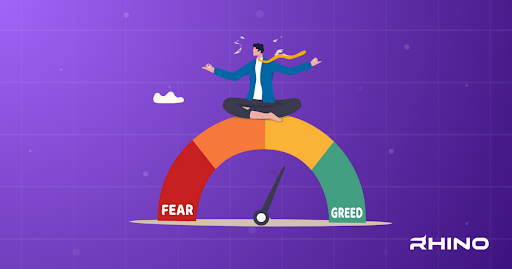
Buy Bitcoin with Zero Fees with Rhino
The most secure way to stack sats. Simple, fast, and zero trading fees.
Financial markets are not just numbers on a screen or tidy charts you can intellectualize. They are volatile, unpredictable, and full of human psychology and hidden variables our minds cannot fully model.
This is because markets are living, breathing ecosystems where the rules change as you play. Every new algorithm, every shift in sentiment, and every black swan event rewrites the underlying dynamics.
Which is why most investors get it wrong. They try to reduce everything down to logic, to formulas, to neat little indices. But the real signal is rarely found in the numbers alone.
The Fear & Greed Index is one of those attempts to flatten a complex reality into a simple gauge. The index is clean, catchy, and resonates. However, it is still a projection of something far more complicated into a lower-dimensional space.
The challenge is learning to see past the needle.
Noise vs. Signal
The hardest part of making investment decisions is not just knowing what to do, but rather eliminating all the noise out there trying to convince you to sell early or buy the pico top. The world is flooded with indicators, dashboards, pundit commentary, models, regressions, and correlations. Everyone is projecting confidence, but very few are anchored in reality.
Noise is cheap. Signal is priceless.
In markets, price is the ultimate signal. Everything else; indices, sentiment gauges, technical overlays, etc, is a derivative. Useful context, perhaps, but not truth.
The Fear & Greed Index sits squarely in this category: a colorful, odometer-like gauge of market mood, a vibe check for Wall Street. It simplifies the complexity of market psychology into a number between 0 and 100, where 0 is extreme fear and 100 is extreme greed. It looks clean, it feels intuitive, and it resonates with Buffett’s aphorism:
“Be fearful when others are greedy, and greedy when others are fearful”
The problem is not the quote. The problem is execution. Almost no one follows it.
The Stock Market’s Fear & Greed Index
The CNN Money team launched the index in 2012, in the long shadow of the financial crisis. Investors wanted a shortcut, a way to measure whether we were climbing the wall of worry or falling into panic. They blended seven indicators:
- Market momentum (S&P 500 vs. 125-day average)
- Stock price strength (Net new highs and lows)
- Stock price breadth (McClellan Volume Summation Index)
- Put/Call options ratio (Fear increases when puts exceed calls)
- Market volatility (Fear spikes when VIX rises above normal)
- Safe haven demand (Investors, historically, flee to bonds when fearful)
- Junk bond demand (Greed drives appetite for riskier bonds)
The Stock Market’s Fear and Greed Index
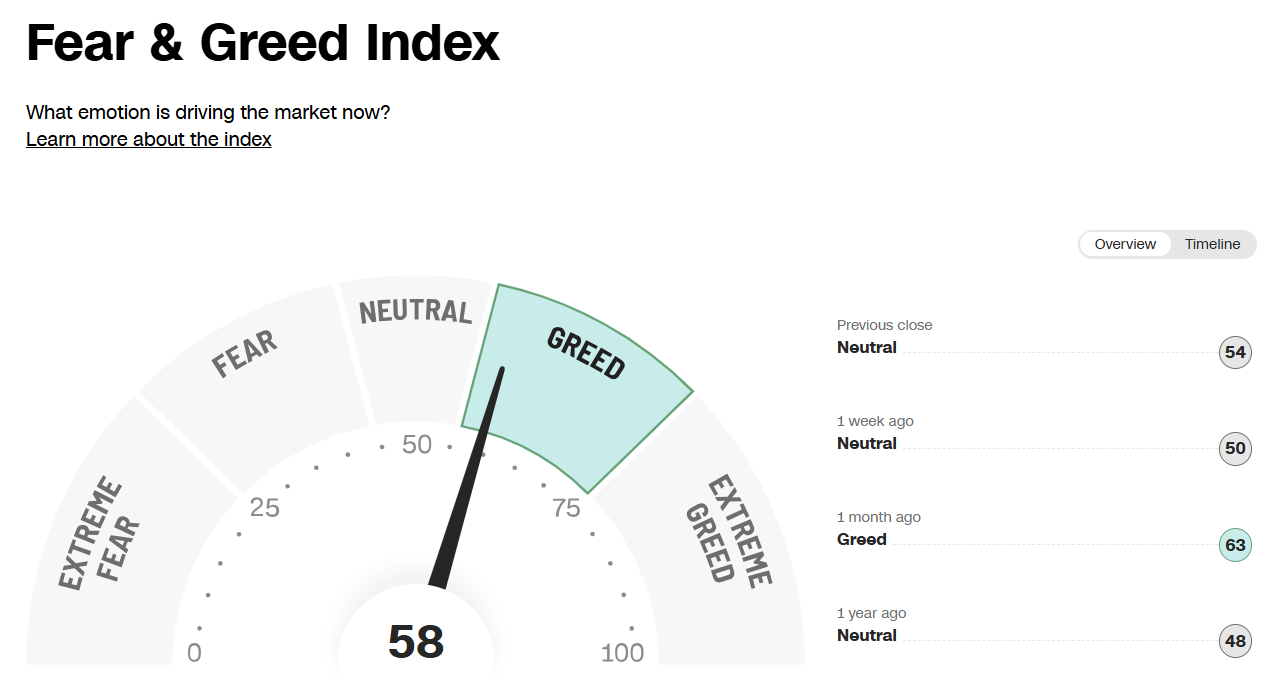
Each of the indicators are equally weighted, updated in real time, and then collapsed into a single score. It is quite elegant in its simplicity. But simplicity is not the same as accuracy.
The Buffett Problem
Buffett’s advice is structurally sound. Contrarianism inherently works precisely because the majority overreacts. Humans herd. We panic together, we FOMO together. The masses buy high, sell low.
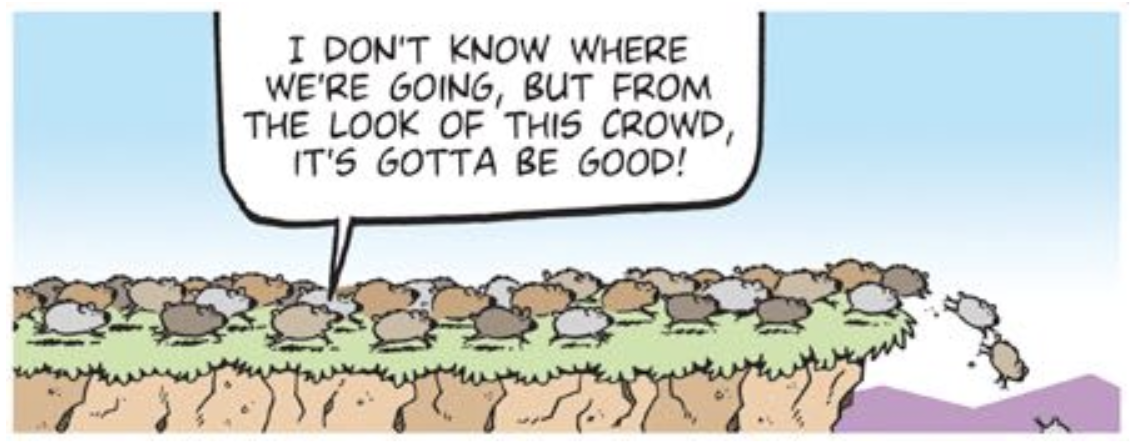
But here is the paradox: being contrarian requires independence of thought at precisely the moment it is hardest to think independently. Fear and greed are not abstract emotions: they are visceral, and physiological. When blood is in the streets, it feels like the world is ending. When prices are euphoric, it feels like the free money will never stop.
The Fear & Greed Index does not solve this paradox. If anything, it amplifies it. A flashing “Extreme Fear” gauge does not calm your nerves, it validates your panic.
Fiat, Fear, and Manufactured Greed
There is a deeper layer here that many investors do not often talk about - fiat currencies themselves are not neutral instruments. They are tools of control. Central banks and governments can print money at will, expand balance sheets, suppress rates, and intervene in markets.
The central planners have and will continue to create manufactured fear and greed cycles. “Experts” who teach economics call them boom & bust cycles. Those at the top often orchestrate panic, sell before the news becomes common knowledge, and then buy the bottom before the next bull market begins. Retail is subsequently often left “holding the bag”, consoling themselves with charts and indices that were designed to lag the real action.
Buffett’s quote is timeless wisdom, but the system ensures that the majority fail to follow it. The central planners pulling the strings of our top down financial system don’t just have stronger stomachs; they have asymmetric access.
That is why the purest contrarian play is not to attempt to “time” the fiat system, but to rather step outside it completely.
Bitcoin in the Mirror of Gold
If you want to sharpen your conviction, look at Bitcoin priced in gold. Gold has been the free market’s chosen form of money for over 5,000 years. Only fiat currency needs ‘legal tender’ status. While some governments have mandated gold's use, it functioned as money in free markets long before and without such laws, fiat cannot.
Gold’s scarcity, durability, and neutrality made it civilization’s oldest organizing principle, and the foundation of empires and trade. Bitcoin is the digital heir to that legacy: more scarce than its predecessor, and infinitely more portable and divisible.
This chart shows that sound money is not a passing trend. It is a story as old as civilization itself. Fiat currencies always end the same way; with debasement, collapse, and a new money reborn from the ashes. Bitcoin gives the entire world the chance to break that cycle.
Bitcoin / Gold Chart Over the Long Term
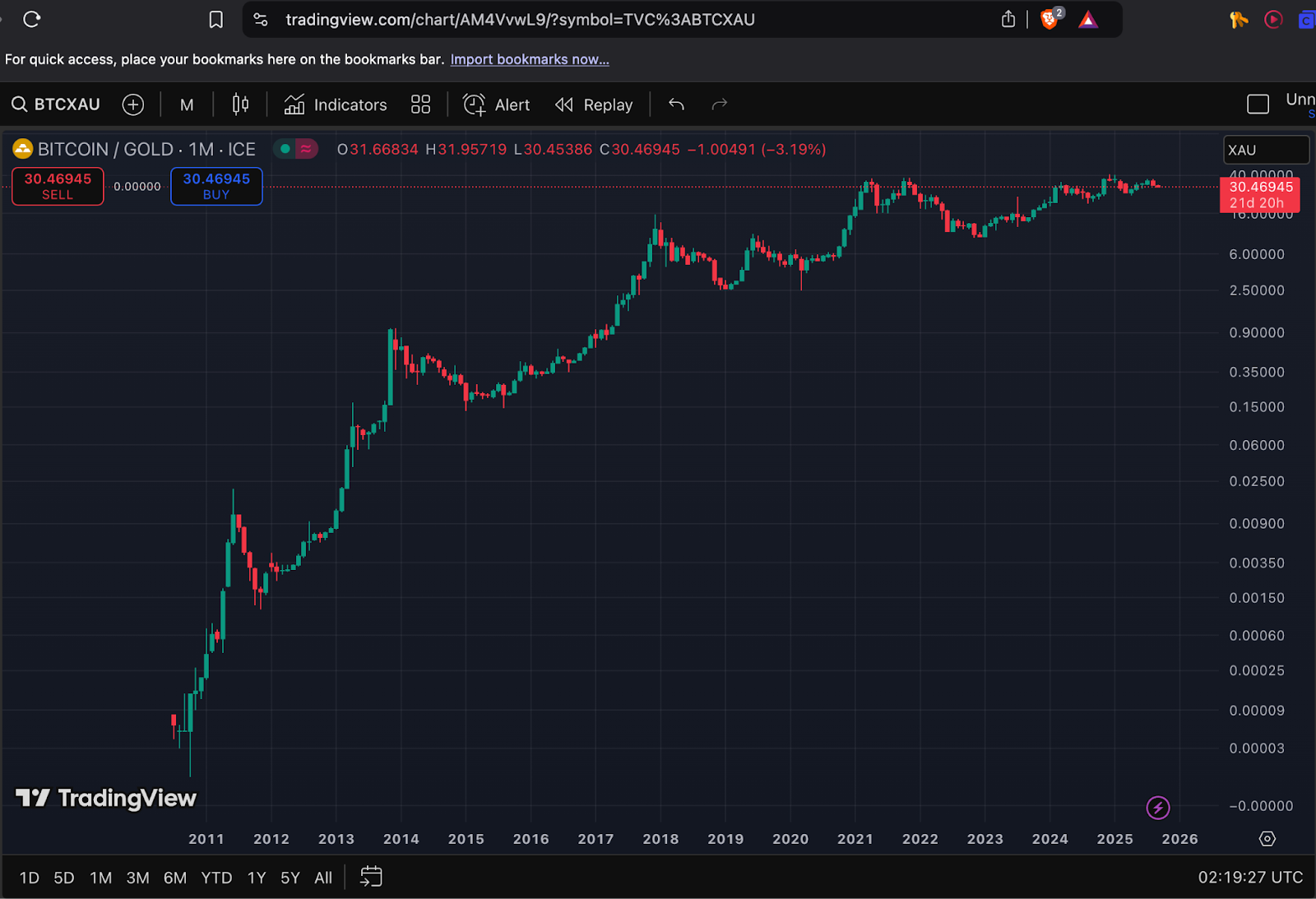
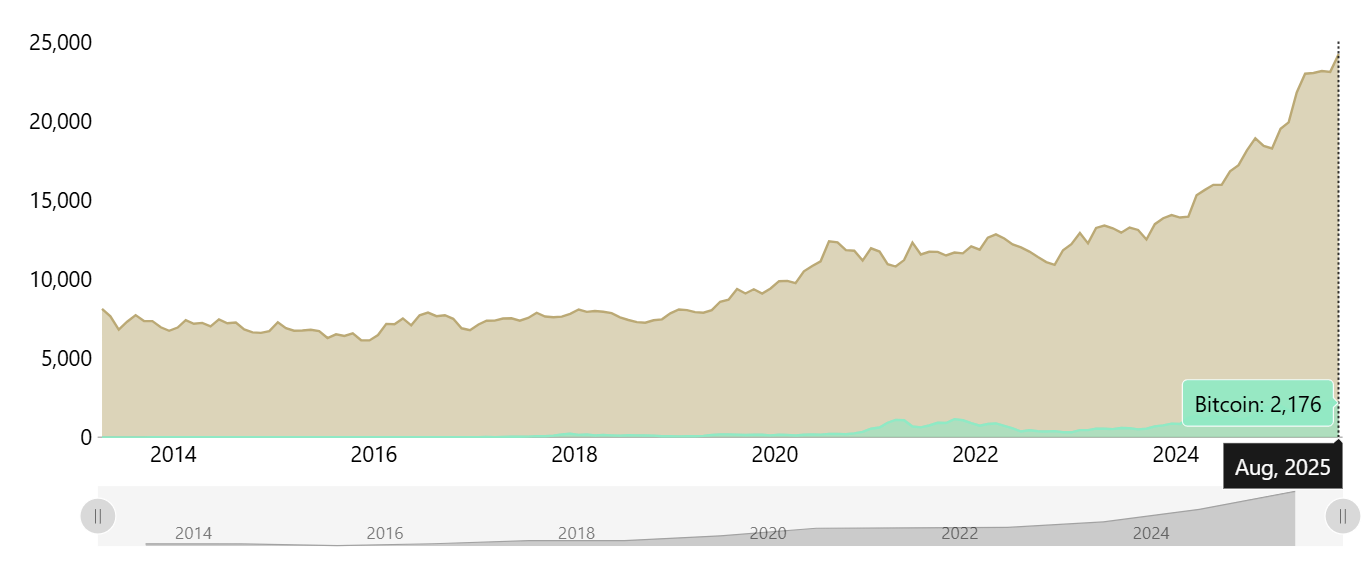
Notice how Bitcoin has not yet made a clean breakout to new highs against gold. That is because gold itself is on a historic run, adding trillions to its market cap in 2025 as people everywhere search for money that cannot be conjured out of thin air.
The signal is clear - the flight to sound money will likely continue as central planners increasingly realize what Bitcoiners have been saying on Twitter for a while now: “nothing stops this train”.
Gold carried the torch for millennia, and now Bitcoin offers an even better way to avoid the cruel fate of fiat monetary collapse and rebirth by porting directly into a better system.
Chart Market Capitalization of Gold ($24.2T) vs Bitcoin ($2.2T)
Bitcoin: The “Anti-Noise” Asset
Bitcoin cuts through the fog. It cannot be printed. It cannot be manipulated by decree. Its supply is fixed, its issuance transparent, its rules unchanging.
This makes Bitcoin the highest-fidelity signal in finance. Every 10 minutes, the chain updates with clear, incorruptible truth. Compare that to the fiat world, where GDP numbers get revised, inflation data gets smoothed, and indices like Fear & Greed mix seven inputs into one blunt gauge.
If price is the ultimate signal, then Bitcoin’s price is the cleanest version of it, because it reflects only the push and pull of human demand against an absolutely scarce supply.
High-Fidelity Signals vs. Low-Fidelity Noise
So what should investors actually pay attention to? Here is a spectrum:
High Fidelity (Signal):
- Price action itself (trend, volume, realized cap)
- On-chain metrics (UTXO data, hash rate, supply distribution)
- Monetary policy constraints (Bitcoin halving, Fed balance sheet size)
Medium Fidelity (Useful Context):
- Bitcoin Sentiment Indices (Fear & Greed, Bitcoin dominance)
- Market structure indicators (options open interest, futures funding rates)
Low Fidelity (Noise):
- Headlines (crafted for clicks not clarity, google trends)
- Pundit takes (anchored in bias)
- Most macro forecasts (pseudo-precision in an uncertain world, although there are some macro people like Lyn Alden, Luke Gromen, and James Lavish who seem to get most of their calls correct.)
The lesson: spend less time staring at the needle, and more time studying the engine.
The Bitcoin Fear & Greed Index
While CNN's equity-focused Fear & Greed Index captures traditional market sentiment, Bitcoin's unique structure demands a more sophisticated approach. Fortunately, companies like Perception & Bitbo are building their own Bitcoin Fear & Greed Index, ones that apply this psychological barometer to the world's most important money.
A Bitcoin Fear & Greed Index could be a powerful tool for understanding the crowd, but Bitcoin's ultimate truth still lives on-chain, in the immutable record of every transaction, every block, every nonce found via proof of work. Thus, it is important to remember these tools measuring Bitcoin Fear and Greed Index remain a map, not the territory.
Planning your Bitcoin Investment
Buffett’s quote, restated for the Bitcoin age, might go something like this:
- Buy on red days.
- Never sell for fiat, unless it is to make a life-changing purchase (like a forever home).
This is why most people are better off dollar-cost averaging into scarce assets instead of trading. However, many people want to trade, and the irony of markets is that the quietest times, the crab phases where price grinds sideways, are often the best for serious work.
When the noise fades and emotions settle, you gain the clarity to write out your playbook. What will you do if your portfolio rips 10x higher in a frenzy of greed? What will you do if it plunges 70 percent lower in a storm of fear?
Planning in calm waters arms you with logic before the chaos arrives. Yes, you may have to adjust as circumstances shift, but it is far easier to refine a clear plan than to improvise in panic. The crab is the rehearsal. The bull and the bear markets are the performance.
Conclusion: Beyond the Needle
The Fear & Greed Index is a mirror, not a compass. It shows you how others feel but not necessarily where the market is going. It reduces higher-dimensional truth, the complex interplay of capital flows, psychology, and macro policy, into a one-dimensional gauge.
That can be useful. But do not mistake it for truth.
The highest truth is still price. And the most uncorrupted price discovery mechanism we have is Bitcoin.
If you want to escape the cycle of fear and greed, the answer is not to watch the needle more closely. It’s to stop playing a game where the rules are rigged. Buy what can’t be printed. Trust the ultimate signal.
Everything else is noise.
.png)
.png)