
Bitcoin Whirlpool Mixing Security And Privacy Guide
Bitcoin Whirlpool uses CoinJoin transactions to break address links and enhance privacy while letting users retain full custody of their bitcoin.

Buy Bitcoin with Zero Fees with Rhino
The most secure way to stack sats. Simple, fast, and zero trading fees.
Bitcoin Whirlpool mixing is a privacy-enhancing technique. It breaks the connection between your bitcoin addresses through a process called CoinJoin.
The Whirlpool protocol was developed by Samourai Wallet. It coordinates multiple users who combine their transactions. This makes it extremely difficult to trace which inputs correspond to which outputs.
For a comprehensive overview of Bitcoin privacy and security practices, see our complete Bitcoin security guide.
Key Summary: Bitcoin Whirlpool mixing uses collaborative transactions called CoinJoins to obscure the links between bitcoin addresses. This significantly improves transaction privacy without requiring trusted third parties.
Key Takeaways:
- Whirlpool uses CoinJoin technology to mix bitcoin with other users
- The process creates equal-denomination outputs that are difficult to trace
- Multiple mixing rounds provide increasing privacy protection
- Users maintain custody of their bitcoin throughout the process
What Is CoinJoin and How Does Whirlpool Work?
CoinJoin is a trustless method. Multiple Bitcoin users combine their transactions into a single collaborative transaction.
Whirlpool implements CoinJoin using a coordinator. This coordinator helps organize participants but never takes custody of funds.
The process works as follows. Multiple users send bitcoin to a mixing pool. All participants contribute equal amounts.
When the mix completes, each participant receives back the same amount they contributed. The bitcoin is sent to a new address that cannot be easily linked to the original address.
Because all outputs are identical in size, blockchain observers cannot determine which input corresponds to which output.
CoinJoin: A privacy technique where multiple Bitcoin users combine their transactions into a single transaction. This makes it difficult to determine which sender paid which recipient. Learn more
Whirlpool differs from other mixing implementations because of its mathematical approach.
The protocol uses a concept called anonymity sets. This measures how many possible interpretations of a transaction history exist.
With each additional mix, the number of possible interpretations grows exponentially. For example, if five users participate in a CoinJoin, there are 120 possible interpretations of who paid whom.
CoinJoin Mixes Transactions so the Outputs Cannot be Traced
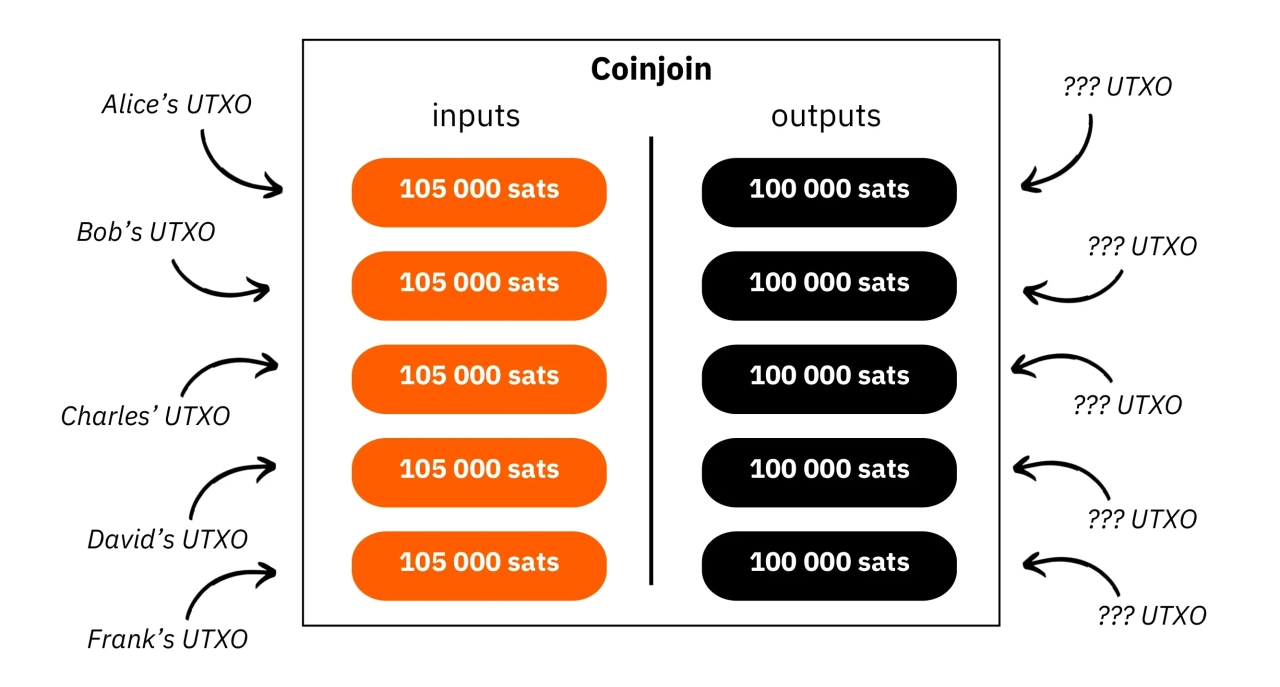
The Whirlpool Mixing Process
The mixing process happens in several distinct phases:
- TX0 (preparation): Your bitcoin is divided into standard denominations such as 0.001, 0.01, 0.05, or 0.5 BTC
- Mix coordination: The coordinator groups participants who have matching denominations
- Output creation: Each participant receives equal-sized outputs sent to new addresses
- Remixing: Outputs can be mixed again multiple times at no additional cost
Why Use Bitcoin Mixing for Privacy?
Bitcoin transactions are permanently recorded on a public blockchain.
Anyone can view transaction amounts, addresses, and timing. This transparency creates privacy risks for both individuals and businesses.
Without mixing, your bitcoin’s transaction history is fully traceable. It can be followed from address to address.
If someone learns that a specific address belongs to you, they can trace your bitcoin backward. They can also track where you spend it in the future.
This creates several practical problems.
Personal financial information becomes public. Your employer can see how much you’ve saved. Merchants can see your balance when you make purchases.
Business competitors can monitor your company’s cash flow and supplier relationships. In some cases, this information can make you a target for theft or unwanted attention.
Chain analysis companies specialize in tracking bitcoin flows across the blockchain.
These firms sell their services to exchanges, regulators, and law enforcement. While legitimate uses exist, this surveillance infrastructure means your financial activity is continuously monitored and recorded in commercial databases.
Legitimate Reasons for Financial Privacy
Privacy is not the same as secrecy for illegal purposes.
Most people have valid reasons to keep financial information confidential:
- Business operations: Companies need to protect sensitive information about suppliers, customers, and financial performance
- Personal safety: High-net-worth individuals reduce kidnapping and theft risks by keeping wealth private
- Competitive protection: Merchants avoid dynamic pricing based on perceived ability to pay
- Political freedom: Dissidents and activists in authoritarian regions need financial privacy for personal safety
How Does Whirlpool Compare to Other Mixing Methods?
Several approaches exist for improving Bitcoin transaction privacy.
Each method involves different tradeoffs in privacy, cost, and complexity.
Centralized Mixers (Not Recommended)
- How they work: You send bitcoin to a service that mixes it with other users and returns it
- Privacy level: Moderate and dependent on the mixer’s internal practices
- Major risk: You must trust the service with custody of your bitcoin
- Legal status: Many centralized mixers have been shut down by law enforcement
Whirlpool (CoinJoin)
- How it works: Trustless collaborative transactions coordinated by open-source software
- Privacy level: High, especially after multiple remixing rounds
- Major advantage: You maintain custody throughout the process
- Considerations: Requires technical setup and transaction fees for the initial mix
PayJoin
- How it works: Two-party collaborative transactions that resemble normal payments
- Privacy level: Moderate and effective against common chain analysis heuristics
- Major advantage: Transactions appear normal on the blockchain
- Limitation: Both sender and receiver must support the protocol
Choose Whirlpool If...
Whirlpool makes sense when you need strong privacy guarantees and want to keep custody of your bitcoin.
It works best for users who plan to hold bitcoin long term. It also suits those who can wait for multiple remixing rounds.
The protocol is especially valuable if you received bitcoin through KYC exchanges. In those cases, your identity is permanently linked to specific addresses.
What Are the Technical Requirements and Costs?
Running Whirlpool requires specific software and involves several types of costs.
The technical barrier is moderate. It is manageable for users who are comfortable with Bitcoin wallet software.
You need a wallet that supports the Whirlpool protocol. Common options include Samourai Wallet for Android and Sparrow Wallet for desktop.
Both wallets are free and open source. This allows independent verification of their security and privacy properties.
Cost Structure
Whirlpool charges a one-time coordinator fee. The fee depends on the pool denomination you choose:
- 0.5 BTC pool: 0.0175 BTC coordinator fee (3.5% of denomination)
- 0.05 BTC pool: 0.00175 BTC coordinator fee (3.5% of denomination)
- 0.01 BTC pool: 0.00025 BTC coordinator fee (2.5% of denomination)
- 0.001 BTC pool: 0.000025 BTC coordinator fee (2.5% of denomination)
You also pay standard Bitcoin network transaction fees.
These apply to the TX0 preparation transaction and the initial CoinJoin. As of late 2024, fees typically range from $2 to $20, depending on network congestion.
Subsequent remixes are free. This is a major advantage compared to competing implementations.
Anonymity Set: The number of possible interpretations of a transaction’s inputs and outputs. A larger anonymity set provides stronger privacy by increasing uncertainty.
Anonymity Set is the Number of Possible Senders an Output Could Belong to

Hardware and Time Requirements
For maximum privacy, you should run your own Dojo server.
This requires a computer with over 500 GB of storage to run a full Bitcoin node. Doing so gives you independence from third-party servers that may log activity.
Alternatively, you can connect to Samourai’s Dojo server. This option is faster to set up.
However, it requires trusting their infrastructure with transaction metadata. While the mixing itself remains private, this can reveal which addresses belong to the same user.
The mixing process usually takes between 10 and 60 minutes. Timing depends on how many users are waiting to mix.
You must keep your wallet online during coordination. After the first mix, outputs can remix automatically whenever enough participants are available.
What Are the Privacy Benefits and Limitations?
Whirlpool greatly improves transaction privacy compared to standard Bitcoin transactions.
However, it does not make bitcoin completely anonymous. Understanding both strengths and limits is important.
After a single mix, observers face uncertainty equal to the number of participants.
For example, if you mix with four other users, there are five possible interpretations of which input is yours.
With each additional remix, uncertainty grows exponentially. After three remixes with five participants each, there are 125 possible interpretations.
Privacy Strengths
- Breaks address clustering: Chain analysis can no longer assume all inputs belong to one person
- Forward-looking privacy: Future transactions using mixed outputs gain protection
- Unlimited remixing: Free remixes allow privacy to improve over time
- No trusted third party: The coordinator cannot steal funds or identify ownership
Privacy Limitations
- Timing analysis: Immediate withdrawal after mixing may reveal ownership patterns
- Amount fingerprinting: Combining mixed outputs can link them to the same user
- Network-level tracking: IP addresses can expose transaction broadcasts without Tor
- KYC history persists: Mixing does not remove records from KYC exchanges
Chain analysis firms continue to develop new heuristics.
While Whirlpool makes tracking significantly harder, well-funded adversaries may still extract some information. Privacy is strongest when users avoid common mistakes such as combining mixed and unmixed bitcoin.
What Are the Legal and Regulatory Considerations?
Using CoinJoin technology like Whirlpool is legal in most jurisdictions.
However, regulations continue to evolve. Legal treatment varies by country and even between agencies.
In the United States, FinCEN has indicated that providing CoinJoin coordination services may trigger licensing requirements. Using CoinJoin as an individual is not prohibited.
The Department of Justice has prosecuted centralized mixers. It has not targeted users of decentralized protocols like Whirlpool.
Some exchanges use chain analysis to flag mixed bitcoin.
In Europe, this is common due to strict AML regulations. Exchanges such as Coinbase and Kraken have reportedly flagged deposits from CoinJoin transactions.
FinCEN: The Financial Crimes Enforcement Network is a bureau of the U.S. Treasury. It analyzes financial transaction data to combat money laundering and terrorist financing. Learn more
Best Practices for Compliance
If you use mixing for legitimate privacy reasons, consider these steps:
- Document your reasons: Keep records explaining your privacy needs
- Avoid mixing before selling: Wait months and use intermediary transactions
- Use privacy-friendly services: Choose platforms that accept mixed bitcoin
- Consider jurisdiction: Regulatory treatment varies widely by country
Financial privacy is a legal right in most jurisdictions. Still, exercising it may cause friction with institutions that prefer full transparency.
How Do You Use Whirlpool Safely?
Using Whirlpool correctly requires careful operational security.
Small mistakes can undermine privacy benefits. Taking time to understand best practices is essential.
Download Samourai Wallet or Sparrow Wallet only from official sources. Verify cryptographic signatures to avoid fake software.
If possible, set up your wallet on a dedicated device. Keep it separate from your regular Bitcoin holdings.
Pre-Mix Preparation
Before starting a mix, organize your bitcoin carefully:
- Separate UTXOs: Keep mixed and unmixed bitcoin in separate wallets
- Consolidate carefully: Combine coins from the same source before mixing
- Choose denominations: Match pool sizes to expected spending patterns
- Use Tor: Route all wallet connections through Tor
During and After Mixing
Once mixing starts, maintain good operational discipline.
Avoid checking mixed outputs repeatedly from the same IP address. This can create timing patterns.
Allow outputs to remix several times before spending them. Whirlpool displays an anonymity score based on the number of possible interpretations.
When spending, never combine mixed and unmixed coins in the same transaction.
This mistake, known as toxic change, completely defeats the purpose of mixing. It reveals that all inputs belong to the same user.
Also avoid creating consistent spending patterns, such as always using the same merchant or fee rate.
For the highest security, run your own Bitcoin node and Dojo server. This removes metadata leaks from third-party servers. While the setup is technical, it provides stronger privacy guarantees.
Frequently Asked Questions
Basics and Definitions
Is Bitcoin mixing illegal?
Using CoinJoin protocols like Whirlpool is legal for individuals in most jurisdictions. Centralized mixers face enforcement, and some exchanges may flag mixed bitcoin.
Do I give up custody of my bitcoin when using Whirlpool?
No. You keep full custody throughout the process. The coordinator never controls funds or private keys.
How long does a Whirlpool mix take?
The initial mix usually takes 10–60 minutes. Remixes happen automatically when enough participants are available.
How-To and Practical
How many times should I remix my bitcoin?
More remixes provide better privacy. Most users benefit from 3–5 remixes, depending on their threat model.
What happens if the coordinator disappears?
Your bitcoin remains safe. You simply cannot initiate new mixes until another coordinator is available.
Can I mix small amounts of bitcoin?
Yes. The 0.001 BTC pool supports smaller amounts. However, fees make very small mixes less efficient.
Comparisons and Troubleshooting
How does Whirlpool compare to using Monero?
Monero provides privacy by default. Whirlpool requires intentional mixing. Bitcoin’s larger ecosystem and liquidity may still make it preferable.
Will my exchange accept mixed bitcoin?
Some exchanges flag CoinJoin deposits. Waiting several months and using intermediary transactions can reduce friction.
What if I combine mixed and unmixed bitcoin?
This links both inputs to the same user and defeats the privacy benefit. You will need to mix again correctly.
Conclusion
Bitcoin Whirlpool mixing provides a trustless way to improve transaction privacy.
By breaking deterministic links between addresses, Whirlpool makes blockchain surveillance far more difficult. Users also maintain custody of their bitcoin throughout the process.
The protocol works best for users who understand the technical and operational requirements. While it offers strong privacy improvements, it does not provide perfect anonymity.
Key considerations before mixing:
- Evaluate whether your threat model requires enhanced privacy
- Understand coordinator fees and network costs
- Commit to proper UTXO management
- Research how exchanges treat CoinJoin transactions
For users seeking Bitcoin financial services that respect privacy while maintaining security, explore Rhino Bitcoin’s Bitcoin-only platform with self-custody options and military-grade security.
References
- Financial Crimes Enforcement Network. “Application of FinCEN’s Regulations to Certain Business Models Involving Convertible Virtual Currencies.” https://www.fincen.gov/
- Bitcoin Wiki. “CoinJoin.” https://en.bitcoin.it/wiki/CoinJoin
- Samourai Wallet. “Whirlpool Technical Documentation.” https://code.samourai.io/
- Bitcoin.org. “Protecting Your Privacy.” https://bitcoin.org/en/protect-your-privacy
- Mempool.space. “Bitcoin Network Statistics.” https://mempool.space/
Important Disclaimers
Disclaimer: Educational information only. Not financial, legal, medical, or tax advice.
Risk Warnings: All investments carry risk, including loss of principal. Past performance is not indicative of future results. Bitcoin is volatile and may not be suitable for all investors.
Conflicts of Interest: Rhino Bitcoin provides Bitcoin financial services. This content is educational and may reference our products.
.png)
.png)