
Bitcoin Vs CBDC: Why Bitcoin Wins For Banking Freedom
As CBDCs expand surveillance and control, Bitcoin offers permissionless, self-custodied money resistant to censorship and debasement.

Buy Bitcoin with Zero Fees with Rhino
The most secure way to stack sats. Simple, fast, and zero trading fees.
Bitcoin offers a decentralized alternative to Central Bank Digital Currencies (CBDCs). It provides permissionless, censorship-resistant money controlled by users rather than governments.
CBDCs extend government control over monetary systems through programmable digital currencies. Bitcoin, in contrast, operates as a neutral protocol that anyone can access without approval from a central authority.
Key Summary:
Bitcoin offers financial sovereignty and privacy as an alternative to CBDCs, which represent centralized, government-controlled digital currencies with programmable restrictions.
Key Takeaways
- Bitcoin operates without a central authority, while CBDCs are government-controlled
- CBDCs allow programmable restrictions on spending, while Bitcoin transactions are permissionless
- Bitcoin offers privacy options, while CBDCs typically enable full transaction surveillance
- Self-custody Bitcoin helps protect against currency debasement and government overreach
What Are Central Bank Digital Currencies (CBDCs)?
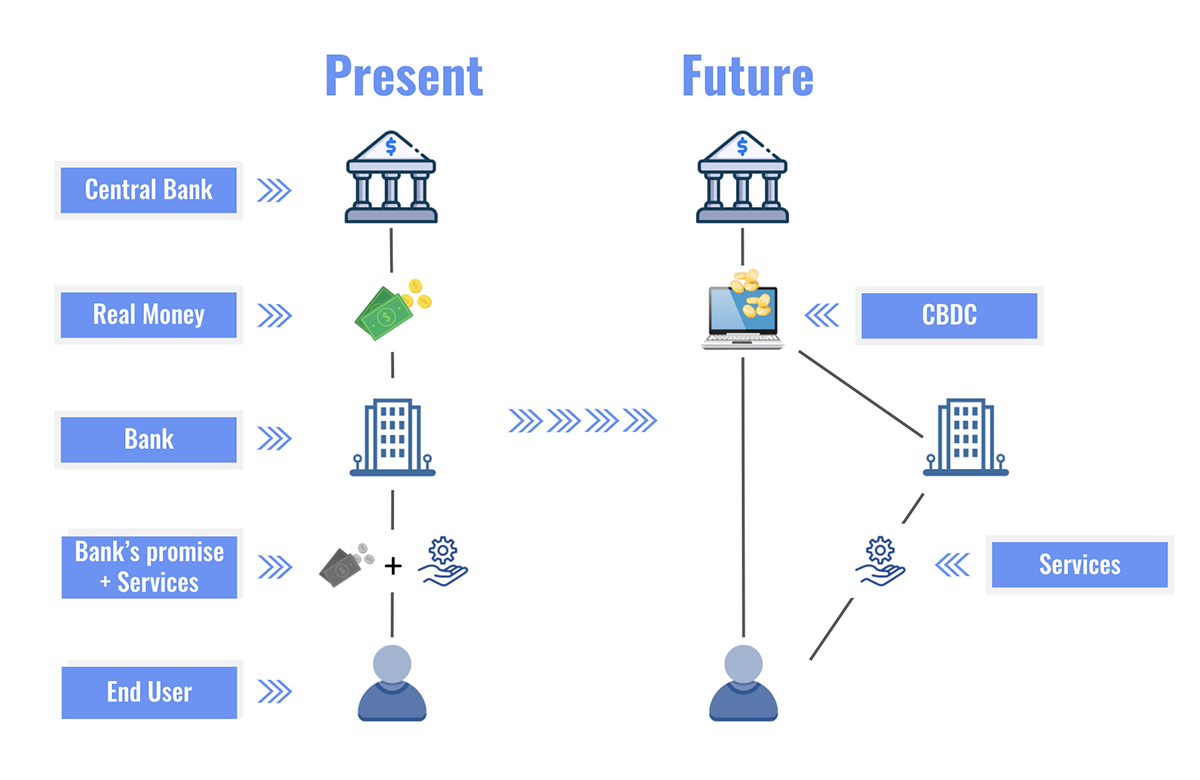
Central Bank Digital Currencies are digital versions of national currencies. They are issued and controlled directly by central banks.
Unlike cash, CBDCs run on digital infrastructure. This infrastructure allows governments full visibility and control over every transaction.
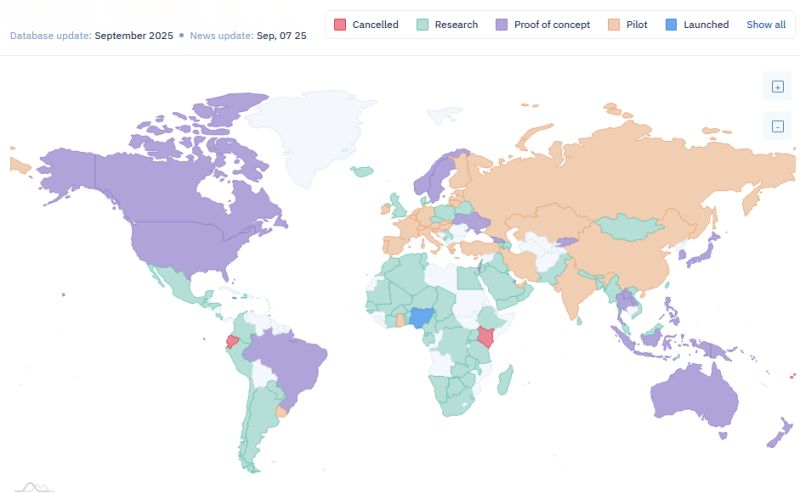
According to the Atlantic Council’s CBDC tracker, over 130 countries—representing 98% of global GDP—are exploring CBDCs as of 2024. Major economies such as China, the European Union, and the United States are actively developing or piloting CBDC systems.
Central Bank Digital Currency (CBDC):
A digital form of fiat currency issued and controlled by a nation’s central bank. CBDCs operate on centralized infrastructure with programmable features.
Learn more from the Bank for International Settlements
How CBDCs Differ From Cash and Digital Payments
CBDCs differ from both physical cash and existing digital payment systems.
Current digital payments move through commercial banks and payment processors. CBDCs would instead create a direct relationship between citizens and central banks.
This structure enables a level of government oversight that has never existed before.
Programmability and Control
CBDCs are programmable by design. This allows authorities to:
- Set expiration dates on money
- Restrict purchases of certain goods
- Limit transactions based on policy rules or social criteria
China’s digital yuan pilots have already demonstrated these capabilities in real-world use.
Today’s Money vs CBDC
Why Bitcoin Serves as a CBDC Alternative
Bitcoin operates on a fundamentally different monetary architecture.
It is a decentralized, permissionless network with no central controller. No government, corporation, or individual can freeze accounts, reverse transactions, or block participation.
Fixed Supply and Monetary Discipline
Bitcoin has a fixed supply of 21 million coins. This makes it resistant to the monetary debasement common in fiat currencies and CBDCs.
Central banks, by contrast, can create unlimited amounts of digital currency at their discretion.
Key Differences Between Bitcoin and CBDCs
- Issuance:
Bitcoin follows a fixed algorithmic schedule. CBDCs are issued at government discretion. - Supply cap:
Bitcoin is limited to 21 million coins. CBDCs have no supply limit. - Control:
Bitcoin users control their private keys. CBDC accounts are controlled by central banks. - Privacy:
Bitcoin offers pseudonymity. CBDCs typically enable complete transaction surveillance. - Censorship resistance:
Bitcoin transactions cannot be blocked or reversed. CBDC transactions can be restricted. - Accessibility:
Bitcoin is globally available. CBDCs are limited to residents of the issuing country.
For a deeper explanation of how Bitcoin replaces traditional banking functions, see our
complete guide to Bitcoin self-custody banking.
How CBDCs Threaten Financial Privacy and Freedom
CBDCs create infrastructure for large-scale financial surveillance.
They give governments real-time visibility into every transaction. Unlike cash, which provides anonymity, CBDCs link all activity directly to individuals.
Programmable Restrictions
CBDCs allow controls that were impossible with physical money, including:
- Forced spending deadlines through expiration dates
- Purchase restrictions tied to policy goals
- Negative interest rates that reduce savings automatically
Real-World Examples
China’s digital yuan shows how this works in practice. The People’s Bank of China has confirmed that all transactions can be tracked.
Authorities can trace money flows, apply spending limits, and restrict where or how funds are used.
Privacy and Civil Liberties Concerns
Research from the Cato Institute highlights risks to:
- Financial privacy
- Economic freedom
- Civil liberties
CBDCs could enable social credit integration, selective enforcement, and financial deplatforming.
Historical Precedents
Governments have abused monetary control during crises before.
India’s 2016 demonetization removed 86% of currency from circulation overnight. This caused economic disruption and increased financial surveillance.
CBDCs would make similar actions instant and unavoidable.
Bitcoin’s Privacy Features and Self-Custody Advantages
Bitcoin transactions are pseudonymous. Public keys act as identifiers instead of personal information.
This structure provides more privacy than CBDCs while still allowing public verification of transactions.
Self-Custody and Financial Sovereignty
Self-custody means controlling your own private keys.
This ensures:
- No account freezes
- No transaction reversals
- No third-party confiscation
Self-Custody:
Personally controlling the private keys to your Bitcoin so no third party can access, freeze, or seize your funds.
Learn more from Bitcoin.org
Security Without Intermediaries
Bitcoin-only platforms like Rhino Bitcoin allow users to keep self-custody while accessing financial services.
Multi-signature security adds protection by requiring multiple keys to authorize transactions.
Privacy Enhancement Techniques
Bitcoin users can improve privacy through:
- CoinJoin transactions: Combine payments to obscure links
- Lightning Network: Off-chain payments with improved privacy
- Address rotation: New addresses for each transaction
- Running a full node: Verify transactions independently
- Tor integration: Hide IP addresses when broadcasting transactions
Lightning Network Privacy
The Lightning Network processes payments off the main blockchain.
Payments route through multiple nodes. This makes tracing the full payment path extremely difficult.
For everyday transactions, Lightning offers fast settlement and improved privacy.
Comparing Bitcoin and CBDC System Architectures
Bitcoin and CBDCs are built on very different system designs. These differences directly affect user freedom and control.
Network Structure
- Bitcoin:
A distributed peer-to-peer network with no central point of failure - CBDCs:
A centralized system operated by a central bank - Implications:
Bitcoin resists censorship and shutdowns. CBDCs are vulnerable to government control.
Transaction Validation
- Bitcoin:
Proof-of-work mining by independent participants worldwide - CBDCs:
Transactions approved by a central authority - Implications:
Bitcoin transactions cannot be reversed. CBDC transactions require approval.
Monetary Policy
- Bitcoin:
Fixed issuance schedule that halves every four years - CBDCs:
Supply determined by policy decisions - Implications:
Bitcoin supply is predictable and limited. CBDC supply is unlimited.
Access Requirements
- Bitcoin:
Permissionless access with an internet connection - CBDCs:
Government approval and identity verification required - Implications:
Bitcoin serves the unbanked. CBDCs exclude undocumented individuals.
Bitcoin’s open-source code allows anyone to audit the rules, run a node, and verify transactions.
CBDCs operate as closed systems controlled by issuing authorities.
Practical Applications of Bitcoin as Money
Bitcoin now functions as practical money, not just a speculative asset.
The Lightning Network enables instant payments with fees under one cent. This makes bitcoin usable for everyday purchases.
Global Payments and Remittances
Bitcoin works globally without intermediaries.
Traditional international transfers can take days and cost 5–7% in fees. Bitcoin transfers settle in minutes with minimal cost.
Common Bitcoin Use Cases
- Bill payments: Utilities and services paid directly with bitcoin
- Online purchases: Accepted through payment processors
- International remittances: Cross-border transfers without banks
- Savings preservation: Protection from currency debasement
- Business payments: No chargeback risk
Bitcoin-backed loans allow users to access cash without selling bitcoin. These loans use bitcoin as collateral and require no credit checks.
Learn more about cross-border payments with the Lightning Network.
Regulatory Landscape for Bitcoin and CBDCs
Bitcoin regulation varies by jurisdiction.
In the United States, the IRS treats bitcoin as property under Notice 2014-21. Capital gains must be reported on transactions.
The Securities and Exchange Commission focuses on Bitcoin-related investment products, not the protocol itself.
CBDC Regulatory Challenges
CBDCs face concerns around:
- Privacy laws
- Financial surveillance limits
- Constitutional protections
The Federal Reserve has published digital dollar discussion papers. Political opposition remains strong due to privacy concerns.
International Approaches
- El Salvador adopted bitcoin as legal tender
- China banned bitcoin activity while advancing its CBDC
- The EU regulates Bitcoin services while developing a digital euro
Bitcoin itself remains decentralized and difficult to regulate directly. On-ramps and off-ramps face the most oversight.
Map of CBDC Status Across the Globe
Transitioning From Traditional Banking to Bitcoin
Moving from banks to Bitcoin requires new responsibilities.
Unlike insured bank deposits, self-custody means users must secure private keys and backups.
How to Get Started
Begin with small amounts. Learn wallet management and security basics before increasing holdings.
Step-by-Step Transition
- Education: Learn Bitcoin fundamentals and security
- Setup: Choose wallets and test with small amounts
- Acquisition: Dollar-cost average through reputable exchanges
- Self-custody: Move funds off exchanges with backups
- Use: Pay bills, transact, or borrow against bitcoin
Multi-signature wallets add protection by requiring multiple approvals for transactions.
Our guide on differences between Bitcoin wallets and Lightning wallets explains which tools fit different use cases.
Bitcoin IRAs allow tax-advantaged retirement savings in bitcoin, depending on account type.
Future Implications of CBDCs and Bitcoin Adoption
CBDCs may accelerate Bitcoin adoption.
As CBDCs become more restrictive, Bitcoin’s permissionless design becomes more attractive to users seeking financial sovereignty.
CBDCs may also introduce people to digital money. This could lead users to explore alternatives with better privacy and control.
Network Effects and Growth
Bitcoin infrastructure continues to expand:
- Lightning Network capacity is growing
- Merchant adoption is increasing
- Financial services are becoming more accessible
Bitcoin and CBDCs will likely coexist.
CBDCs may dominate government and compliance use cases. Bitcoin will serve users prioritizing privacy, censorship resistance, and scarcity.
Frequently Asked Questions
What is the main difference between Bitcoin and a CBDC?
Bitcoin is decentralized and permissionless. CBDCs are government-controlled and programmable.
Can governments ban Bitcoin?
Governments can regulate services but cannot shut down the Bitcoin network itself.
Is Bitcoin more private than CBDCs?
Bitcoin is pseudonymous. CBDCs typically link all transactions to identities.
How can I use Bitcoin daily?
Lightning wallets enable instant payments. Debit cards convert bitcoin at checkout.
What happens to my Bitcoin if a CBDC launches?
Nothing. Bitcoin operates independently.
Are CBDCs better for the unbanked?
Bitcoin requires no permission or documentation. CBDCs usually do.
How do transaction costs compare?
Lightning transactions cost fractions of a cent. CBDC fees remain uncertain.
Can I hold both?
Yes. Many users will hold both for different purposes.
What security advantages does Bitcoin offer?
Self-custody prevents freezes, seizures, and debasement.
How does Bitcoin protect against inflation?
Bitcoin’s fixed supply prevents monetary debasement.
Conclusion
Bitcoin offers a strong alternative to CBDCs.
It preserves financial sovereignty through self-custody, permissionless access, and censorship resistance.
Key Considerations
- Your privacy needs
- Tolerance for government oversight
- Ability to secure self-custody
- Local regulatory environment
For those seeking protection from programmable money,
explore Rhino Bitcoin’s comprehensive Bitcoin banking platform.
References
- Bank for International Settlements – Central Bank Digital Currencies
https://www.bis.org/cpmi/publ/d174.pdf - IRS – Notice 2014-21
https://www.irs.gov/pub/irs-drop/n-14-21.pdf - Atlantic Council – CBDC Tracker
https://www.atlanticcouncil.org/cbdctracker/ - Cato Institute – CBDC Risks
https://www.cato.org/policy-analysis/risks-central-bank-digital-currencies - Bitcoin.org – Secure Your Wallet
https://bitcoin.org/en/secure-your-wallet
Important Disclaimers
Disclaimer: Educational information only. Not financial, legal, medical, or tax advice.
Risk Warnings: Investments carry risk, including loss of principal. Bitcoin is volatile.
Conflicts of Interest: Rhino Bitcoin provides Bitcoin financial services.
.png)
.png)