
Bitcoin Taproot Privacy Features For Enhanced Security And Custody
Taproot boosts Bitcoin privacy by hiding complex transactions behind simple-looking signatures and scripts.
Buy Bitcoin with Zero Fees with Rhino
The most secure way to stack sats. Simple, fast, and zero trading fees.
Bitcoin’s Taproot upgrade introduced major privacy improvements through Schnorr signatures and MAST (Merkelized Alternative Script Trees). These features make complex transactions look the same as simple ones on the blockchain. As a result, privacy improves for all Bitcoin users.
Taproot allows multi-signature transactions to appear identical to single-signature transactions. This makes it much harder for observers to tell how a transaction was created or who is involved.
Key Summary:
Taproot privacy features use Schnorr signatures to make multi-signature and smart contract transactions look identical to standard transactions. This improves on-chain privacy for Bitcoin users.
Key Takeaways
- Taproot makes complex transactions look like simple ones
- Schnorr signatures allow keys to be combined for better privacy
- MAST limits how much script data appears on-chain
- Adoption depends on wallet and exchange support
This article explains Taproot privacy features in the wider context of Bitcoin security and custody. For a full overview of Bitcoin security basics, see our complete Bitcoin security guide.
What Is Bitcoin Taproot?
Taproot is a Bitcoin protocol upgrade that was activated in November 2021. It combines three Bitcoin Improvement Proposals: BIP 340, 341, and 342.
It is the most important Bitcoin upgrade since SegWit in 2017. Taproot introduced Schnorr signatures, Taproot script-path spending, and Tapscript.
This upgrade changed how Bitcoin transactions are built and verified. By replacing the Elliptic Curve Digital Signature Algorithm (ECDSA) with Schnorr signatures, Taproot enables signature aggregation and stronger privacy.
Schnorr Signatures:
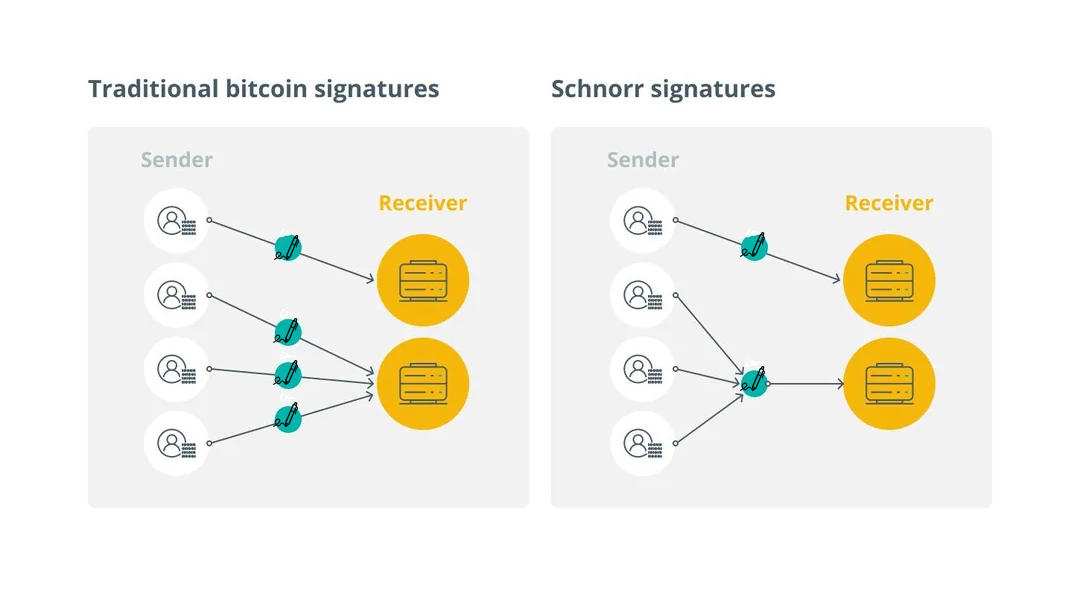
A digital signature method that allows multiple signatures to be combined into one. This makes multi-signature transactions look the same as single-signature transactions.
Learn more
Traditional Bitcoin Signatures vs Schnorr Signatures
What Taproot Privacy Features Deliver
In real-world use, Taproot provides several important benefits:
- Transaction uniformity: Multi-sig wallets, Lightning channels, and smart contracts look like standard payments
- Reduced on-chain footprint: Less data is revealed, which leads to smaller transactions and lower fees
- Enhanced fungibility: Bitcoin becomes more interchangeable when transaction types cannot be identified
- Future-ready privacy: Taproot creates a base for additional privacy upgrades
How Schnorr Signatures Improve Privacy
Schnorr signatures improve privacy through key aggregation. This allows multiple public keys to combine into a single public key.
Because of this, a 2-of-3 multi-signature wallet appears on-chain as a normal single-signature transaction.
Before Taproot, multi-signature transactions revealed how many keys were involved and how many signatures were required. A 3-of-5 setup was clearly visible on the blockchain. This exposed internal security practices and organizational structure.
The privacy benefits go beyond hiding transaction details:
- Larger anonymity sets: More transaction types blend together on-chain
- Script privacy: Spending conditions stay hidden until coins are spent
- Signature efficiency: One combined signature replaces multiple signatures
- Lightning Network privacy: Channel opens and closes look like regular transactions
On-chain data from mempool.space shows that Taproot adoption has grown steadily since activation. As of early 2025, about 15–20% of Bitcoin transactions use Taproot outputs. As adoption grows, privacy improves for everyone.
What Is MAST and Why Does It Matter?
MAST stands for Merkelized Alternative Script Trees. It allows Bitcoin scripts to be organized as Merkle trees.
With MAST, only the part of the script that is actually used is revealed on-chain. Any unused spending conditions stay completely private and never appear on the blockchain.
For example, consider a bitcoin inheritance setup with three options:
- Immediate spending by the owner
- Spending by beneficiaries after six months
- Spending by a backup key after one year
With MAST, only the option that is used becomes visible on-chain.
Merkle Tree:
A cryptographic structure that allows efficient verification by revealing only the relevant branch. Merkle trees are widely used in Bitcoin.
Learn more
A Merkle Tree Structure Allows for Verification of Large Data Sets

Privacy Benefits of MAST
MAST offers several clear privacy advantages:
- Conditional privacy: Timelocks and complex arrangements stay hidden
- Reduced data leakage: Unused script paths never reach the blockchain
- Flexible security models: Advanced custody without sacrificing privacy
- Compact proofs: Only the executed path must be verified
Practical Applications of MAST
MAST makes complex Bitcoin contracts more private. Estate planning can include multiple backup plans without revealing the full structure. Business treasuries can use approval hierarchies that remain confidential.
Lightning Network implementations benefit as well. Channels can include dispute resolution and penalty paths without exposing them publicly. This makes Lightning activity harder to detect and analyze.
Comparing Taproot to Previous Privacy Methods
To understand Taproot’s importance, it helps to compare it with older privacy approaches.
Bitcoin has always offered pseudonymity. Users could avoid address reuse, but transaction graph analysis still revealed patterns and relationships.
Pre-Taproot Multi-Signature
- Privacy level: Low, all participants and thresholds are visible
- Transaction size: Large and increases with each added key
- Identifiability: Easy to distinguish from single-signature transactions
- Best for: Situations where transparency matters more than privacy
Taproot Multi-Signature
- Privacy level: High, indistinguishable from single-signature transactions
- Transaction size: Compact and consistent, regardless of participants
- Identifiability: Looks exactly like a standard payment on-chain
- Best for: Privacy-focused users, Lightning channels, and complex custody
CoinJoin Transactions
- Privacy level: Very high for hiding ownership
- Transaction size: Large, with many inputs and outputs
- Identifiability: Clearly recognizable as privacy-focused transactions
- Best for: Breaking transaction history links
How to Use Taproot Privacy Features
To use Taproot privacy features, you need a wallet that supports Taproot addresses. These addresses start with “bc1p.”
Most major Bitcoin wallets added Taproot support in 2022 and 2023. This includes hardware wallets like Trezor and Ledger.
Getting Started with Taproot
Follow these steps to begin:
- Check wallet support: Confirm your wallet supports Taproot (BIP 341)
- Create Taproot addresses: Generate new receiving addresses starting with “bc1p”
- Move funds slowly: Transfer bitcoin over time to avoid linking UTXOs
- Use Taproot by default: Make Taproot your standard address type
- Enable Lightning support: Use Taproot-compatible Lightning channels
Platforms like Rhino Bitcoin support Taproot addresses. This allows users to benefit from better privacy and lower fees while using Bitcoin banking services.
Taproot Adoption Considerations
Full adoption takes time. Some exchanges still do not support Taproot withdrawals, although support continues to expand.
Blockchain analysis firms have adjusted their tools to recognize Taproot patterns. Even so, the privacy improvements remain meaningful.
Taproot transactions are usually 10–15% cheaper than legacy transactions. This is due to more efficient signature encoding and smaller witness data. Lower fees create a strong incentive to adopt Taproot.
Limitations and Privacy Considerations
Taproot improves transaction-level privacy, but it does not solve every privacy issue.
It does not protect against IP address tracking, address reuse, or data collected by exchanges. These factors can still reveal user behavior.
Key Privacy Limitations
- Network privacy: IP addresses and network data remain visible
- Exchange KYC: Regulated exchanges still collect identity information
- Address reuse: Reusing addresses weakens Taproot’s benefits
- Timing analysis: Transaction amounts and timing are still public
- UTXO analysis: Consolidating UTXOs can reveal ownership patterns
Bitcoin provides pseudonymity, not full anonymity. Taproot strengthens pseudonymity by hiding transaction types. Strong privacy still requires combining multiple tools.
Combining Taproot with Other Privacy Tools
The best privacy strategy uses multiple layers:
- Use Taproot addresses for transaction uniformity
- Route Bitcoin traffic through Tor for network privacy
- Use CoinJoin to break transaction history links
- Never reuse addresses
Lightning Network users benefit even more. Lightning payments do not appear on the blockchain. Only channel opens and closes are visible, and Taproot helps hide those as well.
Taproot's Impact on Bitcoin Security and Custody
Taproot also improves security for multi-signature custody.
By hiding multi-signature usage, Taproot removes an information signal that could attract attackers. Before Taproot, a visible 3-of-5 transaction suggested a high-value target.
Taproot removes this clue. This improves operational security for both institutions and individuals.
Security Benefits for Custody Models
- Corporate treasuries: Approval processes remain private
- Inheritance planning: Timelocked arrangements stay hidden
- Collaborative custody: Third-party key holders are not exposed
- Emergency recovery: Backup paths remain invisible until needed
For more details on secure custody, see our comprehensive Bitcoin security guide.
Future Privacy Enhancements Building on Taproot
Taproot lays the groundwork for future privacy improvements.
Cross-input signature aggregation (CISA) could allow multiple inputs to share a signature. This would reduce on-chain data and improve privacy even further.
Proposals like ANYPREVOUT and OP_CHECKTEMPLATEVERIFY build on Taproot’s design. They enable advanced smart contracts while preserving transaction uniformity.
Ongoing Privacy Research
The Bitcoin community is also exploring:
- Silent payments: Reusable payment codes that create unique addresses
- Zero-knowledge proofs: Verifying transactions without revealing details
- Confidential transactions: Hiding amounts while keeping auditability
- Dandelion++: Better transaction propagation to resist network analysis
Each of these ideas builds on the foundation Taproot provides.
Frequently Asked Questions
What is Bitcoin Taproot?
Taproot is a Bitcoin protocol upgrade activated in November 2021. It introduces Schnorr signatures and MAST, making complex transactions look like simple ones and reducing transaction sizes.
How does Taproot improve Bitcoin privacy?
Taproot hides transaction types by making multi-signature, Lightning, and smart contract transactions indistinguishable from standard payments.
Do I need a new wallet to use Taproot?
You need a wallet that supports Taproot addresses starting with “bc1p.” Most major wallets added support in 2022–2023.
Are Taproot transactions cheaper than legacy transactions?
Yes. Taproot transactions are usually 10–15% cheaper due to more efficient signature encoding.
Can I send bitcoin to Taproot addresses from any wallet?
Most modern wallets and exchanges support Taproot addresses. Older software may not. Always test with a small transaction first.
Does Taproot make Bitcoin completely anonymous?
No. Taproot improves pseudonymity, not full anonymity. Network data and operational mistakes can still reduce privacy.
How does Taproot affect Lightning Network privacy?
Taproot makes Lightning channel operations look like normal transactions, hiding Lightning activity from observers.
What is the difference between Taproot and CoinJoin?
Taproot hides transaction structure. CoinJoin hides ownership by mixing transactions. They work in different ways and can be used together.
Do exchanges support Taproot withdrawals?
Most major exchanges added support between 2022 and 2024. Support varies, so always check first.
Can Taproot privacy features be compromised?
The cryptography cannot be reversed, but poor practices like address reuse or IP leaks can still harm privacy.
Conclusion
Taproot is a major improvement to Bitcoin’s on-chain privacy. By hiding complex transaction structures, it protects users while also lowering transaction fees.
Key Points to Remember
- Make sure your wallet supports Taproot addresses
- Combine Taproot with other privacy tools
- Remember that Taproot improves pseudonymity, not anonymity
- Use network-level privacy tools like Tor
For users who want Taproot privacy alongside full Bitcoin services, explore Rhino Bitcoin’s platform with Taproot support and Lightning Network integration.
References
- Bitcoin Core Development Team. “Bitcoin Improvement Proposals 340, 341, 342 (Taproot).” Bitcoin.org. https://bitcoin.org
- Mempool.space. “Taproot Adoption Statistics.” On-chain data analytics. https://mempool.space
- Wuille, Pieter. “Schnorr Signatures for Bitcoin: Technical Overview.” Bitcoin Optech Newsletter. https://bitcoinops.org
- Lightning Network Documentation. “Taproot Channels Specification.” Lightning Network. https://lightning.network
- Internal Revenue Service. “Notice 2014-21: Virtual Currency Guidance.” IRS.gov. https://www.irs.gov
Important Disclaimers
Disclaimer: Educational information only. Not financial, legal, medical, or tax advice.
Risk Warnings: All investments carry risk, including loss of principal. Past performance does not predict future results. Bitcoin is volatile and may not be suitable for all investors.
Conflicts of Interest: Rhino Bitcoin provides Bitcoin financial services. This content is educational and may reference our products.
.png)
.png)