
Bitcoin Security Guide: Wallets & Cold Storage
Learn Bitcoin wallet security, hardware wallets, cold storage, and multi-signature setups. Complete guide to protecting your cryptocurrency from theft and loss.
Buy Bitcoin with Zero Fees with Rhino
The most secure way to stack sats. Simple, fast, and zero trading fees.
Bitcoin Security Guide: Wallets & Cold Storage
Bitcoin security and custody represent the foundation of safe digital asset ownership, encompassing the methods, tools, and practices used to best protect your Bitcoin from theft, loss, and/or unauthorized access.
Unlike traditional banking where institutions safeguard your funds, Bitcoin operates on a "be your own bank" principle, placing the responsibility for security directly in your hands.
The security of your Bitcoin depends entirely on how well you protect your private keys (the underlying cryptographic data or ‘codes’ that prove ownership and enable transactions. This fundamental shift from institutional custody to self-custody creates both unprecedented financial sovereignty and significant responsibility for implementing proper security measures.
Key Points:
- Private keys are the only proof of Bitcoin ownership and must be secured at all costs.
- Hardware wallets provide the highest security for most users by keeping keys offline.
- Multi-signature wallets require multiple approvals, adding layers of protection against single points of failure.
- Cold storage keeps Bitcoin completely offline, offering maximum security for long-term holdings.
- Seed phrase backup and recovery planning are essential for preventing permanent loss.
- Two-factor authentication adds crucial protection to wallet access and exchange accounts.
- Estate planning ensures your Bitcoin can be recovered by beneficiaries if needed.
What Are Bitcoin Wallets and How Do They Work?
Bitcoin wallets are software applications or hardware devices that store your private keys and enable you to send, receive, and manage your bitcoin. Contrary to common belief, Bitcoin wallets don't actually store Bitcoin (they store the cryptographic keys that prove ownership of Bitcoin addresses on the blockchain).
Every Bitcoin wallet contains two essential components: a public key (which generates your Bitcoin address for receiving funds) and a private key (which authorizes outgoing transactions). The private key is essentially your digital signature, mathematically linked to your public key through advanced cryptography.
Private Key: A secret 256-bit number that serves as the master password for your Bitcoin. Anyone with access to your private key can spend your Bitcoin, making its security absolutely critical.
When you create a new wallet, it generates a seed phrase (also called a recovery phrase or mnemonic phrase) consisting of 12 or 24 randomly selected words. This seed phrase can regenerate all your private keys, making it the ultimate backup for your entire wallet. The mathematical relationship between seed phrases and private keys follows the BIP39 standard, ensuring compatibility across different wallet software.
Bitcoin wallets come in several categories, each offering different trade-offs between security and convenience:
Hot wallets stay connected to the internet, enabling quick transactions but exposing private keys to potential online threats.
Cold wallets remain offline, providing maximum security but requiring more steps for transactions.
Software wallets run on computers or smartphones, offering convenience with varying security levels.
Hardware wallets store keys on dedicated devices, combining strong security with reasonable usability.
Paper wallets involve printing private keys on physical paper, creating completely offline storage.
Types of Bitcoin Wallets and their Classification
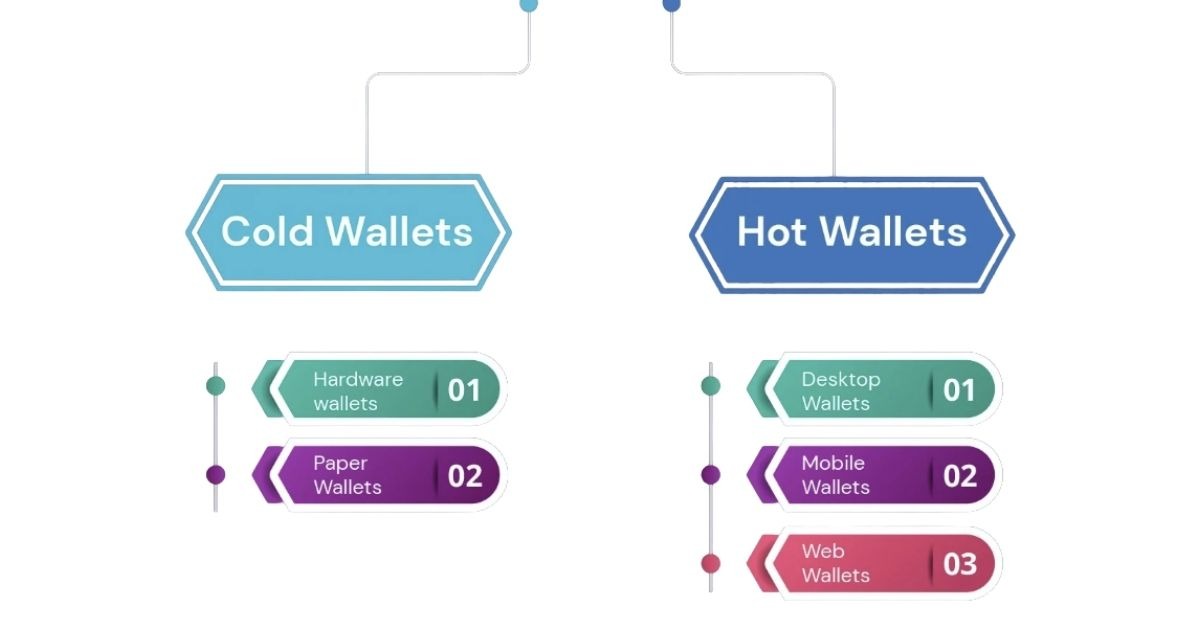
Source: Blockchain Council
The security of any Bitcoin wallet depends primarily on where and how the private keys are stored. Keys stored on internet-connected devices face risks from malware, hackers, and software vulnerabilities. Keys stored offline eliminate these digital threats but introduce physical security considerations.
Understanding wallet architecture helps explain why Bitcoin security differs fundamentally from traditional financial security. Banks and credit card companies can reverse fraudulent transactions, but Bitcoin transactions are irreversible. Once Bitcoin leaves your wallet, only the recipient can send it back (remember, there's no customer service number to call if something goes wrong!).
How Do Hardware Wallets Maximize Security?
Hardware wallets offer the highest practical security for most Bitcoin users by storing private keys on dedicated, air-gapped devices that never expose keys to internet-connected computers. These specialized devices create an isolated environment where private keys remain secure even when connected to compromised computers.
The security advantage of hardware wallets stems from their secure element chips—tamper-resistant processors designed to protect sensitive data. When you initiate a Bitcoin transaction, the hardware wallet signs the transaction internally using your private key, then sends only the signed transaction (not the private key) to your computer for broadcasting to the Bitcoin network.
Secure Element: A tamper-resistant hardware component designed to securely store sensitive data and perform cryptographic operations. These chips are used in credit cards, passports, and premium hardware wallets.
SLS32 Chip as the Secure Element in a Trezor Wallet
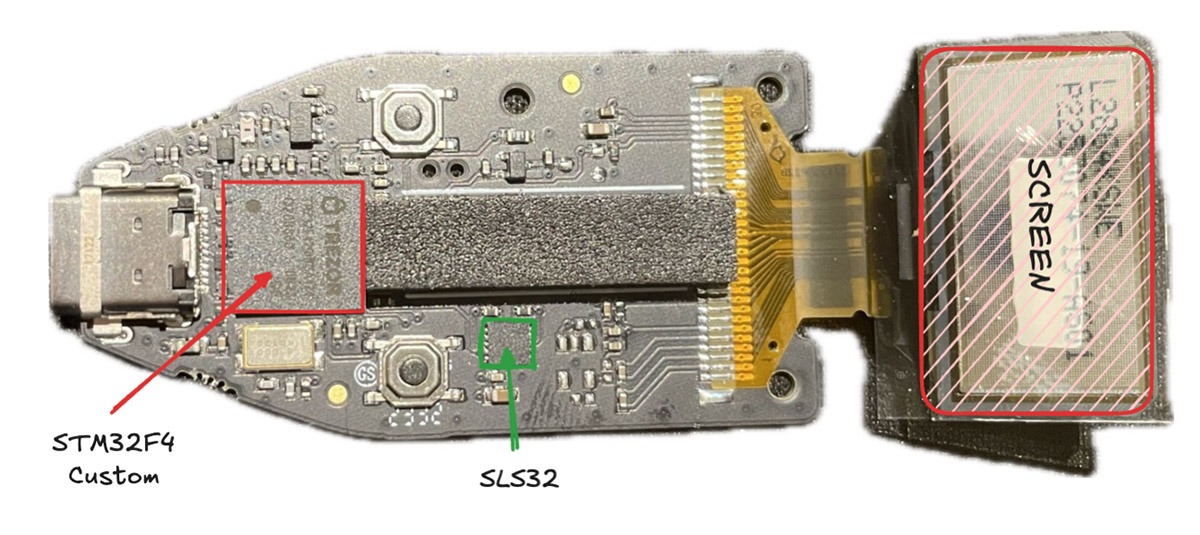
Source: Ledger
Leading hardware wallet manufacturers implement multiple security layers to protect against various attack vectors:
PIN protection prevents unauthorized physical access to the device.
Passphrase support adds an optional 25th word to your seed phrase for additional protection.
Secure boot processes ensure the device firmware hasn't been tampered with.
Anti-tampering mechanisms destroy keys if physical intrusion is detected.
Open-source firmware allows security researchers to audit the code for vulnerabilities.
Hardware wallets protect against numerous threats that affect software wallets. Malware cannot extract private keys from properly functioning hardware wallets, even if your computer is completely compromised. Keyloggers cannot capture your private keys because the sensitive operations happen within the hardware device. Physical theft of the hardware wallet alone doesn't grant access to funds without knowing the PIN and recovery phrase.
The transaction process with hardware wallets involves several security checkpoints. First, you initiate a transaction using wallet software on your computer or phone. The software creates an unsigned transaction and sends it to the hardware wallet. The hardware wallet displays transaction details on its screen, allowing you to verify the recipient address and amount. After you confirm the transaction by pressing buttons on the device, the hardware wallet signs the transaction and returns it to the wallet software for broadcasting.
Popular hardware wallet options include the Ledger Nano series, Trezor devices, and Coldcard for Bitcoin-only storage. Each offers different features, security models, and user interfaces. The Ledger Nano S Plus provides basic security features at an affordable price point. The Trezor Model T offers a touchscreen interface and advanced passphrase features. The Coldcard specializes in Bitcoin-only storage with air-gapped transaction signing capabilities.
Hardware Wallets have Different Shapes, Sizes, and Features
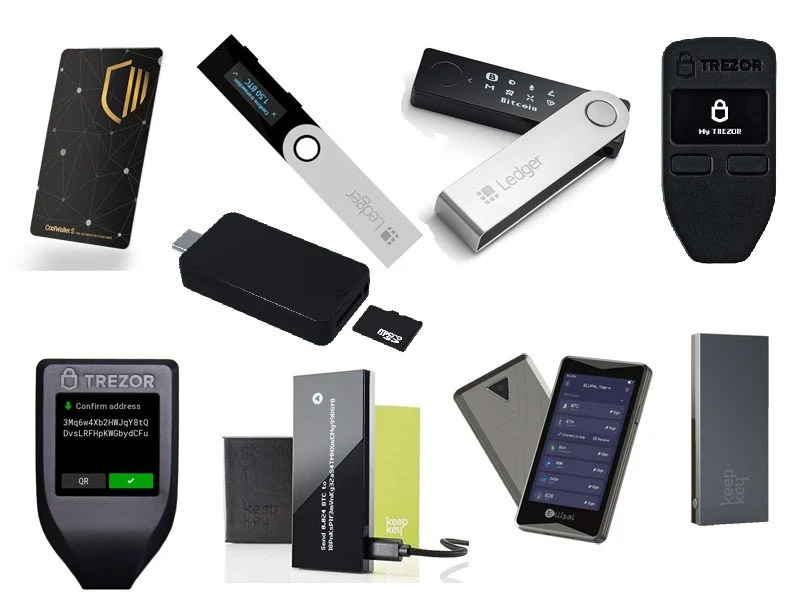
Source: CoolWallet
Hardware wallets aren’t perfect though, and users must understand their limitations. The devices themselves can fail, potentially making funds inaccessible if backup measures aren't in place. Some hardware wallets have experienced security vulnerabilities requiring firmware updates. Physical attacks by sophisticated adversaries might compromise certain devices under specific circumstances.
Proper hardware wallet usage requires maintaining secure backups of recovery phrases, keeping firmware updated, and purchasing devices directly from manufacturers to avoid tampering. The combination of hardware wallet security with proper operational security practices provides robust protection for most Bitcoin holders.
What Is Bitcoin Cold Storage and When Should You Use It?
Bitcoin cold storage refers to keeping private keys completely offline, disconnected from any internet-connected device or network. This approach provides the highest level of security against digital threats by eliminating the possibility of remote attacks, malware infections, or online breaches affecting your Bitcoin.
Cold storage becomes essential when holding significant amounts of Bitcoin for extended periods, particularly when the value represents a substantial portion of your wealth or when security concerns outweigh convenience requirements. Many Bitcoin investors follow a strategy of keeping small amounts in hot wallets for regular transactions while storing the majority of holdings in cold storage.
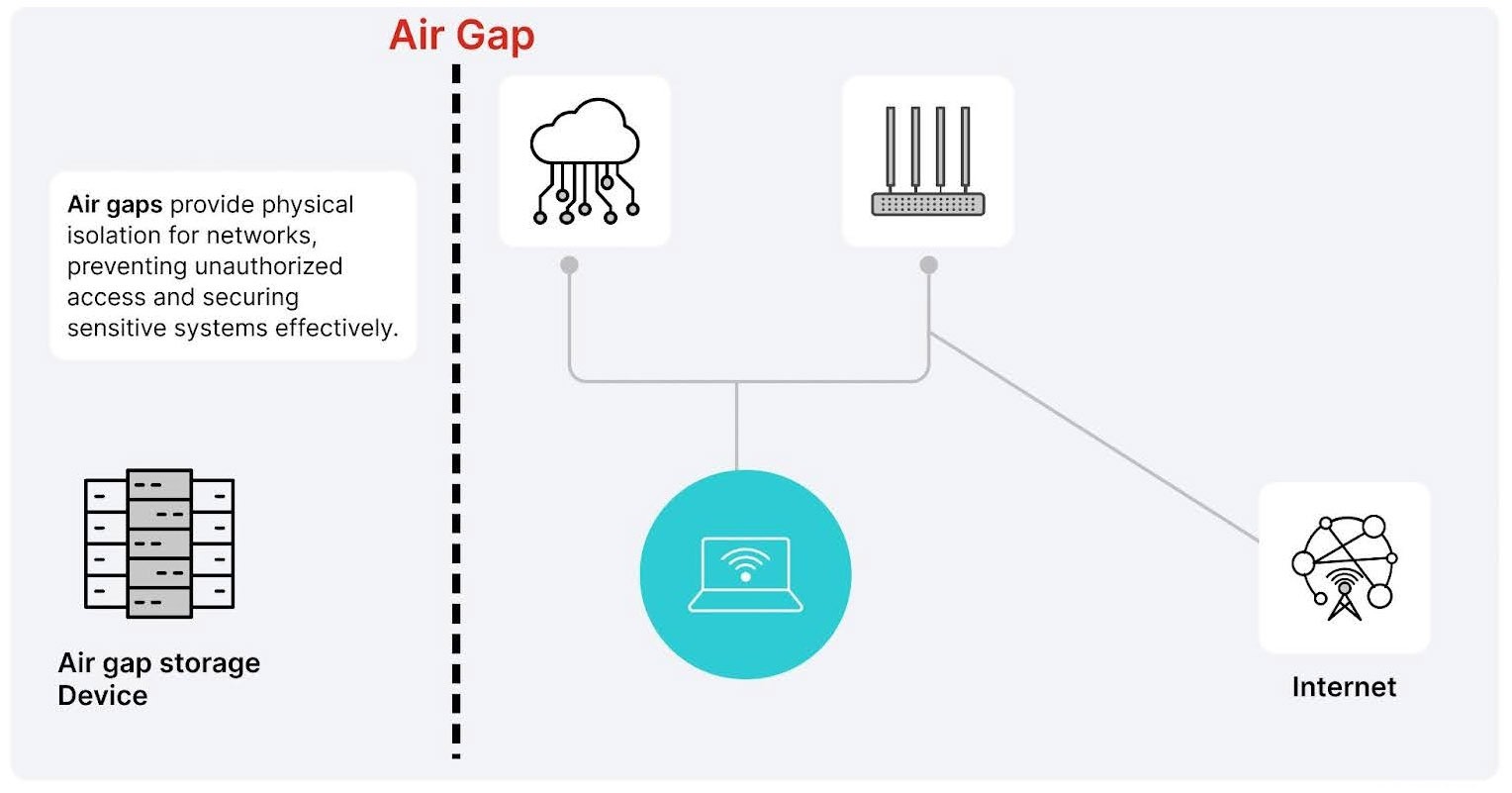
Air Gap (Definition): A security measure that isolates a computer or device from unsecured networks, including the internet. Air-gapped systems can only be accessed through physical presence, eliminating remote attack vectors.
Air Gapped Devices are Segregated from the Internet
Source: Fortinet
Several methods enable effective Bitcoin cold storage, each with different security and usability characteristics:
- Hardware wallets in cold storage mode remain disconnected from computers except for setup and major transactions.
- Air-gapped computers running wallet software on devices that never connect to the internet.
- Paper wallets involve printing private keys and addresses on physical paper.
- Steel seed storage preserves recovery phrases on metal plates resistant to fire, water, and corrosion.
- Multi-signature cold storage requires multiple offline signing devices for transaction authorization.
The most secure cold storage implementations use dedicated air-gapped computers running minimal operating systems specifically configured for Bitcoin operations. These systems generate private keys using high-quality entropy sources, create transactions offline, and sign transactions without network connectivity. Signed transactions are transferred to online computers using QR codes, USB drives, or SD cards for broadcasting to the Bitcoin network.
Setting up proper cold storage requires careful attention to security throughout the entire process. The computer used for generating keys must be clean of malware, preferably using a fresh operating system installation or a specialized Bitcoin distribution like Tails. Random number generation must be truly random, not predictable pseudorandom sequences that attackers might reproduce.
Physical security becomes paramount in cold storage scenarios. Storage locations must protect against theft, fire, flood, and other environmental hazards. Many cold storage users implement geographic distribution, keeping copies of recovery materials in multiple secure locations such as bank safe deposit boxes, home safes, or trusted family members' custody.
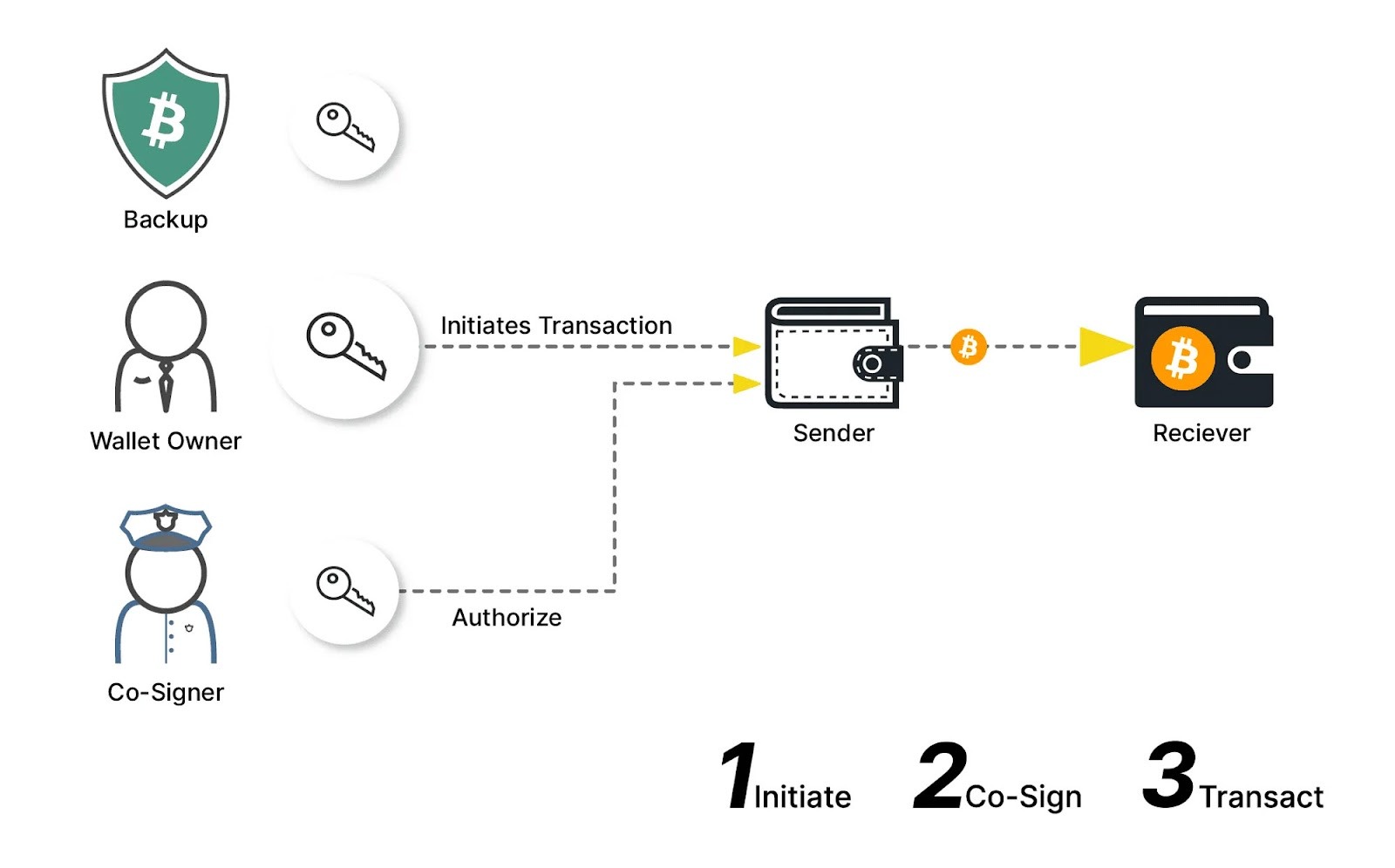
Advanced cold storage users often implement multi-signature schemes requiring signatures from multiple offline devices to authorize transactions. This approach eliminates single points of failure while maintaining the security benefits of offline storage. A common configuration uses a 2-of-3 multisig setup where three signing devices are created, but only two signatures are required for transactions.
The trade-off for cold storage security is reduced convenience and increased complexity. Accessing cold-stored Bitcoin requires retrieving offline devices, creating and signing transactions manually, and carefully managing the process to maintain security. These operational requirements make cold storage most suitable for long-term holdings rather than frequently accessed funds.
Cold storage also requires robust backup and recovery planning. Multiple copies of recovery phrases, stored in different geographic locations, protect against loss or damage to any single backup. Estate planning becomes crucial for cold storage, as the complex security measures that protect against theft can also prevent legitimate access by beneficiaries.
Why Use Multi-Signature Wallets for Enhanced Protection?
Multi-signature (multisig) wallets require multiple private keys to authorize Bitcoin transactions, eliminating single points of failure and providing enhanced security through distributed control. Instead of relying on one private key that could be lost, stolen, or compromised, multisig wallets implement threshold schemes where multiple signatures from different keys are required.
The most common multisig configurations use M-of-N schemes, where M signatures are required from a total of N possible signers. A 2-of-3 multisig wallet, for example, generates three private keys but requires only two signatures to authorize transactions. This configuration allows for one key to be lost or compromised while maintaining access to funds and security against single-key theft.
Multi-Signature (Multisig): A Bitcoin security feature requiring multiple cryptographic signatures to authorize a transaction. This creates shared control and eliminates the risk of a single compromised key resulting in total loss of funds.
A 2 of 3 Multisig Transaction
Source: Bitcoin Magazine
Multisig wallets provide compelling advantages for both individual users and organizations managing Bitcoin:
- Eliminates single points of failure by distributing control across multiple keys.
- Increases security threshold as attackers must compromise multiple keys rather than one.
- Enables shared custody for businesses, families, or investment groups.
- Provides backup protection when one key becomes inaccessible.
- Reduces insider threat risk in organizational settings through required cooperation.
For individual users, multisig wallets excel in estate planning and long-term storage scenarios. A family might use a 2-of-3 configuration where the primary holder controls one key, a spouse controls another, and a trusted family member or attorney holds the third. This setup ensures funds remain accessible if one key is lost while requiring cooperation to prevent unilateral access.
Business applications for multisig include treasury management, where multiple executives must approve large transactions. A company might implement a 3-of-5 scheme requiring three board members to sign off on any Bitcoin expenditure. This approach provides both security and accountability, creating audit trails and preventing unauthorized fund movements.
The technical implementation of multisig involves creating a special Bitcoin address that encodes the signature requirements. When spending from a multisig address, the transaction must include valid signatures from the required number of keys. The Bitcoin network validates these signatures automatically, rejecting transactions that don't meet the specified threshold.
Setting up multisig wallets requires compatible software and careful key management planning. Popular multisig wallet software includes Electrum, Specter Desktop, and Casa for consumer use, while enterprise solutions like Unchained Capital and BitGo serve institutional clients. Each signing device or software must be configured with the complete multisig wallet information to participate in transaction signing.
Key distribution strategies significantly impact multisig security and usability. Geographic distribution places signing devices in different physical locations, protecting against localized threats like fire or theft. Device diversity uses different hardware wallet brands or software implementations to protect against manufacturer-specific vulnerabilities. Trusted party distribution involves giving keys to different individuals or institutions to prevent collusion.
Operational security for multisig requires careful coordination and communication among key holders. Procedures must exist for authorizing legitimate transactions while preventing unauthorized access. Regular testing ensures all key holders can access their devices and participate in signing when needed. Backup and recovery planning becomes more complex with multiple keys requiring separate storage and protection.
The complexity of multisig implementations can create new risks if not properly managed. Users might lose access if too many keys become unavailable, or create vulnerabilities through poor operational security. Social engineering attacks might target key holders to obtain multiple signatures through deception rather than technical compromise.
How to Secure Your Seed Phrase Properly
Seed phrase security represents the most critical aspect of Bitcoin custody because your 12 or 24-word recovery phrase serves as the master key for regenerating all wallet private keys. Proper seed phrase protection requires understanding both digital and physical threats while implementing multiple layers of security to prevent loss, theft, or unauthorized access.
The importance of seed phrase security cannot be overstated - anyone who gains access to your complete, correctly ordered seed phrase can recreate your wallet and steal your Bitcoin from anywhere in the world. Conversely, losing your seed phrase while your wallet becomes inaccessible results in permanent loss of funds with no recovery mechanism.
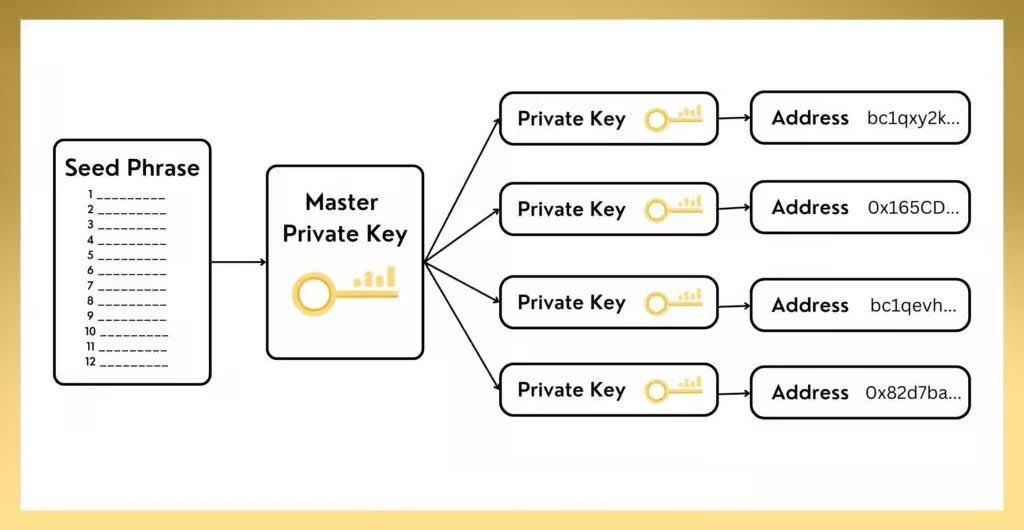
Seed Phrase: A human-readable representation of your wallet's master private key, typically consisting of 12 or 24 words selected from a standardized list. This phrase can regenerate your entire wallet and all associated private keys.
Seed Phrases are Used to Generate Private Keys and Addresses
Source: Professional Crypto Recovery
Effective seed phrase security begins with proper generation using hardware wallets or reputable software with strong entropy sources. Never use seed phrases generated by online tools, mobile apps of questionable origin, or any system that might have compromised randomness. Hardware wallets provide the most reliable seed phrase generation through their dedicated secure elements.
Physical storage methods for seed phrases require balancing accessibility with security, considering various threat models:
- Paper storage offers simplicity but vulnerability to fire, water, and degradation over time.
- Metal storage plates resist environmental damage and provide long-term durability.
- Laminated cards protect against moisture while remaining affordable and accessible.
- Engraved metal creates permanent, weather-resistant storage for critical backups.
- Cryptographic splitting divides the seed phrase across multiple physical locations.
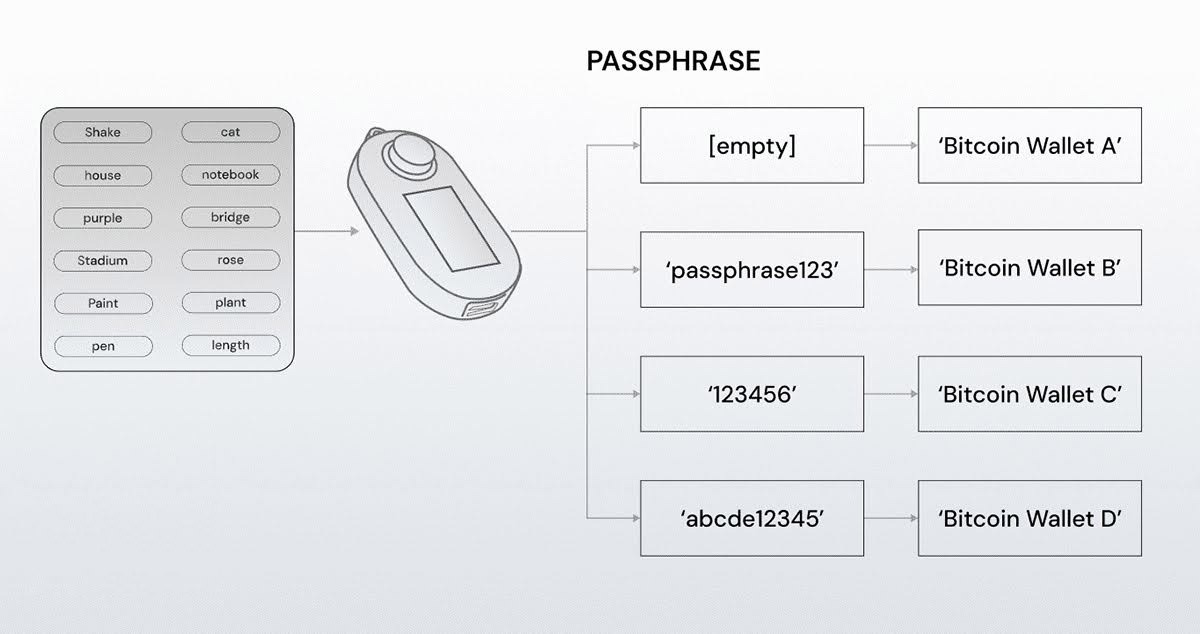
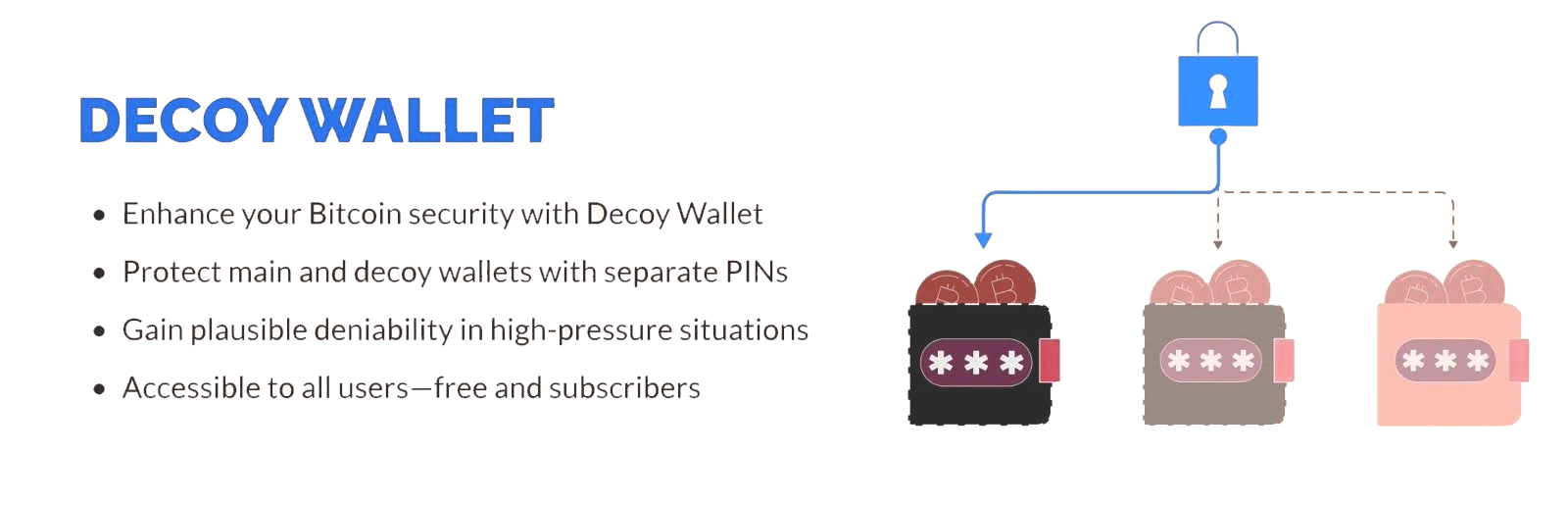
The BIP39 passphrase feature adds a 25th word to your seed phrase, creating plausible deniability and additional security. A passphrase-protected wallet generates completely different addresses and private keys, effectively creating hidden wallets within the same seed phrase. This feature enables creating decoy wallets with small amounts while keeping main holdings behind passphrase protection.
Each Passphrase Creates a Unique Wallet from the Same Seed Phrase
Source: Cypherock
Geographic distribution of seed phrase backups protects against localized disasters like fire, flood, or theft affecting a single location. A robust backup strategy might include copies in a home safe, bank safe deposit box, and trusted family member's custody. Each location should provide adequate physical security while remaining accessible when needed.
Environmental protection preserves seed phrases against natural deterioration and disasters. Paper backups require protection from moisture, fire, and UV exposure through appropriate storage containers. Metal storage solutions resist environmental damage but may attract unwanted attention. Specialized products like Cryptosteel capsules or custom engravings on stainless steel provide maximum durability.
Digital seed phrase storage introduces significant risks and generally should be avoided. Screenshots, photos, cloud storage, password managers, and email systems create digital attack vectors that undermine the security benefits of offline key storage. If digital storage becomes necessary, encryption with strong passwords and secure deletion of unencrypted copies becomes essential.
Operational security around seed phrases requires careful handling procedures. Never enter seed phrases into computers or phones connected to the internet except when using trusted wallet software for legitimate operations. Avoid discussing seed phrase locations or storage methods with others. Be aware of surveillance threats when accessing or handling backup materials.
Testing and verification ensure seed phrase backups remain accurate and accessible. Periodically verify that backup copies are complete, correctly ordered, and legible. Test wallet recovery using backup materials in a secure environment to confirm they work as expected. However, avoid unnecessary exposure of seed phrases during testing.
Family and estate planning considerations become complex with seed phrase security. Beneficiaries need access to recovery materials but shouldn't have access during your lifetime. Some users implement time-locked mechanisms or split-knowledge schemes where multiple family members must cooperate to reconstruct seed phrases.
Common seed phrase security mistakes include storing backups in easily discoverable locations, using predictable hiding places, creating incomplete or incorrect copies, and failing to protect against insider threats. Taking photographs of seed phrases creates digital copies that may be automatically uploaded to cloud services. Writing additional information near seed phrase storage that reveals its purpose attracts unwanted attention.
Comparing Different Types of Bitcoin Wallets
Understanding the security trade-offs between different wallet types enables informed decisions about protecting your Bitcoin based on your specific needs, technical expertise, and risk tolerance. Each wallet category offers distinct advantages and limitations that make them suitable for different use cases and security requirements.
The wallet security spectrum ranges from highly convenient but less secure options to maximum security implementations requiring significant technical knowledge and operational complexity. Choosing the appropriate wallet type depends on factors including the amount of Bitcoin stored, frequency of transactions, technical comfort level, and threat model considerations.
Wallet Type Comparison:
Mobile Hot Wallet
- Security Level: Low-Medium
- Convenience: Highest
- Best For: Daily transactions, small amounts
- Key Vulnerabilities: Malware, phone theft, app vulnerabilities
Desktop Hot Wallet
- Security Level: Medium
- Convenience: High
- Best For: Regular use, moderate amounts
- Key Vulnerabilities: Computer malware, operating system exploits
Hardware Wallet
- Security Level: High
- Convenience: Medium
- Best For: Long-term storage, significant holdings
- Key Vulnerabilities: Physical theft, firmware vulnerabilities
Air-Gapped Cold Storage
- Security Level: Highest
- Convenience: Low
- Best For: Maximum security, large holdings
- Key Vulnerabilities: Operational complexity, human error
Multi-Signature
- Security Level: Very High
- Convenience: Low-Medium
- Best For: Shared custody, estate planning
- Key Vulnerabilities: Key management complexity, coordination
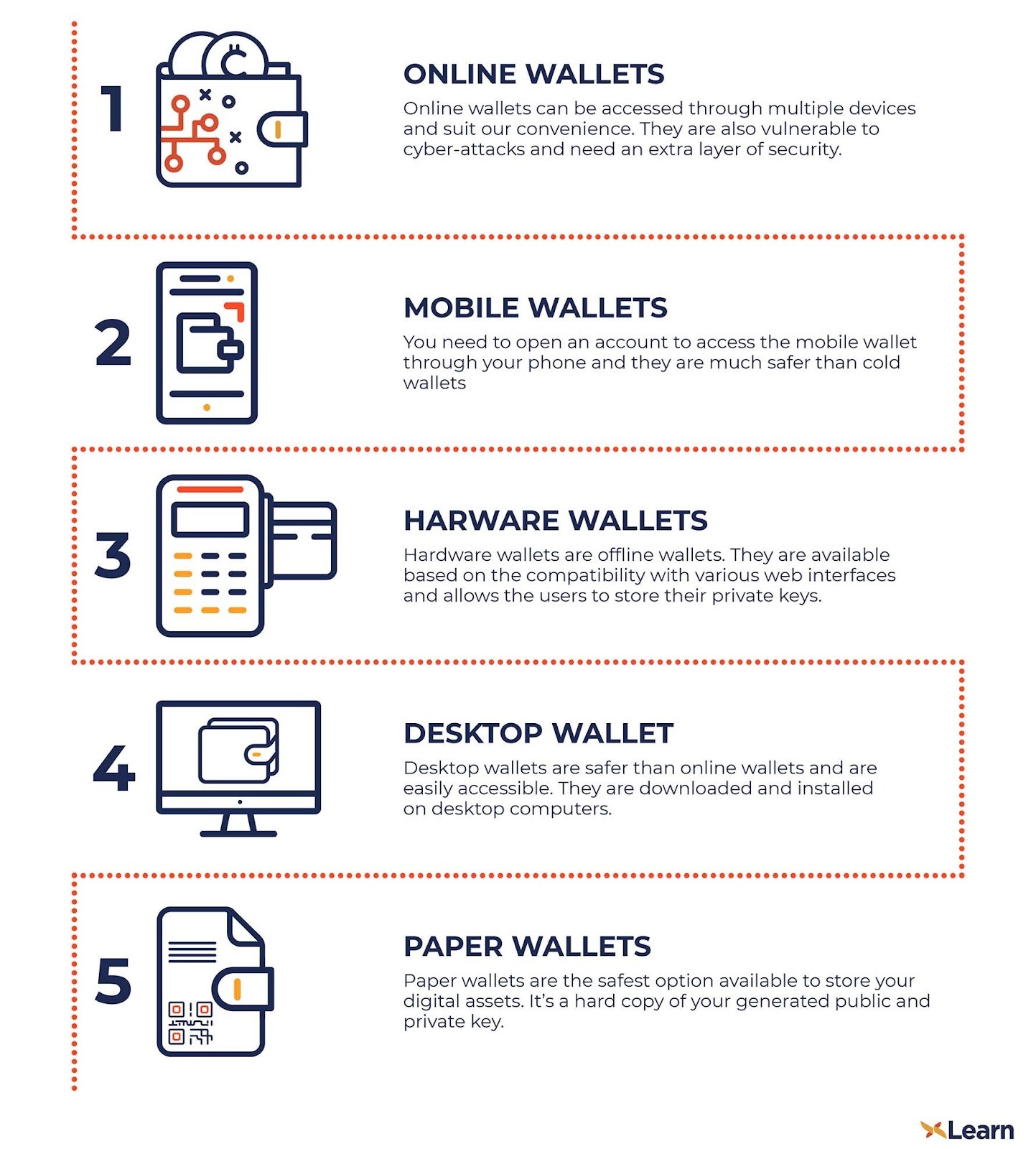
Mobile wallets excel in convenience and user-friendliness, making them ideal for small amounts used in daily transactions. Popular options like Blue Wallet, Exodus, and Phoenix provide intuitive interfaces with reasonable security for modest holdings. However, mobile wallets face significant risks from malware, operating system vulnerabilities, and physical device theft. The convenience of mobile wallets makes them suitable for "spending money" amounts rather than significant savings.
Desktop wallets offer enhanced security compared to mobile options while maintaining reasonable usability for regular transactions. Bitcoin Core provides the highest validation security by running a full node, while lightweight options like Electrum offer faster setup with good security features. Desktop wallets face risks from computer malware, operating system exploits, and physical computer access by unauthorized users.
Web wallets and exchange custody provide maximum convenience but represent the lowest security option for Bitcoin storage. These services control your private keys, creating counterparty risk and making your Bitcoin vulnerable to exchange hacks, regulatory seizures, or business failures. While convenient for trading and small amounts, web wallets should never store significant Bitcoin holdings long-term.
Hardware wallets represent the optimal balance between security and usability for most Bitcoin users. Devices like Ledger Nano S Plus, Trezor Model One, and Coldcard provide strong protection against digital threats while remaining accessible for regular use. Hardware wallet security depends on proper setup, firmware updates, and secure backup procedures. Physical theft of hardware wallets alone doesn't compromise funds if proper PIN and passphrase protection are implemented.
Paper wallets offer simple cold storage but require careful generation and handling procedures. Creating secure paper wallets involves using offline computers with high-quality randomness sources and avoiding online paper wallet generators that may be compromised. Paper wallets work best for long-term storage of specific amounts rather than wallets requiring ongoing transactions.
Brain wallets attempt to store Bitcoin using memorable phrases or passwords but create significant security risks due to poor human randomness and predictable pattern selection. Professional security researchers can crack most brain wallets using dictionary attacks and pattern analysis. Brain wallets should be avoided in favor of properly generated seed phrases.
Different Bitcoin Wallet Types
Source: Red Belly Blockchain
Enterprise and institutional wallet solutions provide additional features like policy enforcement, audit trails, and regulatory compliance tools. Services like BitGo, Fireblocks, and Anchorage offer institutional-grade custody with insurance coverage and compliance features. These solutions trade some self-custody benefits for professional management and regulatory compliance.
The evolution of wallet technology continues improving security and usability. Lightning Network integration enables instant, low-cost transactions while maintaining security. Smart contract wallets on Bitcoin sidechains offer programmable security features. Shamir's Secret Sharing implementations provide mathematically robust ways to split seed phrases across multiple parties.
Wallet selection strategies often involve using multiple wallet types for different purposes. A common approach uses hardware wallets for long-term savings, mobile wallets for daily spending, and exchange accounts for trading activities. This layered approach optimizes both security and functionality while limiting exposure at each security level.
Setting Up Two-Factor Authentication for Bitcoin Security
Two-factor authentication (2FA) adds crucial security layers to Bitcoin-related accounts by requiring multiple verification methods beyond simple passwords. While 2FA cannot protect self-custody Bitcoin wallets directly, it provides essential protection for exchange accounts, web wallets, and online services that interact with your Bitcoin holdings.
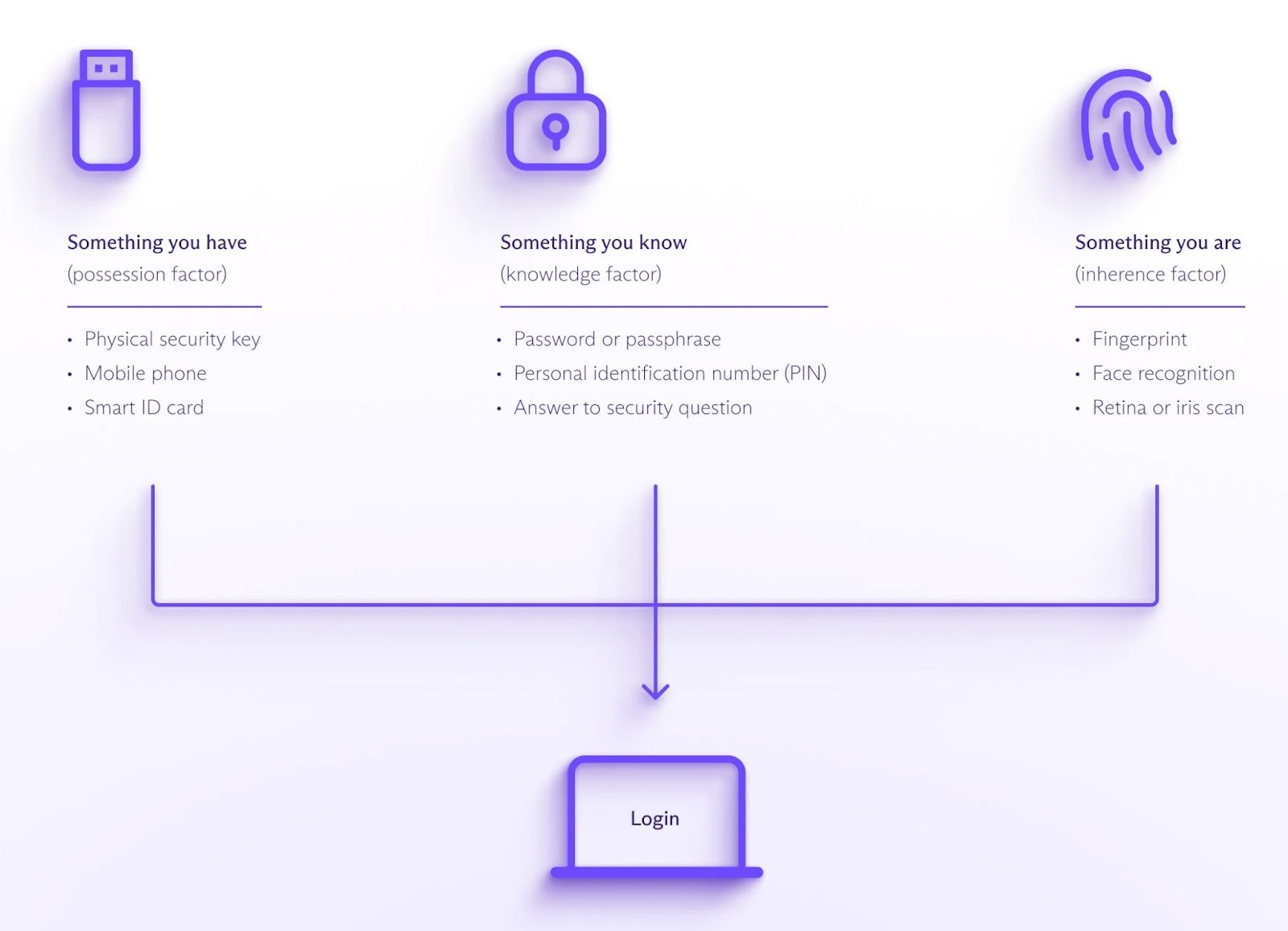
The security principle behind 2FA relies on combining "something you know" (password) with "something you have" (authentication device) or "something you are" (biometric). This multi-factor approach dramatically increases security because attackers must compromise multiple authentication methods rather than just guessing or stealing a password.
Two-Factor Authentication (2FA): A security process requiring two different authentication factors to verify user identity. Common factors include passwords, SMS codes, authenticator apps, and hardware tokens.
Multiple Factors can be Employed in 2FA
Source: Proton
Authenticator apps provide the most practical and secure 2FA implementation for most Bitcoin users. Applications like Google Authenticator, Authy, and 1Password generate time-based codes using the TOTP (Time-based One-Time Password) standard.
These apps work offline, generate unique codes every 30 seconds, and resist SIM-swapping attacks that target SMS-based 2FA.
Setting up authenticator app 2FA involves several critical steps:
- Download and install a reputable authenticator app on your mobile device.
- Access the 2FA settings in your exchange or service account.
- Scan the QR code displayed by the service using your authenticator app.
- Verify the setup by entering the current code from your authenticator app.
- Save the backup recovery codes provided by the service in secure storage.
- Test the 2FA login process to ensure it works correctly.
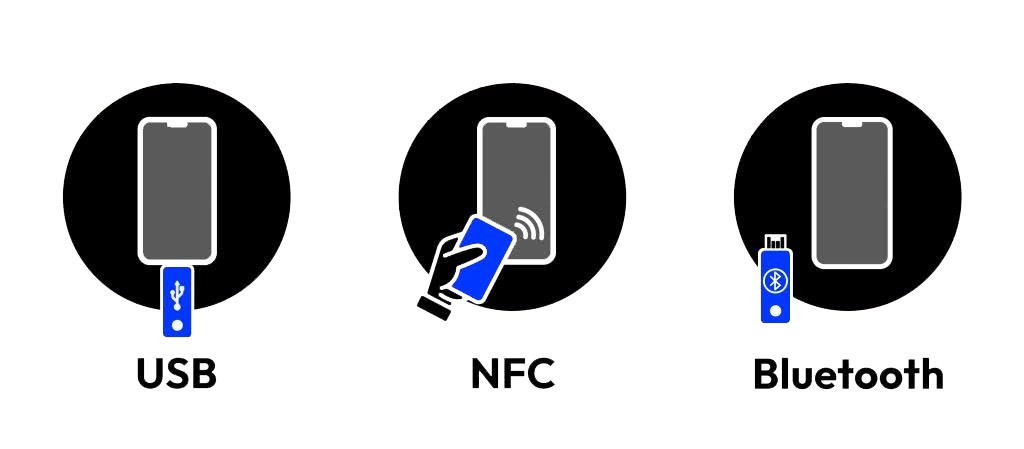
Hardware security keys offer the highest 2FA security by implementing the FIDO2/WebAuthn standard. Devices like YubiKey and Google Titan Keys provide cryptographic authentication that resists phishing attacks, man-in-the-middle attacks, and other sophisticated threats. Hardware keys work by signing authentication challenges with private keys stored securely on the device.
Types of Hardware Security Keys
Source: Keeper Security
SMS-based 2FA provides better security than passwords alone but faces significant vulnerabilities from SIM-swapping attacks. Attackers can convince mobile carriers to transfer your phone number to their control, enabling them to receive your SMS authentication codes. Despite these risks, SMS 2FA offers better protection than no 2FA for users who cannot use authenticator apps or hardware keys.
Email-based 2FA serves as a fallback option but provides limited additional security since email accounts themselves may be compromised. Email 2FA works best when the email account uses strong authentication and differs from the primary account being protected. This method helps detect unauthorized access attempts but doesn't prevent attacks against compromised email accounts.
Biometric authentication includes fingerprint scanning, facial recognition, and other biological verification methods. While convenient, biometric authentication works best as a device unlock mechanism rather than primary 2FA for Bitcoin accounts. Biometric data cannot be changed if compromised, and various spoofing techniques can defeat biological authentication systems.
Exchange-specific 2FA configurations often include additional security features tailored to cryptocurrency trading:
API key restrictions limit third-party application access and permissions.
Withdrawal whitelist allows withdrawals only to pre-approved addresses.
IP address restrictions prevent access from unauthorized locations.
Time-based locks require waiting periods before enabling or disabling security features.
Email confirmations provide additional verification for sensitive operations.
Backup and recovery planning becomes essential when using 2FA because losing access to your authentication method can lock you out of accounts permanently. Most services provide backup recovery codes during 2FA setup that can restore access if your primary 2FA device becomes unavailable. These backup codes require secure storage separate from your authentication device.
Multi-device 2FA strategies protect against device loss or failure by registering multiple authenticator apps or hardware keys with the same account. Some authenticator apps like Authy provide cloud synchronization across devices, while others require manual setup on each device. Hardware key users should register multiple keys with critical accounts to prevent lockouts.
2FA security depends heavily on protecting the underlying authentication factors. Strong, unique passwords remain essential even with 2FA enabled. Authenticator app access should be protected with device lock screens and regular security updates. Hardware keys require physical security to prevent theft and unauthorized use.
Common 2FA implementation mistakes include using weak backup authentication methods, storing recovery codes insecurely, or failing to update 2FA settings when changing devices. Some users disable 2FA during device changes and forget to re-enable it, leaving accounts vulnerable. Others rely on single points of failure by using only one authentication method without backup options.
Bitcoin Estate Planning and Inheritance Considerations
Bitcoin estate planning requires careful preparation to ensure your cryptocurrency can be accessed by beneficiaries while maintaining security during your lifetime. Unlike traditional assets managed by financial institutions with established inheritance procedures, Bitcoin's self-custody model creates unique challenges for transferring wealth across generations.
The fundamental challenge of Bitcoin inheritance stems from the irreversible nature of lost private keys. Traditional estate planning relies on institutions that can verify identity and transfer assets to heirs, but Bitcoin requires cryptographic proof that cannot be recovered if the necessary information is lost or inaccessible.
Dead Man's Switch: A mechanism that automatically triggers an action when a person becomes incapacitated or dies. In the context of Bitcoin specifically, these systems can automatically transfer private keys or instructions to designated beneficiaries after a predetermined period of inactivity.
Effective Bitcoin estate planning must address several critical components while balancing security, accessibility, and legal compliance:
Documentation of wallet types, locations, and access procedures for each holding.
Secure storage of recovery phrases and passwords that beneficiaries can eventually access.
Legal instructions that comply with estate law while maintaining operational security.
Technical education for beneficiaries who may lack cryptocurrency knowledge.
Regular updates as holdings, technology, and family circumstances change.
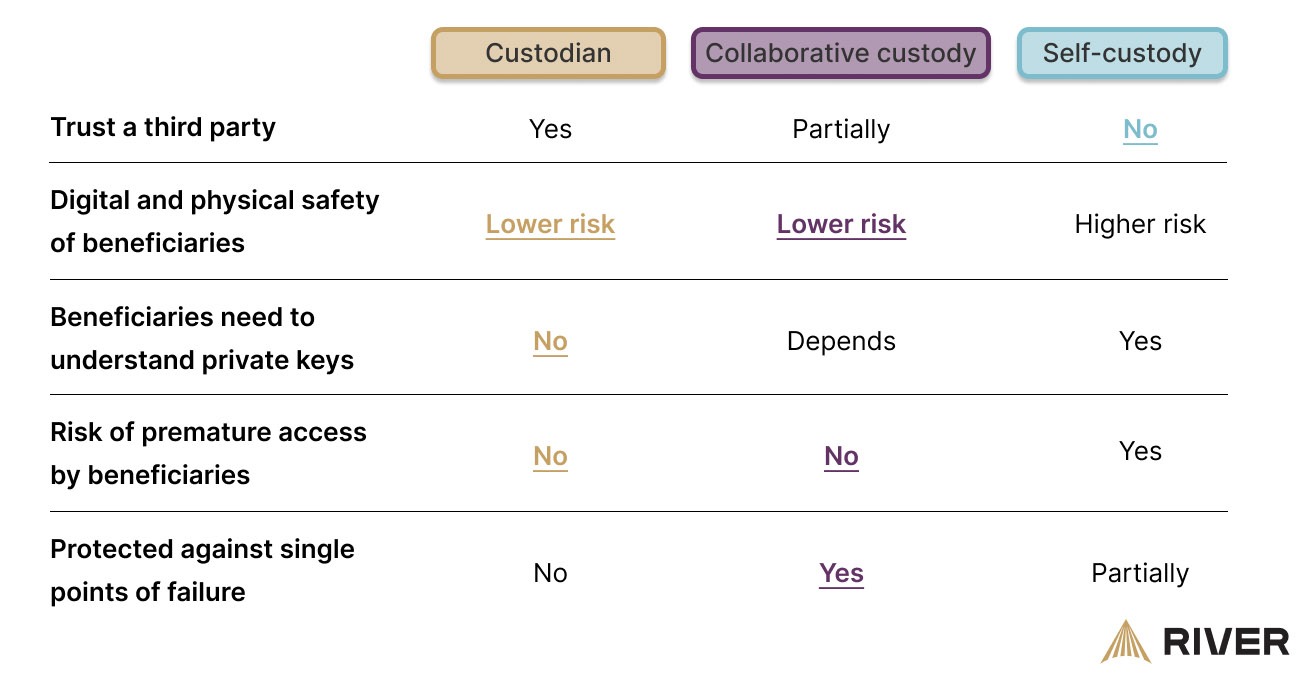
Multi-signature inheritance solutions provide robust protection against both premature access and permanent loss. A common configuration uses a 2-of-3 multisig wallet where you control one key, a trusted family member holds another, and a professional service or attorney holds the third. This setup prevents any single party from accessing funds while ensuring inheritance is possible if you become incapacitated.
Professional Bitcoin inheritance services offer specialized solutions for bitcoin estate planning. Companies like Casa, Unchained Capital, and Trust & Will provide technical infrastructure combined with legal compliance for Bitcoin inheritance. These services typically use multi-signature wallets with professional co-signers and legal documentation that meets estate planning requirements.
Bitcoin Inheritance Setups Compared
Source: River
Time-locked inheritance mechanisms use Bitcoin's built-in scripting capabilities to create automatic transfers after specified time periods. These solutions require periodic on-chain transactions to reset the timer, automatically transferring Bitcoin to beneficiaries if the reset deadline passes. Time-locked solutions provide mathematical certainty but require ongoing maintenance and blockchain transaction fees.
Traditional estate planning integration requires working with attorneys who understand cryptocurrency law and technical requirements. Wills and trusts must include specific instructions for accessing Bitcoin without revealing sensitive information in public court documents. Many estate attorneys now recommend separate cryptocurrency inheritance documents that provide technical details while keeping legal documents focused on broader asset distribution.
Information security in estate planning requires protecting inheritance instructions while ensuring they're accessible to appropriate parties when needed. Sensitive technical information should never appear in wills or other documents that become public records. Instead, sealed instructions stored with attorneys or in safe deposit boxes can provide technical details while maintaining privacy.
Family education becomes crucial for successful Bitcoin inheritance because beneficiaries must understand enough about cryptocurrency security to avoid mistakes that could result in permanent loss. Educational preparation should cover basic Bitcoin concepts, wallet security principles, and specific procedures for accessing inherited holdings. Regular updates help family members stay current with changing technology and security practices.
Backup verification procedures ensure inheritance plans remain functional as technology and circumstances evolve. Regular testing should verify that backup materials are accurate, accessible, and sufficient for wallet recovery. However, testing must be conducted carefully to avoid exposing sensitive information or creating additional security risks.
Geographic distribution strategies for estate planning materials must consider both security and accessibility for beneficiaries. Storage locations should be secure during your lifetime but accessible to appropriate parties after death. Multiple backup locations protect against localized disasters while ensuring beneficiaries can access materials when needed.
Legal jurisdiction considerations affect Bitcoin estate planning because cryptocurrency regulations vary significantly between countries and states. International Bitcoin holdings may face complex tax and legal requirements during inheritance transfers. Professional legal advice becomes essential for significant Bitcoin estates or complex family situations.
Corporate inheritance structures use business entities to hold Bitcoin, potentially simplifying inheritance while providing additional legal and tax benefits. LLC or trust structures can hold Bitcoin with clear succession planning and professional management capabilities. These approaches require ongoing legal and tax compliance but may offer advantages for significant holdings.
Common estate planning mistakes include storing inheritance information with the Bitcoin holdings themselves, creating single points of failure where loss of access prevents both normal use and inheritance. Other mistakes involve providing too little information for successful recovery or too much information that compromises security during the holder's lifetime.
Technology-based inheritance solutions continue evolving with new approaches including smart contracts, social recovery mechanisms, and automated inheritance services. However, these solutions often require trade-offs between security, complexity, and reliance on third-party services that may not exist long-term.
Common Bitcoin Security Mistakes to Avoid
Bitcoin security mistakes often result from misunderstanding the fundamental differences between traditional financial systems and cryptocurrency, leading to irreversible losses that no customer service department can remedy. Understanding and avoiding these common pitfalls protects both new and experienced Bitcoin users from preventable security failures.
The irreversible nature of Bitcoin transactions amplifies the consequences of security mistakes that might be recoverable in traditional banking systems. While banks can reverse fraudulent transactions and replace stolen credit cards, Bitcoin operates without central authorities capable of undoing transactions or recovering lost private keys.
1. Password & Authentication Failures
- Weak or reused passwords across Bitcoin accounts create single points of failure.
- Insecure password storage in browsers, plain text files, or cloud services.
- Disabled or inadequate 2FA, particularly relying solely on SMS 2FA, which is vulnerable to SIM-swapping attacks.
2. Private Key & Seed Phrase Mishandling
- Digital storage of seed phrases (photos, screenshots, cloud backups) eliminates offline security.
- Incomplete or incorrect backups that prevent wallet recovery.
- Co-location risks when storing seed phrases with hardware wallets in the same location.
- Oversharing seed phrases, even with trusted individuals, without proper security protocols.
3. Exchange & Custody Risks
- Extended exchange storage of large amounts exposes Bitcoin to hacks, seizures, and platform failures.
- Treating exchanges as wallets rather than temporary trading platforms.
- Ignoring security features like withdrawal whitelists, API restrictions, and time delays.
- Using unregulated platforms without proper due diligence.
4. Transaction Security Errors
- Unverified recipient addresses leading to irreversible sends to wrong or scammer addresses.
- Untrusted wallet software from unofficial sources containing malware.
- Public WiFi usage for Bitcoin transactions.
- Rushed transactions without proper verification of addresses and fees.
5. Physical Security Oversights
- Poor backup storage like keeping hardware wallets with recovery phrases in one location.
- Weak concealment of seed phrases on easily discovered materials or obvious locations.
- Environmental vulnerability with no protection against fire, flood, or material degradation.
- Public disclosure of holdings or security practices creating personal safety risks.
6. Software & Device Vulnerabilities
- Outdated software exposing wallets to known exploits.
- Compromised devices from using shared/public computers or downloading from unofficial sources.
- Inadequate device security including missing screen locks, automatic updates, or malware protection.
7. Social Engineering Susceptibility
- Phishing attacks impersonating legitimate Bitcoin services.
- Unsolicited investment opportunities and "too good to be true" schemes.
- Information disclosure to callers or emailers claiming to represent Bitcoin services.
- Unverified social media advice leading to pump-and-drop schemes.
8. Backup & Recovery Failures
- Single backup copies without redundancy.
- Untested recovery procedures that may fail when actually needed.
- Insecure backups while primary wallet security is strong.
- Outdated backup instructions when security procedures change.
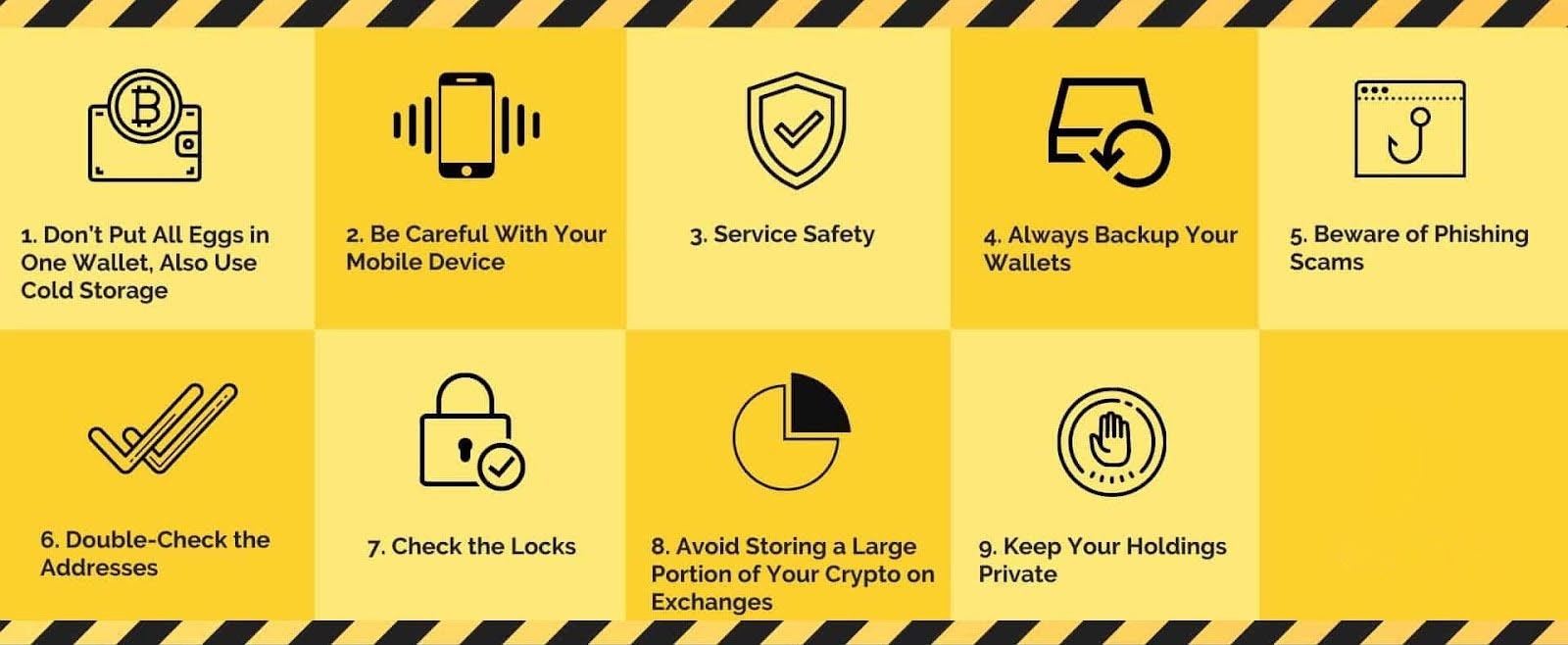
Best Security Practices About your Bitcoin Holdings
Source: CryptoPotato
Prevention strategies for these common mistakes include education, redundancy, regular security reviews, and conservative approaches that prioritize security over convenience. Many Bitcoin security mistakes stem from overconfidence, time pressure, or misunderstanding the unique risks associated with cryptocurrency ownership.
How to Choose the Right Security Solution
Selecting appropriate Bitcoin security solutions requires careful analysis of your specific circumstances, including the amount of Bitcoin held, technical expertise level, usage patterns, and personal threat model. No single security approach works optimally for all users, making personalized security planning essential for effective Bitcoin protection.
The decision-making process should begin with honest assessment of your Bitcoin holdings relative to your overall wealth and the potential impact of different loss scenarios. Small amounts used for experimentation or occasional transactions require different security measures than significant holdings representing major portions of your wealth.
Holdings-based security guidelines provide starting points for security planning:
- Under $1,000: Mobile wallets with strong passwords and 2FA provide adequate security for learning and small transactions.
- $10,000-$100,000: Multi-signature setups or professional custody services may justify their complexity for substantial amounts.
- Over $100,000: Air-gapped cold storage, multi-signature configurations, and professional estate planning become essential considerations.
Technical expertise assessment helps match security solutions to user capabilities and comfort levels:
- Beginner users benefit from hardware wallets with extensive documentation and customer support.
- Intermediate users can implement multi-signature wallets and cold storage with proper education and practice.
- Advanced users may utilize air-gapped systems, custom security protocols, and complex inheritance planning.
- Professional users often require enterprise solutions with audit trails, compliance features, and institutional custody.
Usage pattern analysis influences security solution selection based on how frequently you need to access your Bitcoin:
- Frequent trading requires keeping some Bitcoin on exchanges or in hot wallets for quick access.
- Regular spending benefits from Lightning Network wallets or mobile wallets for daily transactions.
- Long-term holding suits cold storage solutions that prioritize security over accessibility.
- Mixed usage often requires multiple wallet types serving different purposes and security levels.
Threat model development helps identify specific risks and appropriate countermeasures:
- Physical threats including theft, loss, or natural disasters affecting storage locations.
- Digital threats such as malware, hacking attempts, or online service breaches.
- Social threats including family disputes, coercion, or targeted attacks based on known Bitcoin holdings.
- Legal threats from regulatory changes, asset forfeiture, or estate planning complications.
Family and inheritance considerations affect long-term security planning:
- Single users may prioritize maximum personal security with simpler inheritance mechanisms.
- Families often benefit from shared custody solutions that provide access to multiple family members.
- Business entities require compliance features, audit trails, and corporate governance integration.
- Estate planning needs influence backup strategies, documentation requirements, and beneficiary education.
Geographic and regulatory factors impact available security options:
- Local regulations may restrict certain wallet types, exchanges, or inheritance mechanisms.
- Travel requirements affect hardware wallet portability and border crossing considerations.
- Banking relationships influence the ability to convert Bitcoin to traditional currencies when needed.
- Tax implications of different security approaches may affect overall financial planning.
Budget considerations help balance security improvements against implementation costs:
- Hardware wallet costs ($50-$200) provide excellent value for most users with significant holdings.
- Professional services ($100-$500+ annually) may justify costs for complex security needs or large holdings.
- Legal consultation costs for estate planning become worthwhile for substantial Bitcoin wealth.
- Time investment for learning and implementing security measures represents significant opportunity costs.
Risk tolerance assessment guides decisions between security and convenience:
- Conservative users may accept reduced convenience for maximum security through cold storage and complex procedures.
- Moderate users often prefer hardware wallets that balance strong security with reasonable usability.
- Aggressive users might accept higher risks for greater convenience through mobile wallets and exchange custody.
Evolution and upgrade planning considers how security needs may change over time:
- Growing holdings may require upgrading from simple wallets to more sophisticated security solutions.
- Changing circumstances such as marriage, children, or career changes affect inheritance and access planning.
- Technology improvements may offer better security solutions that justify migration from existing setups.
- Learning and experience enable users to implement more advanced security measures over time.
Testing and validation procedures ensure chosen security solutions work correctly:
- Backup testing verifies that recovery procedures work without exposing live private keys.
- Transaction testing confirms that security procedures don't prevent normal Bitcoin operations.
- Access testing ensures authorized users can complete necessary operations within reasonable time frames.
- Emergency testing validates that backup procedures work under stress or time pressure.
The optimal security solution often involves layered approaches using multiple wallet types and security measures rather than relying on single solutions. Many Bitcoin users implement tiered security with different protection levels for different purposes and amounts.
Advanced Security Practices for High-Value Bitcoin Holdings
Advanced Bitcoin security practices become essential when protecting significant wealth, managing institutional holdings, or defending against sophisticated adversaries with substantial resources and motivation. These techniques require higher technical expertise and operational complexity but provide correspondingly stronger protection against advanced threats.
High-value Bitcoin holdings attract targeted attacks that differ qualitatively from opportunistic threats facing typical users. Sophisticated adversaries may use social engineering, physical surveillance, advanced persistent threats, and multi-vector attacks that require comprehensive security approaches rather than relying on single protective measures.
Air-gapped transaction signing represents the gold standard for Bitcoin transaction security by keeping private keys completely isolated from network-connected devices. This approach uses dedicated computers that never connect to the internet for key generation, transaction creation, and signing operations. Signed transactions transfer to online devices through QR codes, USB drives, or other offline media for broadcasting to the Bitcoin network.
Implementing secure air-gapped workflows requires specialized software like Electrum offline mode, Specter Desktop, or custom scripts running on dedicated hardware. The air-gapped device generates unsigned transactions, signs them with stored private keys, and outputs signed transactions for transfer to online devices. This process eliminates digital attack vectors while maintaining the ability to conduct Bitcoin transactions.
Hardware security modules (HSMs) provide enterprise-grade protection for Bitcoin private keys through tamper-resistant hardware specifically designed for cryptographic operations. HSMs offer stronger physical security than consumer hardware wallets, implementing features like tamper detection, secure key storage, and certified cryptographic algorithms that meet government and financial industry standards.
Geographic key distribution spreads multi-signature keys across multiple physical locations and jurisdictions to protect against localized threats, legal seizures, and coordinated attacks. A sophisticated implementation might place keys in different countries with different legal systems, making it difficult for any single authority to compromise the entire multi-signature setup.
Advanced multi-signature configurations can implement complex spending policies that go beyond simple M-of-N schemes:
- Time-locked signatures that become valid only after specified dates or block heights.
- Threshold schemes requiring different numbers of signatures for different transaction amounts.
- Hierarchical signatures where some keys can authorize others to sign on their behalf.
- Conditional signatures that depend on external data sources or events.
Decoy and duress protection strategies protect against physical coercion by creating plausible alternative explanations for Bitcoin holdings. Decoy wallets contain small amounts that can be revealed under duress while protecting larger holdings. Duress passwords or alternative seed phrases can reveal decoy wallets while keeping main holdings hidden.
Decoy Wallets Through Different PINs
Source: Nunchuk
Advanced operational security (OPSEC) practices minimize information leakage that could enable targeted attacks:
- Compartmentalization of information so no single person knows complete security procedures.
- Communication security using encrypted channels for any security-related discussions.
- Financial privacy techniques that obscure Bitcoin holdings and transaction patterns.
- Physical security measures including surveillance detection and secure travel procedures.
Professional custody integration combines self-custody benefits with institutional security services through hybrid approaches. These solutions might use client-controlled keys in multi-signature arrangements with professional custodians, providing institutional security while maintaining user control and avoiding complete counterparty risk.
Supply chain security for hardware becomes critical when dealing with high-value holdings. This includes purchasing hardware directly from manufacturers, verifying firmware authenticity, and implementing procedures to detect tampering during shipping or storage. Some advanced users maintain their own hardware wallet firmware or use devices with verifiable hardware security features.
Covert storage techniques hide the existence of Bitcoin holdings through:
- Steganography that embeds seed phrases in apparently innocent files or documents.
- Brain wallet alternatives using memorized information combined with cryptographic functions.
- Hidden storage in unexpected physical locations or disguised as other objects.
- Digital steganography hiding encrypted seed phrases within image files or other digital media.
Advanced backup strategies protect against sophisticated attacks on backup materials:
- Cryptographic sharing using Shamir's Secret Sharing to split seed phrases mathematically.
- Layered encryption protecting backup materials with multiple encryption layers.
- Distributed storage across multiple service providers and geographic locations.
- Redundant formats storing the same information in multiple formats and media types.
Monitoring and detection systems provide early warning of potential compromise:
- Address monitoring services that alert on any transactions involving your addresses.
- Network monitoring for unusual traffic patterns or connection attempts.
- Physical security systems monitoring storage locations for unauthorized access.
- Digital forensics capabilities for investigating suspected security incidents.
Legal and regulatory compliance for high-value holdings requires specialized expertise:
- Anti-money laundering (AML) compliance for large transactions and holdings.
- Know your customer (KYC) requirements when interacting with regulated services.
- Tax reporting obligations that vary by jurisdiction and transaction type.
- Asset protection strategies that comply with local laws while preserving privacy.
Insurance considerations become relevant for institutional holdings or significant personal wealth:
- Self-insurance through diversified holdings and robust security practices.
- Commercial insurance products specifically designed for cryptocurrency holdings.
- Captive insurance structures for large holders who want customized coverage.
- Legal liability insurance protecting against errors in security implementation.
Implementation of advanced security practices requires careful planning, regular testing, and ongoing maintenance to ensure procedures remain effective as threats and technology evolve. The complexity of these approaches demands significant time investment and technical expertise, making them suitable primarily for high-value holdings where the additional security justifies the implementation costs.
Frequently Asked Questions
1. What happens if I lose my hardware wallet or device, but I still have my seed phrase?
If you lose your hardware wallet but have your seed phrase safely stored, you can recover complete access to your Bitcoin using any compatible wallet software. Import your seed phrase into a new hardware wallet, software wallet, or even a temporary mobile wallet to regain control of your funds.
The seed phrase contains all the cryptographic information needed to regenerate your private keys and access your Bitcoin addresses. However, you should transfer your Bitcoin to new addresses generated by a fresh seed phrase after recovery, especially if you suspect your old hardware wallet was stolen rather than simply lost.
2. How long do hardware wallets last, and what happens if or when they break?
Hardware wallets typically last 5-10 years with normal use, but the device lifespan doesn't affect your Bitcoin security since your funds exist on the blockchain, not on the physical device. When a hardware wallet stops working, you simply restore your seed phrase to a new device and regain complete access to your Bitcoin.
The most important factor is maintaining secure backup copies of your seed phrase, not the longevity of any specific hardware device. Some users replace their hardware wallets every few years as a precautionary measure, while others use devices until they fail naturally.
3. Can quantum computing actually break Bitcoin’s security model, and how can I protect myself against it?
Current quantum computers pose no immediate threat to Bitcoin security, but sufficiently powerful quantum computers could potentially break the elliptic curve cryptography that secures Bitcoin private keys. This threat remains theoretical and likely decades away, requiring quantum computers with millions of stable qubits.
Bitcoin's development community also actively monitors quantum computing progress and has proposed quantum-resistant cryptographic upgrades. For current protection, avoid reusing Bitcoin addresses and consider moving funds to fresh addresses periodically, as quantum attacks would primarily threaten addresses with exposed public keys from previous transactions.
4. Is it safe to use multi-signature wallets with family members who aren't very technically sophisticated?
Multi-signature wallets can work well with non-technical family members if you provide proper education, clear documentation, and regular practice with the technology. Start with simple 2-of-3 configurations where you control one key, a technically capable family member controls another, and a third party like an attorney or service provider holds the backup key.
Create detailed written instructions for accessing and using their signing device, conduct regular practice sessions, and ensure they understand the importance of protecting their key and backup materials. Consider professional multi-signature services that provide technical support for family members when needed.
5. Should I store my seed phrase in a bank safe deposit box?
Bank safe deposit boxes can provide good physical security for seed phrase storage, but consider both the benefits and risks. Benefits include fire protection, theft deterrence, and controlled access. Risks include potential bank closures, government seizures, natural disasters affecting the bank, and the possibility that seed phrase storage might violate the bank's terms of service.
Many Bitcoin users successfully use safe deposit boxes as one component of a geographically distributed backup strategy. Consider splitting your seed phrase or using passphrases so that safe deposit box access alone isn't sufficient to access your Bitcoin.
6. What's the difference between a 12-word vs a 24-word seed phrase in terms of security?
A 12-word seed phrase provides 128 bits of entropy, while a 24-word seed phrase provides 256 bits of entropy, making the 24-word version significantly more secure against brute force attacks. However, both offer more than adequate security for practical purposes—128 bits would require astronomical resources and time to crack using current technology.
The choice between 12 and 24 words often comes down to user preference and specific wallet requirements. Some hardware wallets default to 12 words for simplicity, while others use 24 words for maximum security. Both are secure enough for any realistic threat model.
7. How do I know if my Bitcoin wallet has been compromised?
Signs of wallet compromise include unexpected transactions appearing in your transaction history, changes to your wallet balance that you didn't authorize, inability to access your wallet with correct credentials, or receiving notifications about login attempts you didn't make. If you suspect compromise, immediately check your Bitcoin addresses on a blockchain explorer to verify all transactions.
If unauthorized transactions have occurred, quickly move any remaining Bitcoin to a new wallet with a fresh seed phrase. For exchange accounts, enable all available security features and contact customer support immediately. Prevention through proper security practices is crucial since Bitcoin transactions cannot be reversed.
8. Can I recover Bitcoin sent to a wrong address?
Bitcoin sent to an incorrect address generally cannot be recovered because transactions are irreversible and there's no central authority that can reverse them. If you sent Bitcoin to an address you control (perhaps an old wallet), you might be able to access it if you still have the private keys.
If you did send BTC to someone else's Bitcoin address, recovery depends entirely on that person's willingness to return the funds (they have no legal or technical obligation to do so). Always double-check recipient addresses before sending transactions, use address book features in your wallet software, and consider sending small test amounts before large transactions to unfamiliar addresses.
9. What should I do if someone claims they can recover my lost Bitcoin for a fee?
Be extremely cautious of anyone claiming they can recover lost Bitcoin, as this is a common scam targeting people who have already suffered losses. Legitimate Bitcoin recovery is only possible in very specific circumstances, such as when you have partial information about your wallet and need help with the remaining details.
Never provide your seed phrase, private keys, or any wallet information to recovery services. Legitimate recovery services work with encrypted wallet files and never need your complete seed phrase. If you believe you have a legitimate recovery case, research the service thoroughly, check references, and understand exactly what information they need and why.
10. How often should I test my Bitcoin backup and recovery procedures?
Test your backup and recovery procedures at least annually, or whenever you make significant changes to your security setup. However, testing must be done carefully to avoid exposing your actual seed phrase or private keys. Use test amounts on separate wallets to verify that your backup materials are complete and accurate.
Practice the entire recovery process from start to finish, including any complex procedures involving multiple devices or people. Document any problems you discover during testing and update your procedures accordingly. Regular testing ensures your backup materials remain accessible and your recovery procedures work correctly when needed in actual emergency situations.
Conclusion
Bitcoin security and custody represent fundamental skills for anyone serious about cryptocurrency ownership, requiring a thoughtful balance between protection and accessibility that traditional banking systems handle automatically. The responsibility shift from institutional custody to personal custody creates both unprecedented financial sovereignty and the need for comprehensive security planning that covers digital threats, physical risks, and human factors.
Effective Bitcoin security builds upon layered defense strategies that eliminate single points of failure while maintaining practical usability for your specific needs and circumstances. Hardware wallets provide excellent security for most users, while multi-signature setups and cold storage solutions serve high-value holdings that justify additional complexity. The key lies in matching security measures to your Bitcoin holdings, technical expertise, and risk tolerance rather than implementing unnecessarily complex solutions or inadequate protection.
The evolution of Bitcoin security continues advancing with improved hardware, software innovations, and emerging best practices that make strong security more accessible to average users. However, the fundamental principles of protecting private keys, implementing secure backups, and maintaining operational security remain constant regardless of technological improvements. Success in Bitcoin custody requires ongoing education, regular security reviews, and adaptation to changing threats and opportunities in the cryptocurrency ecosystem.
References
- Nakamoto, S. (2008). Bitcoin: A Peer-to-Peer Electronic Cash System. https://bitcoin.org/bitcoin.pdf
- BIP39 - Mnemonic code for generating deterministic keys. Bitcoin Improvement Proposals. https://github.com/bitcoin/bips/blob/master/bip-0039.mediawiki
- Antonopoulos, A. M. (2017). Mastering Bitcoin: Programming the Open Blockchain. O'Reilly Media.
- NIST Special Publication 800-57 Part 1 Rev. 5: Recommendation for Key Management. National Institute of Standards and Technology.
- Cryptographic Hardware Security. Federal Information Processing Standards Publication 140-2. https://csrc.nist.gov/publications/detail/fips/140/2/final
- BIP32 - Hierarchical Deterministic Wallets. Bitcoin Improvement Proposals. https://github.com/bitcoin/bips/blob/master/bip-0032.mediawiki
- Academic Research on Cryptocurrency Security. IEEE Security & Privacy Magazine, multiple issues 2018-2024.
- Multi-signature Bitcoin Addresses. BIP11. https://github.com/bitcoin/bips/blob/master/bip-0011.mediawiki
Disclaimer: This content is for educational and informational purposes only and should not be construed as financial, investment, legal, or tax advice. Bitcoin security and custody involves risks including technical complexity, user error, and security vulnerabilities. Always conduct your own research and consult with qualified professionals before making financial decisions or implementing security measures.
Risk Warning: Bitcoin and cryptocurrency self-custody involve significant risks including total loss of funds, permanent inaccessibility due to lost private keys or seed phrases, hardware failure, theft, and regulatory uncertainty. Security implementations are subject to user error, technological failures, and evolving threat landscapes. Users should only store amounts they can afford to lose and should thoroughly understand the requirements and limitations of self-custody before proceeding.
Disclosure: This content may contain references to Rhino Bitcoin and various Bitcoin security products and services. The author may have business relationships with companies mentioned in this article. All information presented is believed to be accurate but is not guaranteed. Security methods and best practices evolve over time and readers should verify current recommendations.
.png)
.png)