
Bitcoin Savings Account Interest: Banking Alternative Guide 2026
Bitcoin savings accounts offer interest on BTC but require giving up custody, adding risk, tax complexity, and no FDIC protection.

Buy Bitcoin with Zero Fees with Rhino
The most secure way to stack sats. Simple, fast, and zero trading fees.
Bitcoin savings account interest refers to yield earned on bitcoin deposits. This yield usually comes from lending, staking-like programs, or interest-bearing accounts offered by cryptocurrency platforms.
Unlike traditional bank savings accounts that pay interest in dollars, bitcoin interest programs pay returns in bitcoin. In some cases, returns are paid in stablecoins. Interest rates and risk levels vary widely depending on the provider.
Within the broader context of bitcoin banking alternatives, interest-bearing bitcoin accounts are one option for users seeking returns on their holdings. However, these programs introduce counterparty risk and custody trade-offs. These risks differ fundamentally from self-custody approaches.
Key Summary:
Bitcoin savings account interest programs offer yield on bitcoin deposits. However, users must give up custody to third parties, which introduces risks not present with self-custody.
Key Takeaways
- Interest rates on bitcoin accounts typically range from 1–8% annually as of 2025
- Users must give up custody of their bitcoin to earn interest
- Programs involve counterparty risk, regulatory uncertainty, and tax complexity
- Self-custody alternatives prioritize security over yield
How Do Bitcoin Savings Accounts Generate Interest?
Bitcoin savings accounts generate interest by lending deposited bitcoin or using it in yield-generating activities.
Platforms pool customer deposits and lend bitcoin to different borrowers. These borrowers may include institutional traders, retail users, or liquidity providers. Borrowers pay interest for access to bitcoin capital.
How Bitcoin Savings Accounts Generate Interest
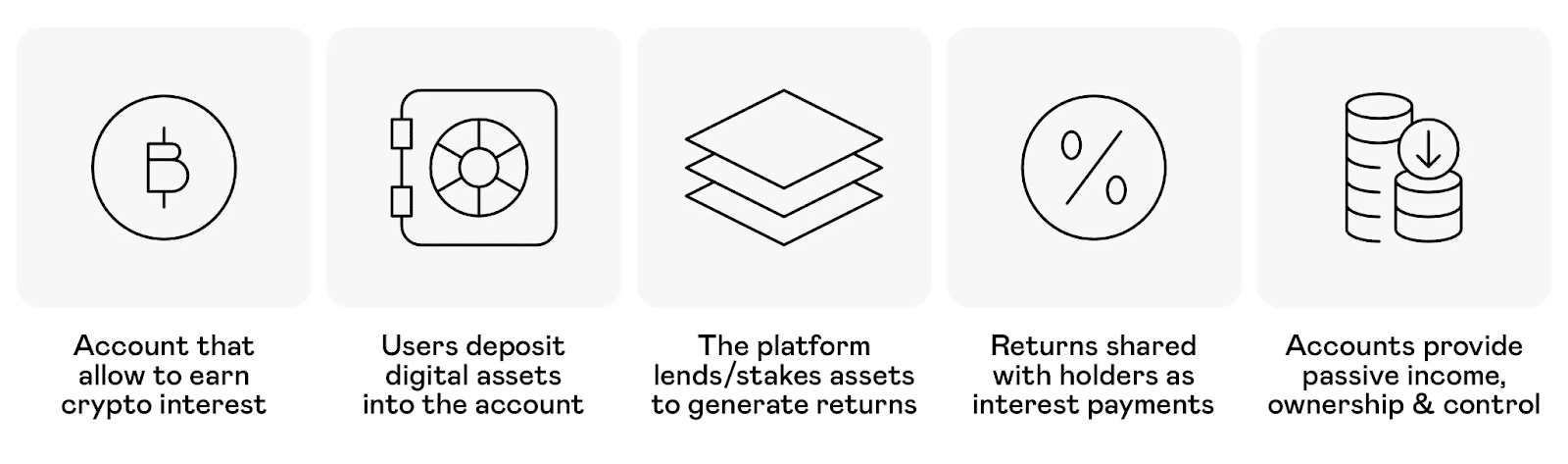
Interest rates depend on market demand. When demand to borrow bitcoin is high, rates tend to rise. This often happens during bull markets. During bear markets, borrowing demand usually falls, and interest rates decline.
Common Yield Generation Methods
- Margin lending: Bitcoin is lent to traders using leverage
- Institutional loans: Crypto companies borrow bitcoin for business operations
- Liquidity provision: Bitcoin is deployed into decentralized finance protocols
- Secured lending: Depositors fund bitcoin-backed loans
Most platforms operate in a way similar to fractional reserve banking. Only part of user deposits is kept in reserve. The rest is lent out. This can create liquidity problems if many users try to withdraw at the same time.
What Are the Risks of Bitcoin Interest Accounts?
Bitcoin interest accounts carry significant risks. These risks are very different from those of insured bank deposits.
The main concern is counterparty risk. This means the platform holding your bitcoin could fail, be hacked, or misuse funds. In some cases, this can result in a total loss of deposits.
Unlike traditional bank accounts, bitcoin interest accounts are not protected by FDIC insurance. FDIC insurance covers up to $250,000 for U.S. dollar deposits at insured banks. Bitcoin accounts usually have no equivalent protection.
Since 2022, several major platforms have failed. Many depositors have been unable to recover their bitcoin.
Platform and Counterparty Risks
- Insolvency: Platforms can fail if borrowers default or markets deteriorate
- Fraud and mismanagement: Some platforms have misused customer funds or operated as ponzi schemes
- Security breaches: Centralized custody makes platforms attractive targets for hackers
- Liquidity crises: Withdrawal freezes can occur during periods of stress
Regulatory and Legal Risks
- Unclear legal status: Many programs operate in regulatory gray areas
- Securities classification: The SEC has argued that some interest programs are unregistered securities
- Sudden shutdowns: Regulatory actions can force platforms to halt withdrawals or close
Tax and Reporting Complications
- Taxable income: Bitcoin interest is treated as ordinary income under IRS guidance
- Reporting burden: Users must track and report interest payments
- Cost basis complexity: Interest payments create new tax lots
The collapse of platforms such as Celsius, BlockFi, and Voyager in 2022 showed these risks clearly. Hundreds of thousands of users lost access to their bitcoin. Bankruptcy cases are still ongoing years later.
Bitcoin Interest Accounts vs Self-Custody Banking
The main trade-off between bitcoin interest accounts and self-custody is yield versus control.
Interest accounts offer the possibility of passive returns. In exchange, users must give up custody. Self-custody focuses on security and sovereignty, but it does not usually generate yield.
Self-custody bitcoin banking alternatives allow users to control their private keys while still accessing financial services. This approach aligns with Bitcoin’s core principle of financial sovereignty. However, it usually does not provide passive income.
Comparison: Interest Accounts vs Self-Custody
Bitcoin Interest Accounts
- Pros:
- Passive yield
- Simple user experience
- Potentially higher returns than traditional savings
- Cons:
- Loss of custody
- High counterparty risk
- Regulatory uncertainty
- No deposit insurance
- Best For:
Users who prioritize yield and understand the custody risks
Self-Custody Banking
- Pros:
- Full control of private keys
- No counterparty risk
- Strong alignment with Bitcoin principles
- Enables Lightning Network usage
- Cons:
- No passive interest
- Requires more technical knowledge
- Users are responsible for security
- Best For:
Users who prioritize security and sovereignty over yield
Bitcoin Custody Options
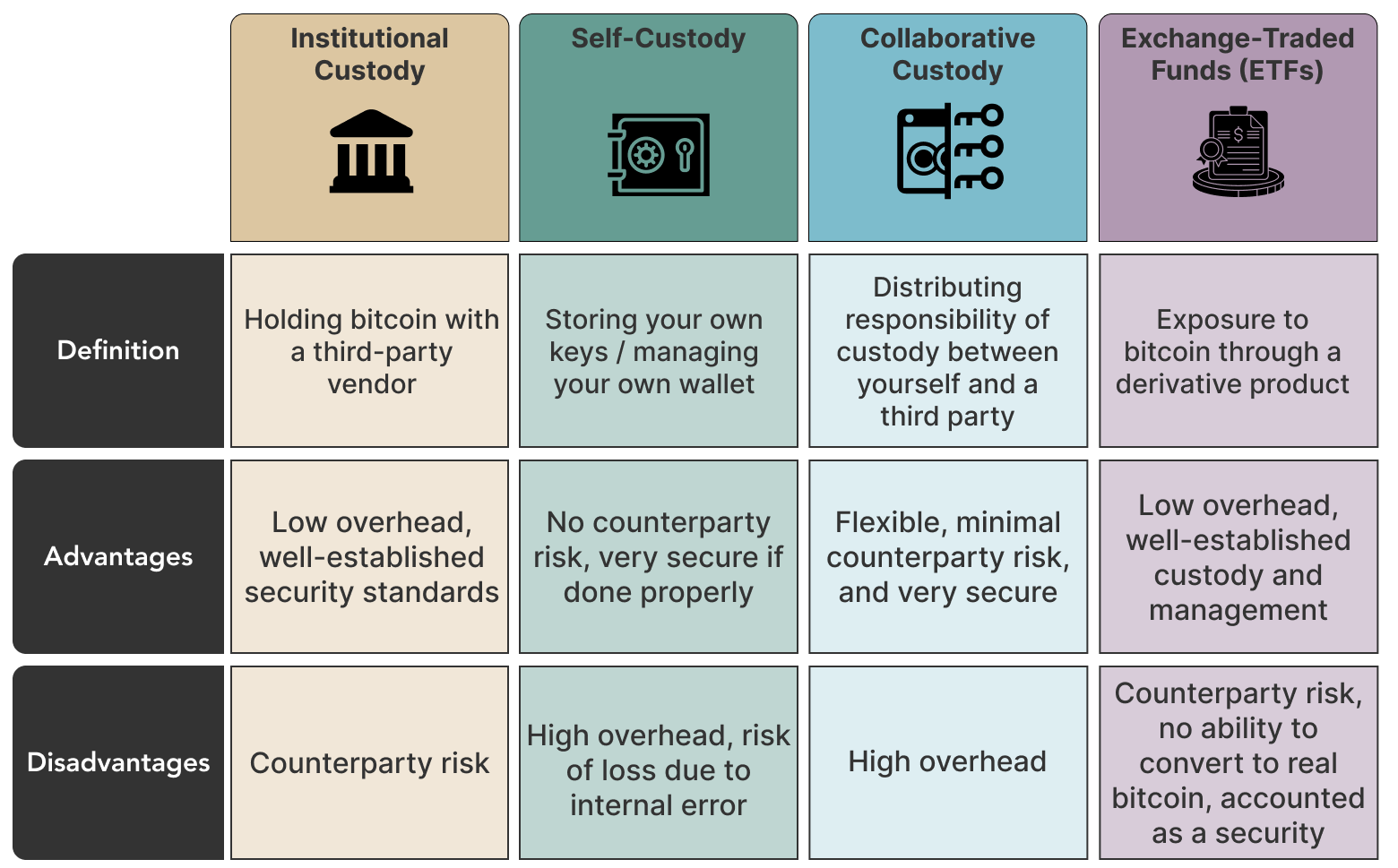
Platforms like Rhino Bitcoin focus on self-custody solutions. These include multi-signature security and Lightning Network functionality. The focus is on bitcoin utility, not yield through lending.
Are Bitcoin Interest Rates Competitive?
Bitcoin interest rates are much lower than their 2020–2021 highs. However, they may still exceed some traditional savings rates.
As of early 2025, reputable platforms typically offer 1–4% annual percentage yield (APY). Rates change based on market conditions.
Traditional savings accounts at major banks offer roughly 0.5–5.0% APY as of early 2025. Online banks and credit unions often offer higher rates.
Rate Comparison Considerations
- Currency risk: Bitcoin interest is paid in a volatile asset
- Insurance gap: Traditional accounts have FDIC protection
- Tax treatment: Bitcoin interest is taxed as ordinary income
- Withdrawal limits: Some platforms impose lockups or limits
The true return depends on bitcoin’s price. If bitcoin rises, interest compounds gains. If bitcoin falls, interest may not offset losses.
Bitcoin (uppercase): Refers to the Bitcoin network and protocol.
bitcoin (lowercase): Refers to the currency units.
What Happened to Major Bitcoin Interest Platforms?
Several large bitcoin interest platforms collapsed between 2022 and 2024. These failures led to billions of dollars in customer losses and increased regulatory scrutiny.
Celsius Network peaked at over $25 billion in customer deposits. In July 2022, it filed for bankruptcy. Celsius had offered interest rates as high as 18%. Its lending strategies failed during the market downturn. Depositors remain locked out years later, with only partial recoveries expected.
BlockFi collapsed in November 2022. The failure followed exposure to Three Arrows Capital and the FTX exchange. Earlier that year, the SEC charged BlockFi with offering unregistered securities. BlockFi paid a $100 million settlement and later filed for bankruptcy.
Voyager Digital filed for bankruptcy in July 2022. It had lent heavily to Three Arrows Capital. Voyager marketed itself as safe, but deposits were not insured. Customers recovered only a portion of their funds after a lengthy process.
These failures shared common traits:
- High interest rates attracted deposits
- Lending to risky borrowers
- Insufficient reserves
- Insolvency during the 2022 bear market
High yields often indicate high risk in crypto lending.
How to Evaluate Bitcoin Savings Account Providers
If you consider a bitcoin interest account, due diligence is essential.
Start by researching regulatory status and compliance history. Platforms with licenses and oversight face stricter requirements. Look for enforcement actions from the SEC, CFTC, or state regulators.
Key Evaluation Criteria
- Regulatory compliance: Clear licensing and jurisdictions
- Insurance and reserves: Reserve ratios and any coverage
- Security practices: Cold storage, multi-signature wallets, audits
- Transparency: Clear disclosures and reserve attestations
- Company history: Operating history and management background
- Withdrawal terms: Lockups, limits, and processing times
Be cautious with unusually high interest rates. Sustainable yields in 2025 are typically 1–4%. Higher rates often signal excessive risk.
Always review the terms of service. Many agreements limit user rights and disclaim platform liability. Understanding these terms is critical.
What Are the Tax Implications of Bitcoin Interest?
Bitcoin interest creates immediate tax obligations.
Under IRS Notice 2014-21 and later guidance, crypto interest is taxable as ordinary income. It is taxed in the year it is received.
Each interest payment must be reported at its fair market value in U.S. dollars. This creates both income tax liability and a new cost basis. If you later sell or spend that bitcoin, capital gains or losses apply.
Tax Considerations
- Ordinary income: Taxed at regular income rates
- Reporting requirement: All interest must be reported
- Cost basis tracking: Each payment is a new tax lot
- Form 1099: Reporting is required even without a form
Taxes reduce the effective yield. For example, a 4% return taxed at 24% becomes about 3% after tax. When combined with price volatility and platform risk, returns may be less attractive.
Self-custody avoids these issues. Bitcoin held in your own wallet triggers no taxes until you sell, spend, or trade it.
Frequently Asked Questions
What is a bitcoin savings account?
A custodial account where users deposit bitcoin and earn interest. Platforms generate yield by lending bitcoin.
How much interest can you earn on bitcoin?
About 1–4% annually as of early 2025, depending on market conditions and provider.
Is bitcoin interest taxable?
Yes. It is taxed as ordinary income when received.
Are bitcoin interest accounts FDIC insured?
No. FDIC insurance only covers U.S. dollar deposits.
What is the difference between bitcoin interest and staking?
Bitcoin uses proof-of-work and does not support staking. Interest comes from lending.
Can you lose money in a bitcoin savings account?
Yes. Platform failures can result in total loss.
How is bitcoin interest different from traditional savings accounts?
Higher risk, no insurance, volatile returns, and less regulation.
What is the safest way to earn interest on bitcoin?
There is no risk-free method. All interest requires giving up custody.
Do you need to report bitcoin interest under $600?
Yes. All interest must be reported.
What happened to Celsius and BlockFi?
Both filed for bankruptcy in 2022 after failed lending strategies.
Conclusion
Bitcoin savings account interest involves a trade-off between yield and security.
Rates of 1–4% may exceed some savings accounts. However, they come with counterparty risk, no insurance, regulatory uncertainty, and tax complexity.
Key Considerations
- Platform solvency is critical
- Past failures show deposits can be lost
- Self-custody prioritizes sovereignty
- Taxes reduce effective returns
For users focused on bitcoin sovereignty and real-world utility, explore Rhino Bitcoin’s self-custody banking alternative. It supports Lightning payments, bill pay, and bitcoin-backed loans without giving up private keys.
References
- Internal Revenue Service. “Notice 2014-21: IRS Virtual Currency Guidance.”
- U.S. Securities and Exchange Commission. “SEC Charges BlockFi…” February 2022.
- Bitcoin.org. “How Bitcoin Works.”
- Lightning Network. “Protocol Documentation.”
- Mempool.space. “Bitcoin Network Statistics.”
Important Disclaimers
Disclaimer: Educational information only. Not financial, legal, or tax advice.
Risk Warnings: All investments involve risk. Bitcoin is volatile.
Conflicts of Interest: Rhino Bitcoin provides bitcoin financial services. This content is educational and may reference our products.
.png)
.png)