
The Best Physical Backup Methods for Bitcoin Security
Learn how physical bitcoin backups using paper or metal protect seed phrases from hacks, device failure, and permanent loss.
Buy Bitcoin with Zero Fees with Rhino
The most secure way to stack sats. Simple, fast, and zero trading fees.
Physical backup methods protect bitcoin by storing recovery information offline on durable materials. These backup options include paper, metal plates, and specialized cryptographic devices.
Each option is designed to preserve the seed phrase or private keys needed to restore a bitcoin wallet if digital devices fail or are lost.
Key Summary: Bitcoin physical backups store recovery information offline using paper, metal, or specialized devices. They protect against digital failure, theft, or loss of access to funds.
Key Takeaways
- Physical backups protect against device failure and digital threats
- Metal backups offer superior durability compared to paper
- Multiple backup locations reduce single-point-of-failure risk
- Proper backup methods complement comprehensive bitcoin security practices
Why Physical Backups Matter for Bitcoin Security
Physical backups serve as the ultimate insurance policy for bitcoin holders. Unlike traditional banking, Bitcoin has no built-in account recovery system.
Bitcoin’s self-custody model places full responsibility on the individual. If a seed phrase is lost and no backup exists, the bitcoin is permanently lost. There is no customer service department that can restore access.
No Password Resets in Bitcoin
The Bitcoin network has no password reset function. According to blockchain analysis firm Chainalysis, approximately 20% of all bitcoin sits in wallets whose owners have lost access.
As of 2023, this represents roughly 3.7 million BTC. Physical backups help prevent this outcome by creating offline recovery points that survive digital failures.
Threats Physical Backups Protect Against
Physical backups protect against several common risks:
- Device failure: Hardware wallets and phones eventually break or malfunction
- Digital attacks: Ransomware and malware cannot access offline storage
- Cloud vulnerabilities: Digital backups face hacking and service shutdowns
- Memory failure: Relying on memorization alone creates unacceptable risk
Seed phrase: A 12- or 24-word sequence that serves as the master key to recover a bitcoin wallet. It is generated using the BIP39 standard. Anyone with access to the seed phrase controls the bitcoin.
Learn more about BIP39
Paper Backup Methods
Paper is the most accessible physical backup option. Writing a seed phrase on paper requires no specialized tools and creates an immediate offline backup.
However, paper is vulnerable to water, fire, and deterioration. For this reason, it is best suited for short-term storage or as one part of a multi-location backup strategy.
Creating a Durable Paper Backup
When creating paper backups, clarity and materials matter. Standard printer paper degrades within years, while acid-free archival paper can last decades.
Pencil graphite resists fading better than most inks. Archival-quality pigment inks are also effective.
Paper Backup Best Practices
- Write by hand: Avoid printers that may store documents in memory
- Use archival materials: Acid-free paper with archival ink or pencil
- Verify accuracy: Double-check every word against the original seed
- Protect from elements: Store in waterproof and fire-resistant containers
- Create multiple copies: Keep backups in separate secure locations
Paper backups work best when laminated or stored in waterproof pouches inside fireproof safes. For larger bitcoin holdings, paper should be one backup method among several.
Metal Backup Solutions
Metal backup devices provide far greater durability than paper. Steel, titanium, and similar metals can withstand fire, water, crushing pressure, and corrosion.
These solutions are well suited for long-term storage. Most involve stamping, engraving, or arranging metal tiles to record a seed phrase.
Types of Metal Backup Systems
Metal backups range from simple stamping kits to more advanced tile-based systems.
Stamping kits include metal plates and letter punches. Users physically stamp each word into the plate.
Tile-based systems use pre-engraved letters that slide into a protective case. This removes the need for stamping while maintaining durability.
Bitcoin Seed Phrases Can be Stamped on a Piece of Durable Metal
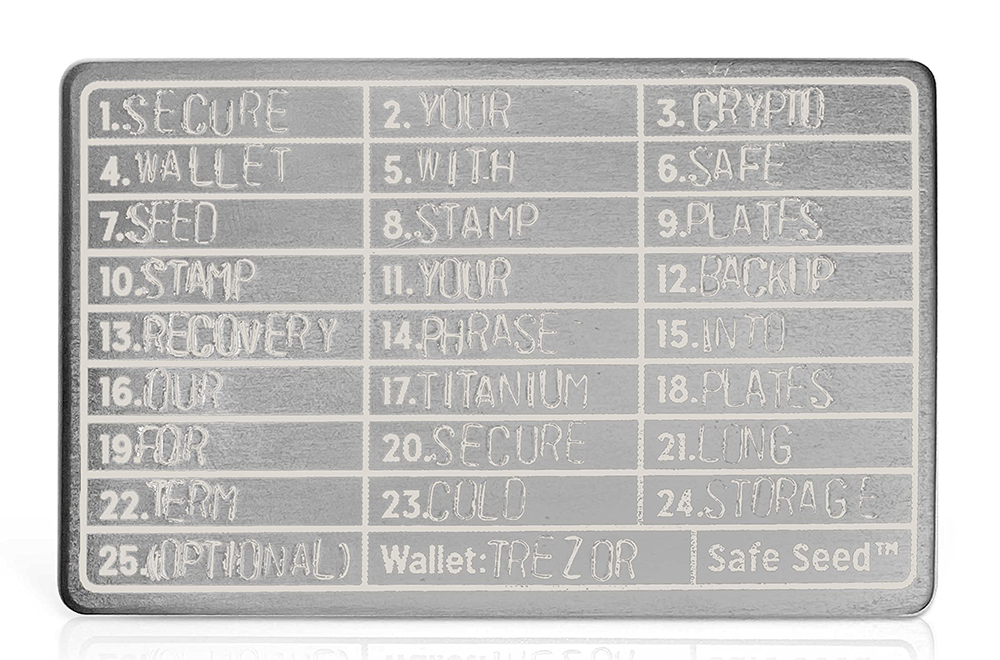
Comparison: Metal Backup Types
Stamped Metal Plates
- Pros: Low cost, widely available, permanent markings
- Cons: Requires physical effort, mistakes are permanent, time-consuming
- Best For: Budget-conscious users comfortable with manual tools
Tile-Based Systems
- Pros: Easy to use, rearrangeable, no tools required, clean appearance
- Cons: Higher cost, tiles may shift if not secured properly
- Best For: Users who prioritize convenience and easy verification
Engraved Solutions
- Pros: Professional quality, highly durable, tamper-evident options
- Cons: Highest cost, may require specialized services
- Best For: High-value holdings needing maximum durability
Popular metal backup products include Blockplate, Cryptosteel, and Billfodl. Each uses a different design but serves the same purpose: creating a fire-resistant, waterproof, and crush-resistant seed phrase backup.
BIP39 standard: A Bitcoin Improvement Proposal that defines how wallets generate human-readable seed phrases from random data. This creates a standardized recovery method across wallet software.
Read the BIP39 specification
Splitting and Distributing Backups
Storing all backups in one location creates a single point of failure. Geographic distribution protects against localized disasters such as fires, floods, or theft.
However, splitting backups requires careful planning. The goal is to balance accessibility with security.
Simple Distribution Strategies
The simplest approach is to store complete backups in multiple secure locations. Common examples include a home safe and a bank safety deposit box.
This method provides redundancy without adding complexity. If one location becomes inaccessible, the other backup remains available.
Advanced Distribution Using Cryptography
More advanced strategies split the seed phrase using cryptographic methods. Shamir's Secret Sharing is one such technique.
It is supported by some hardware wallets, including Trezor Model T. This method divides a seed into multiple shares and requires a set number of shares for recovery.
For example, a 3-of-5 setup creates five shares. Any three can recover the wallet, while two or fewer reveal nothing.
Distribution Strategy Considerations
- Location security: Each site should match the value being protected
- Access control: Consider who can physically access each location
- Geographic diversity: Separate locations enough to avoid shared risks
- Recovery complexity: More complex setups increase recovery effort
Bank safety deposit boxes offer strong physical security. However, they raise privacy concerns and limit access hours. In some cases, court orders or government actions may affect access.
Shamir's Secret Sharing Explained
Shamir's Secret Sharing uses mathematics to protect split backups. Unlike simply dividing a seed phrase in half, each share reveals no information on its own.
Users define both the total number of shares and the number required for recovery. For example, in a 2-of-3 setup, any two shares can restore the wallet.
Only use Shamir’s Secret Sharing with wallets that explicitly support it. Manually splitting a BIP39 seed phrase breaks the checksum and can make recovery impossible.
Compatible hardware wallets include Trezor Model T and Keystone devices.
Specialized Backup Devices and Tools
Several companies offer purpose-built backup tools beyond basic metal plates. These products focus on durability, tamper resistance, and ease of use.
Cryptotag uses titanium plates with laser-engraved characters. Grade 5 titanium withstands temperatures up to 1,665°C (3,029°F), far exceeding typical house fires. This durability comes at a higher cost.
Billfodl, recently rebranded as Privacyidea Backup, uses stainless steel sliding tiles. Its 316 stainless steel resists corrosion and survives temperatures up to 1,399°C (2,550°F).
Coldbit Steel provides a compact stamping solution with guided templates. These templates reduce stamping errors and support both 12-word and 24-word seed phrases.
Many manufacturers publish independent fire and crush test results. These reports help users understand the level of protection offered.
Digital Backup Considerations and Risks
This article focuses on physical backups. However, understanding digital risks highlights why physical methods matter.
Digital backups stored on computers, phones, or cloud services face unique vulnerabilities that physical backups avoid.
Common Digital Backup Risks
Digital devices are connected to the internet. Malware designed to steal bitcoin seed phrases actively scans for wallet files and text documents.
Cloud storage services add further risk. They create new attack surfaces and rely on third-party security controls.
Encryption helps but introduces new problems. Users must protect the encryption password. If it is weak or forgotten, the backup becomes unusable.
Digital Backup Risks:
- Malware and keyloggers: Capture seed phrases during access
- Cloud breaches: Third-party compromises expose data
- Automated backups: Wallet files may be copied to insecure locations
- Data remnants: Deleted files may remain recoverable
Physical backups eliminate these attack vectors. An air-gapped metal plate cannot be hacked, infected, or breached remotely.
Air-gapped: A security method where data has no network connection, preventing remote access or digital attacks. Physical backups are inherently air-gapped.
Testing and Verifying Backups
Creating a backup is only half the process. Verification ensures it works when needed.
Many bitcoin holders discover too late that backups contain errors or are incompatible with their wallet software.
How to Verify a Backup Safely
The safest method is to test with a small amount of bitcoin. Restore a wallet containing minimal funds using only the backup.
This confirms the backup is accurate, readable, and compatible.
Backup Verification Checklist
- Perform test recovery: Restore a small-value wallet
- Verify word accuracy: Check each word against the BIP39 list
- Inspect physical condition: Look for corrosion or damage
- Check storage containers: Confirm fireproof and waterproof protection
- Document locations: Record where backups are stored without exposing contents
Use dedicated devices for testing and wipe them afterward. Some hardware wallets offer dry-run recovery modes that verify a seed phrase without loading it.
Multi-Signature and Advanced Backup Strategies
Multi-signature wallets distribute control across multiple keys. A 2-of-3 multisig requires two keys to authorize transactions.
This setup provides security if one key is compromised and redundancy if one key is lost.
Each key requires its own backup. A common setup stores keys in different physical locations, such as a home safe, a bank vault, and a trusted third party.
Additional Multisig Backup Requirements
Recovering a multisig wallet requires more than seed phrases. Configuration data must also be preserved.
Multisig Backup Components:
- Private key seed phrases: One for each signer
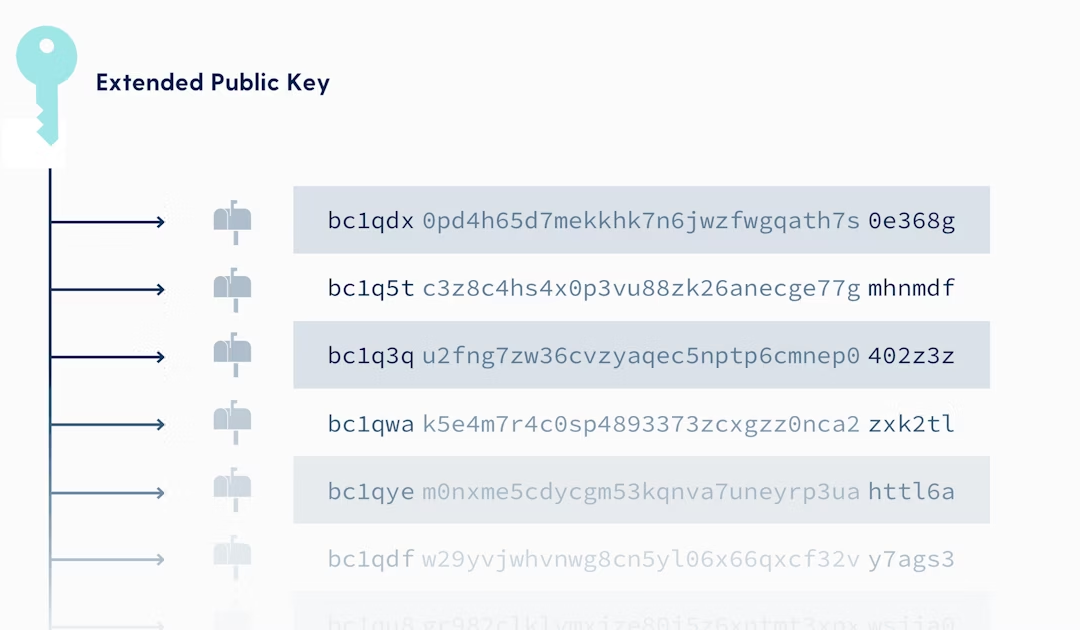
- Extended public keys: Xpubs from all participants
- Wallet configuration: Script type, derivation paths, and scheme
- Coordinator software: Details of the software used
Addresses can be Derived from the Extended Public Key (XPUB)
Popular multisig solutions include Electrum, Sparrow, Unchained Capital, and Casa. Each uses slightly different formats, making documentation essential.
Multi-signature wallet: A bitcoin wallet that requires multiple private keys to authorize transactions, reducing single points of failure.
Learn more about multisig
Inheritance Planning and Estate Considerations
Physical backups are essential for bitcoin inheritance planning. Without documentation, heirs may never find backups or understand how to use them.
A complete inheritance plan includes instructions stored alongside backups. These instructions should explain what the backup is and how to use it.
Some users rely on automated systems such as time locks or dead man’s switches. While useful, these add complexity and potential failure points.
Inheritance Planning Elements
- Backup location map: Secure list of storage locations
- Recovery instructions: Step-by-step guidance for heirs
- Wallet software details: Compatible applications
- Legal documentation: Estate and will provisions
- Trusted executor: Someone capable of handling the process
Legal rules vary by jurisdiction. In the U.S., most states have adopted RUFADAA, which provides fiduciary access to digital assets.
Common Mistakes and How to Avoid Them
Even experienced bitcoin holders make backup mistakes that affect security or recovery.
The most serious error is using only one backup location. A single disaster can destroy all copies.
Another mistake is over-complicating systems. Complex setups often fail during recovery.
Mistakes to Avoid
- Single-location storage: Use multiple geographic locations
- Unverified backups: Always test recovery
- Poor physical security: Protect backups properly
- Over-complex systems: Simpler solutions are more reliable
- Ignoring inheritance: Plan for future access
Photographing seed phrases is especially dangerous. Phone backups, cloud syncing, and metadata create uncontrolled copies.
Comparing Backup Options
Choosing the right backup depends on technical comfort, value protected, and personal risk tolerance.
By Durability
- Paper backups: Cheap and accessible, but vulnerable
- Laminated paper: Water-resistant but not fireproof
- Stamped metal: Strong fire and water resistance
- Tile-based metal: Durable with easier verification
- Titanium solutions: Maximum durability at higher cost
By Cost
Paper backups cost almost nothing. Metal stamping kits range from $30–60. Tile-based systems cost $80–150. Titanium options can exceed $200.
For significant holdings, spending $100–200 on backups is minimal compared to total loss.
Frequently Asked Questions
Basics and Definitions
What is a bitcoin seed phrase?
A seed phrase is a 12- or 24-word master backup generated using the BIP39 standard. Anyone with the phrase can access the bitcoin.
Can I store my backup digitally?
Digital backups face risks that physical backups avoid. Physical backups are strongly recommended.
How many backups should I create?
At least two in separate locations. Three provides better redundancy.
How-To and Practical
What is the best metal for backups?
Stainless steel offers the best balance of cost and durability. Titanium is best for high-value holdings.
Should I laminate paper backups?
Lamination protects against water but not fire. Treat laminated paper as temporary.
How do I verify a backup safely?
Restore a test wallet with a small amount of bitcoin using only the backup.
Can I split my seed phrase manually?
No. Manual splitting breaks the checksum. Use Shamir’s Secret Sharing instead.
Comparisons and Troubleshooting
What temperatures can metal backups withstand?
Stainless steel survives up to 1,400°C. Titanium can exceed 1,665°C.
Are safety deposit boxes safe?
They provide security but have privacy and access limits. Use them as one of multiple locations.
What if a backup is damaged?
This is why multiple backups are critical. Others can be used to recover funds.
Conclusion
Physical backups are the foundation of responsible bitcoin self-custody. Metal solutions provide long-term durability, while geographic distribution protects against localized disasters.
The best strategies balance security, accessibility, and simplicity. Most users succeed with metal backups stored in two or three locations and clear inheritance instructions.
Key Considerations:
- Match backup materials to value protected
- Use multiple secure locations
- Test recovery before relying on backups
- Plan for inheritance
For users seeking self-custody options with institutional-grade security, explore how Rhino Bitcoin combines multi-signature protection with user-controlled keys to provide strong security without sacrificing access.
.png)
.png)