
Bitcoin Loan Underwriting Process: Complete Guide To Bitcoin-Backed Lending
Bitcoin loan underwriting focuses on collateral value, LTV ratios, and real-time monitoring instead of credit checks or income verification.

Buy Bitcoin with Zero Fees with Rhino
The most secure way to stack sats. Simple, fast, and zero trading fees.
The bitcoin loan underwriting process evaluates borrowers and their collateral to determine loan eligibility, loan terms, and risk levels for bitcoin-backed lending products.
Unlike traditional lending, which relies on credit scores and income verification, bitcoin loan underwriting focuses on collateral value, loan-to-value ratios, and real-time asset monitoring.
This process differs fundamentally from conventional lending. Bitcoin’s price volatility requires continuous monitoring and automated risk management systems to protect both lenders and borrowers.
For a comprehensive overview of how these loans function, see our complete guide to bitcoin-backed loans.
Key Summary: Bitcoin loan underwriting assesses collateral value and loan-to-value ratios rather than credit scores. Automated systems monitor positions and manage volatility risk in real time.
Key Takeaways
- Bitcoin loan underwriting removes credit checks and focuses on collateral
- Loan-to-value ratios typically range from 30% to 50% to maintain safety margins
- Automated monitoring systems track bitcoin prices 24/7 to manage liquidation risk
- Custody arrangements and collateral verification are critical underwriting components
How Does Bitcoin Loan Underwriting Differ from Traditional Lending?
Bitcoin loan underwriting removes the lengthy documentation and credit verification common in traditional lending.
Instead, the process focuses on verifiable on-chain assets rather than subjective assessments of creditworthiness.
Traditional banks often spend weeks verifying employment, income, debt-to-income ratios, and credit history.
Bitcoin lenders, by contrast, can complete underwriting in minutes. They confirm blockchain-based collateral ownership and calculate appropriate loan-to-value ratios using current market prices.
Key differences include:
- No credit checks: Eligibility depends on collateral value, not FICO scores
- Instant verification: Blockchain transactions confirm ownership immediately
- Continuous monitoring: Automated systems track collateral value at all times
- Global accessibility: Borrowers from any country can access loans
- Transparent pricing: Smart contracts or clear protocols define all terms upfront
Platforms like Rhino Bitcoin use this streamlined approach to offer bitcoin-backed loans without traditional banking bureaucracy.
This makes capital accessible to users worldwide, regardless of credit history.
Pros of Bitcoin-Backed Lending vs Traditional Loans

What Are the Core Components of Bitcoin Loan Underwriting?
Bitcoin loan underwriting includes four primary evaluation areas. Together, these components determine loan approval and loan terms.
Each area addresses specific risks related to cryptocurrency lending.
Collateral Verification and Custody
Lenders must confirm that borrowers actually own the bitcoin pledged as collateral.
Verification usually happens through blockchain analysis or by transferring bitcoin directly to lender-controlled wallets.
Custody arrangements typically fall into three categories:
- Full custody: The lender holds the collateral in its own wallets during the loan term
- Third-party custody: Qualified custodians hold assets in segregated accounts
- Smart contract custody: Decentralized protocols automatically lock collateral
In most cases, centralized lenders require full custody. This ensures they can liquidate collateral quickly if needed.
Decentralized lending protocols rely on smart contracts. These contracts automatically enforce collateral rules without human intervention.
Loan-to-Value Ratio Calculation
The loan-to-value ratio determines how much a borrower can access compared to the value of their collateral.
Lower LTV ratios protect lenders from price volatility. At the same time, they still provide borrowers with useful liquidity.
Loan-to-Value Ratio (LTV): The percentage of collateral value provided as a loan. It is calculated as (Loan Amount ÷ Collateral Value) × 100. Lower ratios offer greater protection against price drops.
How LTV is Calculated
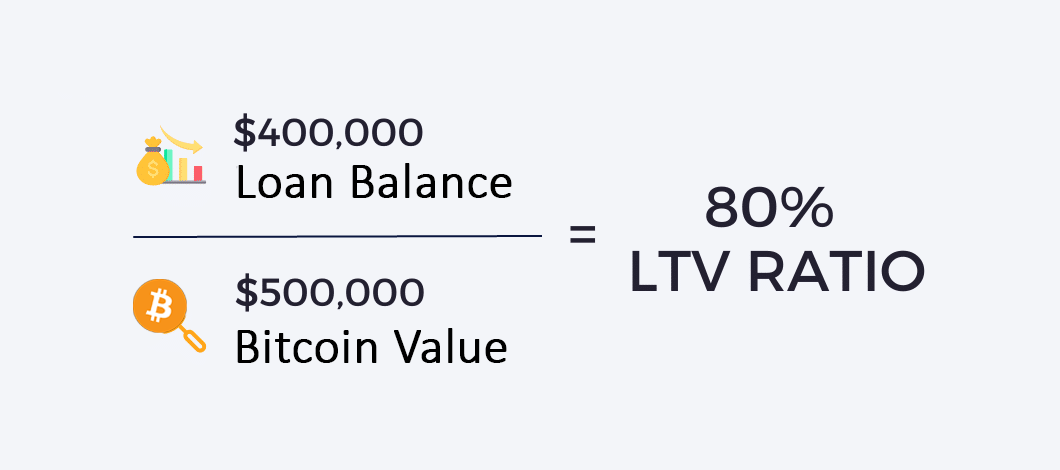
Typical LTV ranges in bitcoin lending include:
- Conservative (30–35% LTV): Maximum safety margin with low liquidation risk
- Moderate (40–50% LTV): A balance between liquidity and protection
- Aggressive (60–70% LTV): Higher liquidation risk that requires active management
For example, if you deposit 1 bitcoin worth $60,000 at a 50% LTV, you receive a $30,000 loan.
In this case, bitcoin could drop 50% before liquidation concerns arise. However, most platforms issue margin calls well before that point.
Borrower Identity Verification
Bitcoin loans do not require credit checks. However, most regulated platforms still perform identity verification.
This process exists to meet anti-money laundering requirements and is known as Know Your Customer verification.
Borrowers usually need to provide government-issued identification and proof of address.
For first-time borrowers, verification typically takes 24–48 hours.
Once approved, future loans process much faster because the platform already has verified credentials on file.
Price Monitoring and Risk Assessment
Bitcoin’s price volatility makes continuous monitoring essential.
Underwriting systems track collateral value against outstanding loan balances in real time.
Risk assessment typically includes:
- Volatility analysis: Historical price movements help define LTV limits
- Liquidation thresholds: Predetermined price levels trigger margin calls
- Market liquidity: Evaluation of how quickly collateral can be sold
- Correlation risk: Analysis of broader market conditions
What Information Do Borrowers Need to Provide?
Bitcoin loan applications require far less documentation than traditional loans.
Most platforms complete underwriting using only a few core information categories.
Required information typically includes:
- Identity verification: Government ID and proof of address for KYC compliance
- Collateral details: Amount of bitcoin pledged and wallet addresses
- Loan preferences: Desired loan amount, repayment term, and interest structure
- Contact information: Email address and phone number for account security
Bitcoin loan applications do not require income statements, tax returns, bank statements, employment verification, or credit reports.
The collateral itself serves as the primary underwriting factor. This removes the need for extensive financial documentation.
Some platforms may request additional information for very large loans. Even then, requirements remain far less burdensome than traditional lending standards.
How Do Lenders Calculate Liquidation Thresholds?
Liquidation thresholds define the bitcoin price level that triggers automatic repayment through collateral sale.
Accurate threshold calculations help protect both lenders and borrowers during extreme market movements.
The basic liquidation price formula works as follows:
Liquidation Price = (Loan Amount ÷ Bitcoin Amount) ÷ Liquidation LTV
For example, borrowing $30,000 against 1 bitcoin with a 75% liquidation threshold results in liquidation if bitcoin falls to $40,000 or below.
Lenders usually set liquidation thresholds 20–30 percentage points above the initial LTV.
A loan with a 50% LTV may face liquidation at 70–80% LTV. This provides time for recovery before forced selling occurs.
Margin Call: A notification requiring borrowers to add collateral or repay part of the loan when the LTV approaches the liquidation threshold. Margin calls help borrowers avoid liquidation.
Most platforms issue margin calls when positions reach 60–65% LTV.
Borrowers typically have 24–72 hours to respond before automatic liquidation occurs. This warning system helps manage short-term price volatility.
What Automated Systems Monitor Bitcoin Loan Risk?
Bitcoin trades 24/7, which makes automated monitoring essential.
Manual oversight cannot react fast enough to sudden price movements common in crypto markets.
Modern bitcoin lending platforms rely on several automated systems.
Real-Time Price Feeds
Underwriting systems connect to multiple cryptocurrency exchanges at once.
They aggregate price data to calculate accurate market values.
Prices update every few seconds to reflect current market conditions.
Using multiple data sources helps prevent manipulation or technical failures.
Most platforms require agreement across three or more exchanges before triggering liquidation.
Automated Liquidation Engines
When collateral values cross liquidation thresholds, automated systems execute sell orders immediately.
Speed is critical. Delays could leave lenders undercollateralized during sharp price drops.
Most liquidation engines sell collateral in stages rather than all at once.
This staged approach reduces market impact and often results in better execution prices.
Risk Scoring Algorithms
Some platforms use advanced risk scoring models.
These systems analyze volatility, trading volume, funding rates, and correlation patterns.
The goal is to predict potential liquidation cascades before they occur.
When risk scores rise too high, platforms may lower maximum LTVs or send proactive warnings to borrowers.
How Do Different Custody Models Affect Underwriting?
Custody arrangements play a major role in underwriting and risk management.
Each custody model offers different trade-offs between control, security, and efficiency.
Comparison: Custody Models in Bitcoin Lending
Centralized Custodial Model
- Pros: Fast liquidation, simple user experience, lower technical complexity
- Cons: Counterparty risk, potential rehypothecation, single point of failure
- Best For: Borrowers who prioritize convenience
Third-Party Qualified Custodian
- Pros: Institutional-grade security, regulatory compliance, insurance coverage
- Cons: Higher fees, slower processes, additional documentation
- Best For: Large loans requiring institutional protections
Smart Contract Custody (DeFi)
- Pros: Transparent rules, no counterparty risk, permissionless access
- Cons: Smart contract vulnerabilities, limited recourse, technical complexity
- Best For: Users comfortable with blockchain technology
Full custody models simplify underwriting because lenders maintain direct control over collateral.
Smart contract models require more advanced underwriting. These must account for risks like oracle failures or governance attacks.
What Regulatory Considerations Impact Underwriting?
Bitcoin lending platforms operate under evolving regulatory frameworks.
These rules vary widely by jurisdiction and directly affect underwriting procedures.
In the United States, platforms often operate under state money transmitter licenses.
They must comply with Bank Secrecy Act requirements, including customer identification, transaction monitoring, and suspicious activity reporting through the Financial Crimes Enforcement Network.
Key regulatory requirements affecting underwriting include:
- KYC verification: Identity confirmation before approval
- Geographic restrictions: Some states restrict crypto lending
- Lending limits: Maximum loan sizes based on licensing tiers
- Interest rate caps: State usury laws may limit pricing
- Accredited investor rules: Larger loans may require wealth verification
Current Securities and Exchange Commission guidance suggests that most bitcoin-backed loans avoid securities classification.
This is because they involve collateral transfers rather than investment contracts.
However, some yield-bearing or structured products may receive additional regulatory scrutiny.
International borrowers face extra complexity. Platforms must ensure compliance with both local laws and the lender’s jurisdiction.
As a result, some platforms limit service to specific countries.
Frequently Asked Questions
Basics and Definitions
Do bitcoin loans require credit checks?
No. Bitcoin-backed loans do not require credit checks because the collateral secures the loan. Lenders focus on LTV ratios instead of credit scores.
What is a good loan-to-value ratio for bitcoin loans?
Most borrowers choose 40–50% LTV for balanced risk and liquidity. Conservative borrowers may prefer 30–35% LTV for added protection.
How long does bitcoin loan underwriting take?
Initial underwriting usually takes 24–48 hours for identity verification. After approval, future loans can process in minutes.
How-To and Practical
What happens if bitcoin’s price drops after I take a loan?
Your LTV increases as collateral value falls. If it nears the liquidation threshold, you will receive a margin call.
Can I withdraw my collateral before repaying the loan?
No. Collateral remains locked until full repayment. Some platforms allow partial withdrawals if LTV improves significantly.
How do I avoid liquidation on my bitcoin loan?
Use conservative LTV ratios, respond quickly to margin calls, and add collateral during volatile periods. Price alerts can help with monitoring.
Comparisons and Troubleshooting
Are decentralized lending protocols safer than centralized platforms?
Each model has different risks. DeFi removes counterparty risk but introduces smart contract risk. Centralized platforms are simpler but require trust.
What documentation is required for large bitcoin loans?
Larger loans may require enhanced due diligence, source-of-funds documentation, and accredited investor verification.
Can I use bitcoin in cold storage as collateral?
Most platforms require moving bitcoin into custody or a smart contract. Some institutional lenders offer multi-signature solutions.
Conclusion
Bitcoin loan underwriting represents a major shift from traditional lending.
It prioritizes collateral verification and real-time monitoring over credit history and income documentation.
Blockchain transparency and automated systems allow fast, accessible loans for borrowers worldwide.
Successful borrowers understand the importance of LTV ratios, liquidation thresholds, and active position management.
While credit checks are eliminated, borrowers take on new responsibilities around monitoring collateral and responding to margin calls.
Key considerations when evaluating bitcoin loans:
- Start with LTV ratios below 50% until familiar with the process
- Choose custody models that match your risk tolerance
- Understand liquidation and margin call procedures
- Monitor positions closely during volatile markets
For borrowers seeking liquidity without selling bitcoin, explore Rhino Bitcoin's bitcoin-backed loan options. These loans offer competitive rates, simple underwriting, and no credit checks.
References
- Financial Crimes Enforcement Network. Application of FinCEN's Regulations to Certain Business Models Involving Convertible Virtual Currencies. U.S. Department of the Treasury. https://www.fincen.gov/resources/statutes-regulations/guidance/application-fincens-regulations-certain-business-models
- Securities and Exchange Commission. Framework for "Investment Contract" Analysis of Digital Assets. SEC.gov. https://www.sec.gov/corpfin/framework-investment-contract-analysis-digital-assets
- Bitcoin.org. How Bitcoin Works. Bitcoin Project. https://bitcoin.org/en/how-it-works
- Internal Revenue Service. Notice 2014-21: IRS Virtual Currency Guidance. IRS.gov. https://www.irs.gov/pub/irs-drop/n-14-21.pdf
- Mempool.space. Bitcoin Network Statistics and Fee Estimates. https://mempool.space
Important Disclaimers
Disclaimer: Educational information only. Not financial, legal, medical, or tax advice.
Risk Warnings: All investments carry risk, including loss of principal. Past performance does not guarantee future results. Bitcoin is volatile and may not suit all investors.
Conflicts of Interest: Rhino Bitcoin provides bitcoin financial services. This content is educational and may reference company products.
.png)
.png)