
Bitcoin Liquidity Pool Lending: Earn Yield Through Decentralized Bitcoin Banking
Bitcoin liquidity pool lending lets users earn yield by depositing bitcoin into shared pools that lend to borrowers through automated, decentralized protocols.
Buy Bitcoin with Zero Fees with Rhino
The most secure way to stack sats. Simple, fast, and zero trading fees.
Bitcoin Liquidity Pool Lending: Earn Yield Through Decentralized Bitcoin Banking
Bitcoin liquidity pool lending is a decentralized way to earn yield on bitcoin. Users deposit bitcoin into shared liquidity pools. These pools generate returns by lending funds to borrowers.
Unlike traditional Bitcoin-backed loans, you do not borrow against your bitcoin. Instead, you provide bitcoin to a lending pool. In return, you earn interest while keeping exposure to Bitcoin’s price movements.
Key Summary: Bitcoin liquidity pool lending allows users to deposit bitcoin into shared pools that lend to borrowers. Lenders earn passive yield through interest payments while maintaining exposure to Bitcoin's price movements.
Key Takeaways
- Liquidity pools enable decentralized lending without traditional intermediaries
- Lenders earn yield by providing bitcoin to borrowing pools
- Smart contracts automate loan terms and collateral management
- Pool participants share both returns and risks collectively
This article explores bitcoin liquidity pool lending within the broader category of Bitcoin-backed lending.
For a full overview of lending mechanics, loan-to-value ratios, and collateral management, see our complete guide to Bitcoin-backed loans and crypto lending.
What Are Bitcoin Liquidity Pools?
Bitcoin liquidity pools are collections of cryptocurrency locked inside smart contracts. These contracts allow users to lend and borrow without relying on banks or other intermediaries.
The pools act as automated systems. They match lenders looking to earn yield with borrowers who need capital.
Traditional intermediaries are not required. Instead, lending protocols use algorithms to set interest rates. These rates change based on supply and demand within each pool.
Liquidity Pool: A smart contract-based collection of cryptocurrency funds that enables decentralized trading, lending, or other financial activities without traditional intermediaries.
Learn more about Bitcoin liquidity
When users deposit bitcoin, they receive pool tokens. These tokens represent their share of the pool. They track both the original deposit and any earned interest.
To exit the pool, lenders redeem their pool tokens. In return, they receive bitcoin plus accumulated yield.
How Liquidity Pools Work
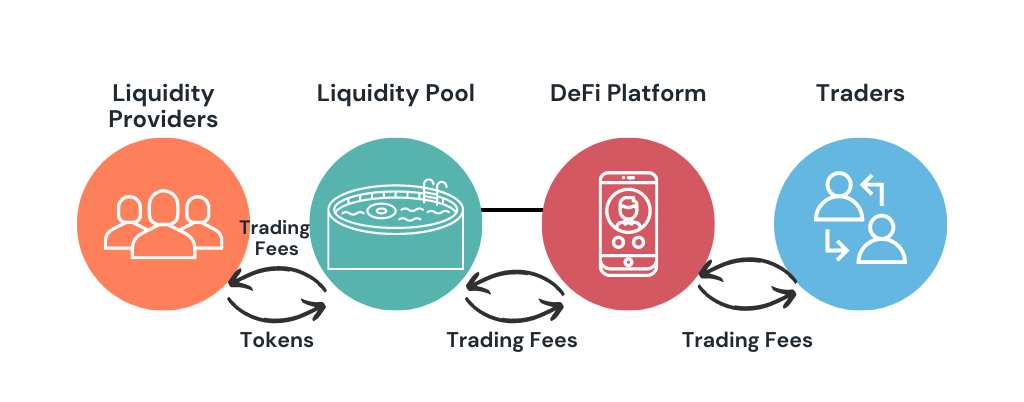
Core Components of a Bitcoin Liquidity Pool
- Deposited bitcoin from multiple lenders
- Smart contracts that define loan terms and interest calculations
- Borrower collateral that secures outstanding loans
- Automated liquidation systems that protect the pool
- Pool tokens that represent proportional ownership
How Bitcoin Liquidity Pool Lending Works
Bitcoin liquidity pool lending uses automated protocols to connect lenders and borrowers. The entire process runs through smart contracts.
Lenders deposit bitcoin into a pool. In return, they receive pool tokens that represent their contribution and earned interest.
Borrowers take loans by locking up collateral. The collateral must be worth more than the loan amount. This overcollateralization reduces default risk for lenders.
Interest rates adjust automatically. They are based on the pool’s utilization ratio, which measures how much of the pool is currently borrowed.
When borrowers repay loans, the principal returns to the pool. Interest is distributed proportionally to all pool token holders.
If a borrower fails to repay, or if collateral value drops too low, liquidation is triggered. The protocol sells collateral to repay the pool.
Common Bitcoin Lending Pool Models
- DeFi platforms using wrapped bitcoin on Ethereum
- Bitcoin-native protocols built on RSK or Stacks
- Lightning Network-based peer-to-peer lending channels
- Centralized platforms offering pooled bitcoin lending
Interest Rates and Yield Generation
Interest rates in bitcoin liquidity pools are not fixed. They change based on supply and demand.
When utilization is low and liquidity is abundant, rates stay near a base level. As borrowing demand increases, rates rise to attract more deposits and limit excessive borrowing.
Most protocols use algorithmic interest rate models. These models rely on utilization curves.
Utilization Ratio: The percentage of pool funds currently borrowed.
It is calculated by dividing total borrowed funds by total pool size.
Higher utilization usually results in higher interest rates.
Sources of Yield in Liquidity Pools
- Interest payments from borrowers
- Protocol token incentives offered by some platforms
- Trading fees from pools that support swaps
- Liquidation penalties distributed to pool participants
As of early 2025, bitcoin lending pool rates typically range from 2% to 8% annually.
Rates vary by platform, utilization levels, and overall market conditions.
During periods of high demand or volatility, rates can increase significantly.
Collateral Requirements and Loan-to-Value Ratios
Bitcoin liquidity pool lending relies on overcollateralization. This protects lenders from defaults and price volatility.
Borrowers must deposit collateral worth more than the loan they receive. Typical loan-to-value (LTV) ratios range from 50% to 75%.
For example, a borrower seeking $10,000 at a 66% LTV must deposit $15,000 in collateral.
This buffer protects the pool if prices fall before liquidation occurs.
Collateral requirements vary by protocol. Some pools accept only bitcoin. Others allow altcoins, stablecoins, or tokenized assets.
Multi-collateral pools assign different LTV ratios based on asset volatility and liquidity.
Understanding loan-to-value ratios and liquidation mechanisms is essential for both lenders and borrowers.
Key Elements of Collateral Management
- Initial LTV set at loan origination
- Continuous monitoring of collateral value
- Margin call warnings before liquidation
- Automated liquidation below maintenance thresholds
Liquidation Mechanisms and Risk Management
Liquidation protects liquidity pools when collateral values decline. It ensures loans remain overcollateralized, even during market downturns.
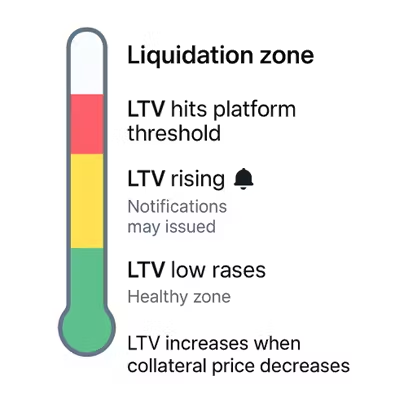
Most protocols trigger liquidation when LTV exceeds a defined threshold. This is usually between 80% and 90%.
When triggered, smart contracts automatically sell enough collateral to repay the loan. Liquidation penalties are included.
Liquidation methods vary by protocol. Some use internal auctions. Others rely on external liquidators or automated market makers.
Liquidation: The automatic sale of borrower collateral when its value drops below required levels.
This process protects lenders and pool solvency.
LTV Increase Could Trigger Liquidation
Liquidation penalties usually range from 5% to 15%.
These penalties compensate the pool and reduce slippage risk during volatile markets.
Risk Management Techniques Used by Protocols
- Conservative LTV ratios
- Tiered liquidation systems
- Reliable real-time price oracles
- Insurance or emergency reserve funds
Pool Lending vs. Direct Bitcoin-Backed Loans
Liquidity pool lending and direct Bitcoin-backed loans serve different purposes.
Pool lending allows users to earn yield.
Bitcoin-backed loans allow users to borrow without selling their bitcoin.
Bitcoin Liquidity Pool Lending (Lender Perspective)
Pros
- Passive income
- Automated management
- Diversified borrower exposure
Cons
- Smart contract risk
- Protocol vulnerabilities
- Potential impermanent loss
Best For: Investors seeking yield who understand DeFi risks.
Direct Bitcoin-Backed Loans (Borrower Perspective)
Pros
- Liquidity without selling bitcoin
- No credit checks
- Continued price exposure
Cons
- Liquidation risk
- Interest costs
- Ongoing collateral monitoring
Best For: Bitcoin holders needing short-term liquidity.
Some platforms, such as Rhino Bitcoin, offer both lending and borrowing services.
Their Bitcoin-only focus avoids altcoin volatility found in multi-asset pools.
Security Considerations and Platform Risk
Security is the primary concern for liquidity pool participants.
Smart contract bugs, oracle failures, and exploits can result in total loss.
Unlike traditional banking, most DeFi platforms do not offer deposit insurance.
Smart contract risk comes from coding flaws. Even audited protocols have suffered major attacks. DeFi hacks have resulted in billions of dollars in losses.
Oracle risk occurs when price feeds fail or are manipulated. Incorrect prices can cause improper liquidations or missed liquidations.
Key Security Factors to Evaluate
- Audit history and auditor reputation
- Time in operation and total value locked
- Governance and multi-signature controls
- Insurance or emergency funds
- Custody and private key practices
Platforms range from fully decentralized protocols to centralized services.
Each model involves trade-offs between control, convenience, and regulation.
Tax Implications of Pool Lending Returns
Bitcoin liquidity pool income is taxable in most jurisdictions.
In the United States, the IRS treats crypto lending income as ordinary income.
Interest and yield are taxable when received.
Lenders must report the fair market value of earned bitcoin or pool tokens.
Additional tax events may occur when pool tokens are redeemed.
Capital gains or losses apply if token value changes.
For example, redeeming $10,000 worth of tokens for $11,000 creates a $1,000 capital gain.
Common Tax Reporting Requirements
- Ordinary income reporting for earned interest
- Capital gains tracking for token value changes
- Detailed transaction records
- Form 1099 reporting when provided
Due to complexity, professional tax advice is strongly recommended.
Cryptocurrency tax enforcement has increased significantly.
Frequently Asked Questions
What is the difference between liquidity pool lending and staking?
Liquidity pool lending earns interest from borrowers.
Staking earns network rewards by validating transactions.
Bitcoin itself does not support traditional staking.
Can I lose money in a bitcoin liquidity pool?
Yes. Risks include smart contract exploits, liquidation failures, impermanent loss, and Bitcoin price declines.
How do I withdraw funds from a liquidity pool?
You redeem your pool tokens through the protocol.
You receive your share of the pool plus earned interest.
High utilization may delay withdrawals.
What happens if a borrower defaults?
Liquidation should prevent defaults.
If liquidation fails, insurance funds may cover losses, though failures are possible.
Are liquidity pool returns guaranteed?
No. Returns vary based on utilization and market conditions.
Past APY does not guarantee future results.
Do lenders need to provide collateral?
No. Only borrowers provide collateral.
Lenders risk their deposits but face no margin calls.
Can the Lightning Network be used for pool lending?
Lightning nodes earn routing fees, which is similar in concept.
Most DeFi pools operate on smart contract platforms instead.
How are interest rates set?
Rates are determined algorithmically using utilization ratios.
Higher utilization leads to higher rates.
Conclusion
Bitcoin liquidity pool lending allows holders to earn yield through decentralized protocols.
Lenders deposit bitcoin and earn interest while maintaining price exposure.
However, the risks are significant.
Smart contract failures, liquidation issues, and regulatory uncertainty must be understood.
Key Considerations for Lenders
- Review protocol audits and history
- Understand tax obligations
- Monitor utilization and yield trends
- Only deposit funds you can afford to lose
For users seeking liquidity instead of yield, explore Rhino Bitcoin's Bitcoin-backed loan options. These loans allow borrowing against bitcoin without selling or credit checks.
References
- Internal Revenue Service. Virtual Currencies.
https://www.irs.gov/businesses/small-businesses-self-employed/virtual-currencies - Bitcoin.org. Vocabulary – Liquidity.
https://bitcoin.org/en/vocabulary#liquidity - Lightning Network. Lightning Network Documentation.
https://lightning.network - Financial Crimes Enforcement Network. Application of FinCEN's Regulations to Certain Business Models Involving Convertible Virtual Currencies.
https://www.fincen.gov/resources/statutes-regulations/guidance/application-fincens-regulations-certain-business-models - Securities and Exchange Commission. Framework for Investment Contract Analysis of Digital Assets.
https://www.sec.gov/corpfin/framework-investment-contract-analysis-digital-assets
Important Disclaimers
Disclaimer: Educational information only. Not financial, legal, medical, or tax advice.
Risk Warnings: All investments carry risk, including loss of principal. Past performance is not indicative of future results. Bitcoin is volatile and may not be suitable for all investors.
Conflicts of Interest: Rhino Bitcoin provides Bitcoin financial services. This content is educational and may reference products.
.png)
.png)