
Bitcoin IRA Contribution Limits 2025: Complete Guide
Learn how Bitcoin IRA contribution limits work, including rules for Traditional, Roth, and rollover accounts to maximize retirement savings.

Buy Bitcoin with Zero Fees with Rhino
The most secure way to stack sats. Simple, fast, and zero trading fees.
Bitcoin IRA contribution limits for 2025 remain consistent with traditional IRA rules set by the Internal Revenue Service (IRS).
Investors can contribute up to $7,000 annually to a Bitcoin IRA ($8,000 if age 50 or older), with these limits applying across all IRA accounts combined, whether they hold bitcoin or traditional assets.
Key Summary:
For 2025, Bitcoin IRA contribution limits are $7,000 for those under 50 and $8,000 for those 50 and older, matching standard IRA limits since bitcoin is treated as property for tax purposes.
Key Takeaways
- 2025 contribution limits: $7,000 under age 50, $8,000 age 50 and older
- Limits apply across all IRA accounts combined, not per account
- Roth and Traditional Bitcoin IRAs follow the same contribution rules
- Income limits apply for Roth IRA contributions and Traditional IRA deductions
Understanding Bitcoin IRA Contribution Limits for 2025
The IRS sets annual contribution limits for all Individual Retirement Accounts, and these limits apply equally to Bitcoin IRAs.
Since the IRS treats bitcoin as property rather than currency, Bitcoin IRAs follow identical contribution rules to traditional retirement accounts holding stocks, bonds, or mutual funds.
For the 2025 tax year, standard contribution limits increased from 2024 levels.
Individuals under age 50 can contribute up to $7,000, while those 50 and older benefit from a $1,000 catch-up contribution, bringing their total to $8,000.
These limits represent the combined total across all IRA accounts you own, including Traditional IRAs, Roth IRAs, and self-directed accounts holding bitcoin.
This aggregate limit means strategic planning is essential.
If you contribute $4,000 to a Traditional IRA holding stocks and $3,000 to a Bitcoin IRA, you've reached the $7,000 limit for someone under 50.
Understanding how these limits work helps investors allocate their retirement savings effectively between traditional assets and bitcoin.
Self-Directed IRA:
A retirement account structure allowing investment in alternative assets beyond stocks and bonds, including bitcoin, real estate, and precious metals. IRS guidelines govern what assets qualify.
How a Self-Directed IRA Differs from a Regular IRA

How Do Contribution Limits Differ by Account Type?
Bitcoin IRAs come in two primary types: Traditional and Roth. While contribution limits are identical for both, the tax treatment differs significantly.
Traditional Bitcoin IRA
- Tax treatment: Contributions may be tax-deductible depending on income and employer plan coverage
- Growth: Bitcoin appreciation grows tax-deferred until withdrawal
- Withdrawals: Taxed as ordinary income in retirement
- Best for: Investors expecting lower tax rates in retirement
Roth Bitcoin IRA
- Tax treatment: Contributions made with after-tax dollars
- Growth: Bitcoin appreciation grows completely tax-free
- Withdrawals: Tax-free in retirement after age 59½ and five-year holding period
- Best for: Younger investors or those expecting higher tax rates in retirement
The choice between Traditional and Roth depends on your current tax situation and retirement timeline.
Both account types share the same $7,000 or $8,000 contribution limit for 2025.
What Income Limits Apply to Bitcoin IRA Contributions?
While contribution amounts stay consistent regardless of income for Traditional IRAs, Roth Bitcoin IRAs have income eligibility requirements.
For 2025, Roth IRA income limits (based on December 2024 IRS guidance):
Single Filers
- Full contribution: MAGI under $150,000
- Partial contribution: MAGI between $150,000 and $165,000
- No contribution: MAGI above $165,000
Married Filing Jointly
- Full contribution: MAGI under $236,000
- Partial contribution: MAGI between $236,000 and $246,000
- No contribution: MAGI above $246,000
Traditional IRA contributions have no income limits, but deductibility depends on access to an employer retirement plan.
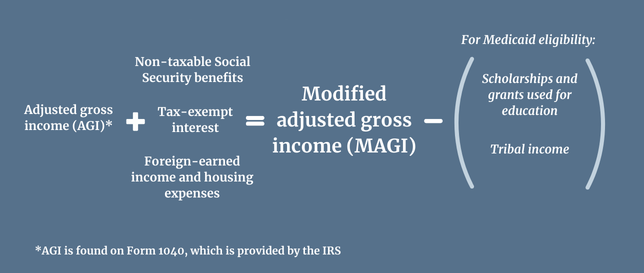
Modified Adjusted Gross Income (MAGI):
Your adjusted gross income plus certain deductions added back, used to determine IRA eligibility and contribution limits. The IRS provides worksheets to calculate MAGI.
How ACA-Specific Modified Adjusted Gross Income (MAGI) is Calculated
Can You Exceed Contribution Limits Through Rollovers?
Rollovers and transfers allow funding a Bitcoin IRA without counting toward annual contribution limits.
A 401(k) to Bitcoin IRA rollover lets investors move funds from an employer-sponsored plan into a self-directed Bitcoin IRA with no dollar cap.
An investor could roll over $100,000 and still contribute the full $7,000 or $8,000 for the year.
Direct trustee-to-trustee transfers are recommended to avoid tax issues. Most custodians offering Bitcoin IRA accounts facilitate these transfers.
Roth conversions also bypass contribution limits but create taxable income in the year of conversion.
What Happens If You Contribute Too Much?
Excess contributions trigger a 6% annual IRS penalty until corrected.
Correction options:
- Withdraw the excess plus earnings before the tax filing deadline
- Apply the excess toward the following year’s contribution limit
Because Bitcoin prices fluctuate, excess correction calculations must include any appreciation or loss during the holding period.
Strategic Contribution Planning for Bitcoin IRAs
Maximizing Bitcoin IRA contributions requires coordination across timing, tax strategy, and asset allocation.
Timing Considerations
- Contributions allowed until the tax filing deadline
- Dollar-cost averaging reduces volatility impact
- Early-year contributions maximize growth potential
Account Selection Strategy
- Roth accounts favor long-term appreciation
- Traditional accounts help reduce current tax burden
- High earners can use backdoor Roth strategies
Some investors split contributions between Traditional and Roth IRAs to hedge future tax uncertainty.
Platforms like Rhino Bitcoin allow investors to integrate Bitcoin IRAs with everyday bitcoin usage, including Lightning Network payments.
How Do Catch-Up Contributions Work?
Investors age 50 and older can contribute an additional $1,000 annually. Eligibility applies for the entire year you turn 50, regardless of birthdate.
From age 50 to 65, max contributions could total $120,000 into a Bitcoin IRA, offering significant tax-advantaged exposure to bitcoin.
What About Spousal IRA Contributions?
Spousal IRAs allow a working spouse to fund an IRA for a non-working spouse.
A married couple could contribute $14,000 total in 2025 ($7,000 each), assuming sufficient earned income.
Each spouse controls their own Bitcoin IRA independently.
This strategy enables diversified bitcoin exposure across multiple retirement accounts.
Frequently Asked Questions
Do Bitcoin IRA contribution limits differ from regular IRA limits?
No. Bitcoin IRA limits match standard IRA limits exactly.
Can I contribute to both a Bitcoin IRA and a regular IRA?
Yes, but the combined total across all IRAs cannot exceed $7,000 or $8,000.
What if I contribute bitcoin instead of cash?
You cannot contribute bitcoin directly. Contributions must be made in cash.
Do 401(k) contributions affect my Bitcoin IRA limit?
No. 401(k) limits are separate from IRA limits.
Can I exceed limits using a backdoor Roth?
No. Backdoor Roth strategies bypass income limits, not contribution limits.
Does bitcoin price affect contribution limits?
No. Limits are based on dollar value at contribution time.
Are there minimum contribution requirements?
The IRS has no minimums, but custodians may impose their own.
Can self-employed individuals contribute?
Yes. They may also consider SEP IRAs or Solo 401(k)s.
Do state tax deductions apply?
State treatment varies. Consult a tax professional.
How do I prove compliance?
Custodians report contributions on IRS Form 5498.
Conclusion
Bitcoin IRA contribution limits for 2025 follow standard IRA rules: $7,000 for those under 50 and $8,000 for those 50 and older. These limits apply across all IRAs combined.
Key Planning Considerations
- Coordinate contributions across accounts
- Consider Roth accounts for tax-free growth
- Use rollovers for larger bitcoin allocations
- Leverage spousal contributions when applicable
For investors ready to integrate bitcoin into a tax-advantaged retirement strategy, explore Rhino Bitcoin’s comprehensive platform offering Bitcoin IRAs alongside everyday bitcoin banking features like Lightning Network payments and bill pay.
References
- IRS: Retirement Topics – IRA Contribution Limits
https://www.irs.gov/retirement-plans/plan-participant-employee/retirement-topics-ira-contribution-limits - IRS: IRA FAQs – Distributions
https://www.irs.gov/retirement-plans/retirement-plans-faqs-regarding-iras-distributions-withdrawals - IRS: Roth IRA Contribution Limits
https://www.irs.gov/retirement-plans/plan-participant-employee/amount-of-roth-ira-contributions-that-you-can-make-for-2024 - IRS Notice 2014-21: Virtual Currency Guidance
https://www.irs.gov/pub/irs-drop/n-14-21.pdf - IRS Publication 590-A
https://www.irs.gov/publications/p590a
Important Disclaimers
Disclaimer: Educational information only. Not financial, legal, medical, or tax advice.
Risk Warning: All investments carry risk, including loss of principal. Bitcoin is volatile and may not be suitable for all investors.
Conflicts of Interest: Rhino Bitcoin provides Bitcoin financial services. This content may reference company products.
.png)
.png)