
Bitcoin IRA Charitable Donations: Tax-Free Retirement Giving Guide
Learn how donating bitcoin from an IRA can satisfy RMDs, avoid capital gains, and support charities in a tax-efficient way.
Buy Bitcoin with Zero Fees with Rhino
The most secure way to stack sats. Simple, fast, and zero trading fees.
Bitcoin IRA charitable donations allow retirement account holders to donate appreciated bitcoin directly to qualified charities. This approach can help avoid capital gains taxes while still supporting causes you care about. In some cases, donors may also receive income tax advantages.
This strategy combines tax-advantaged retirement planning with charitable giving. It is especially useful for bitcoin holders who want to maximize tax efficiency while making a positive impact.
Key Summary: Donating bitcoin from an IRA to charity can eliminate capital gains taxes on appreciation while providing meaningful tax advantages. This makes it a tax-efficient way to support charitable causes.
Key Takeaways
- Traditional IRA charitable donations can avoid ordinary income tax on distributions
- Roth IRA charitable donations provide no tax benefit but preserve tax-free growth for heirs
- Qualified Charitable Distributions (QCDs) can satisfy Required Minimum Distributions for those age 70½ and older
- Direct donations of appreciated bitcoin can avoid capital gains taxes entirely
This article explores charitable giving strategies within the broader context of Bitcoin IRA investing and retirement planning. Understanding how to combine philanthropy with your Bitcoin retirement strategy can help maximize both tax benefits and social impact.
How Do Bitcoin IRA Charitable Donations Work?
Bitcoin IRA charitable donations generally work in two main ways. These include Qualified Charitable Distributions (QCDs) from traditional IRAs and direct charitable bequests.
QCDs allow individuals who are 70½ or older to transfer up to $100,000 per year directly from their IRA to a qualified charity. These transfers count toward Required Minimum Distributions (RMDs) and do not create taxable income.
The IRS excludes QCDs from gross income. As a result, the charity receives the full donation amount, and the donor avoids paying ordinary income tax. This is very different from taking a taxable distribution first and donating afterward, which would trigger income taxes before any charitable benefit.
Key Requirements for QCDs
- The donor must be at least 70½ years old at the time of distribution
- The transfer must go directly from the IRA custodian to a qualified 501(c)(3) organization
- The annual limit is $100,000 per taxpayer (married couples may each donate $100,000)
- The donation must otherwise qualify as a charitable contribution, excluding donor-advised funds and private foundations
- No charitable deduction can be claimed for the QCD amount
Qualified Charitable Distribution (QCD): A direct transfer from a traditional IRA to a qualified charity that is excluded from taxable income and applied toward Required Minimum Distributions.
Understanding Qualified Charitable Distributions (QCDs)
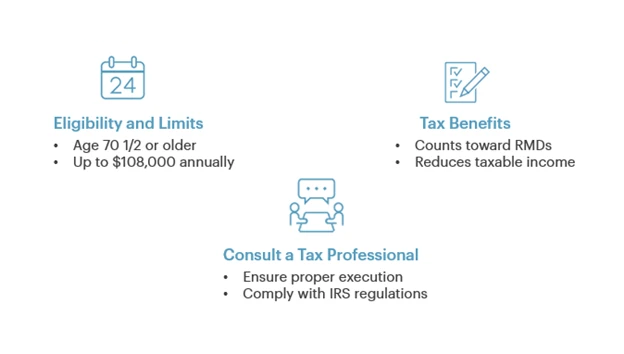
What Are the Tax Benefits of Donating Bitcoin From an IRA?
The tax benefits depend entirely on the type of IRA holding the bitcoin.
Traditional IRA charitable donations offer the greatest advantage. They allow account holders to satisfy RMD requirements without recognizing taxable income. This effectively converts what would normally be an ordinary income tax event into a tax-free charitable contribution.
This strategy becomes especially valuable when bitcoin has appreciated significantly inside a traditional IRA. Donors avoid paying ordinary income tax rates, which can reach 37% federally as of 2024. At the same time, the charity receives the full fair market value of the bitcoin.
Tax Treatment Comparison
Traditional IRA QCD
- Tax benefit: Distribution is excluded from gross income
- RMD satisfaction: Counts toward the annual RMD requirement
- Charitable deduction: None (not needed because income is not recognized)
- Best for: Individuals age 70½ or older with RMD obligations
Roth IRA Charitable Gift
- Tax benefit: None, since Roth distributions are already tax-free
- RMD satisfaction: Not applicable, as Roth IRAs have no lifetime RMDs
- Charitable deduction: None available
- Best for: Donors focused on philanthropy rather than tax savings
Taxable Account Bitcoin Donation
- Tax benefit: Fair market value charitable deduction plus capital gains tax avoidance
- RMD satisfaction: Not applicable
- Charitable deduction: Up to 30% of adjusted gross income for appreciated property
- Best for: Individuals under 70½ with highly appreciated bitcoin in taxable accounts
According to IRS Publication 590-B, QCDs may be made from traditional IRAs, inherited IRAs, inactive SEP-IRAs, and inactive SIMPLE IRAs. Donations cannot be made from active SEP or SIMPLE IRAs. QCDs also cannot be made directly from 401(k), 403(b), or 457 plans unless the assets are first rolled into a traditional IRA.
Which Charities Accept Bitcoin IRA Donations?
Most qualified 501(c)(3) organizations can receive bitcoin donations from IRAs. However, not all charities are prepared to handle cryptocurrency.
Larger organizations often have systems in place to receive and convert bitcoin. Smaller charities may lack the technical capability or prefer traditional assets.
Many well-known organizations accept bitcoin donations. These include major universities such as MIT, Stanford, and Harvard. Healthcare organizations like the American Cancer Society and St. Jude Children’s Research Hospital also accept cryptocurrency. Environmental groups such as The Nature Conservancy and Rainforest Foundation US do as well. Technology-focused nonprofits, including the Electronic Frontier Foundation and Internet Archive, have accepted bitcoin for years.
Considerations When Selecting a Charity
- Technical capability: Can the organization receive bitcoin directly?
- Conversion policy: Will the charity convert bitcoin immediately or hold it?
- Processing fees: What costs are deducted from the donation?
- Documentation: Will proper tax acknowledgment be provided?
- Mission alignment: Does the organization’s work align with your values?
Many charities partner with cryptocurrency donation processors such as The Giving Block or Engiven. These platforms handle the technical aspects of receiving and converting bitcoin while ensuring proper documentation for donors.
How Do You Execute a Bitcoin IRA Charitable Donation?
Making a bitcoin donation from an IRA requires coordination between your IRA custodian, the charity, and sometimes a cryptocurrency processor. This process is more complex than donating cash or publicly traded securities.
First, confirm that the charity can accept bitcoin. Obtain their receiving wallet address or details for their crypto donation processor. Next, contact your IRA custodian to begin the QCD process. You will specify either a dollar amount or a bitcoin quantity.
Your custodian will need complete charity information, including the organization’s name, Tax ID number, and receiving wallet address.
Step-by-Step Donation Process
- Step 1: Confirm you meet the age requirement (70½ or older)
- Step 2: Verify the charity’s 501(c)(3) status and bitcoin acceptance
- Step 3: Contact your IRA custodian to request a charitable distribution
- Step 4: Provide charity details, including wallet address and Tax ID
- Step 5: The custodian transfers bitcoin directly to the charity
- Step 6: Obtain written acknowledgment from the charity
- Step 7: Keep all documentation for tax reporting
Timing is important. The donation must be completed by December 31 to count for the current tax year. While bitcoin transactions usually confirm quickly, custodian processing times can vary. Starting at least two weeks before year-end helps prevent delays.
Some custodians may not support direct bitcoin QCDs. In these cases, you may need to convert bitcoin to cash inside the IRA before making the donation. This preserves QCD treatment but removes the benefit of donating appreciated cryptocurrency.
What Are the Valuation and Documentation Requirements?
Accurate valuation and proper documentation are critical for Bitcoin IRA charitable donations. The IRS requires written acknowledgment for donations over $250. Additional substantiation is required for property donations over $500.
Bitcoin is valued at its fair market value at the time of donation. This value is usually based on prices from major exchanges when the transaction is confirmed on the blockchain.
Your IRA custodian should provide records showing the amount of bitcoin transferred and its reported value. The charity must provide written acknowledgment that includes its name, the donation date, and a description of the property received.
Required Documentation
- IRA custodian statement showing distribution date, quantity, and value
- Charity acknowledgment letter received before filing your tax return
- Blockchain transaction record confirming the transfer
- Form 1099-R from the custodian, if issued
- Form 8606 if contributing to traditional and Roth IRAs in the same year
The IRS does not require formal appraisals for cryptocurrency donations under $5,000. However, clear valuation records strengthen your documentation. IRS Notice 2014-21 confirms that virtual currency is treated as property for tax purposes.
Fair Market Value (FMV): The price at which property would change hands between a willing buyer and seller, with both parties having reasonable knowledge of the facts. For bitcoin, FMV is typically based on exchange prices at the time of donation.
What Happens If Documentation Is Inadequate?
If documentation is incomplete, the IRS may disallow QCD treatment. This converts the donation into a taxable distribution subject to ordinary income tax.
This outcome removes the primary tax benefit of the QCD. It may also lead to penalties if taxes were underpaid. Proper documentation helps avoid this risk.
The charity’s acknowledgment letter must state whether you received any goods or services in exchange for the donation. Even small benefits can affect tax treatment. The acknowledgment must be received before you file your tax return or by the filing deadline.
What Are Common Mistakes to Avoid With Bitcoin IRA Charitable Donations?
Several common mistakes can eliminate the tax benefits of Bitcoin IRA charitable donations.
The most common error is receiving the IRA distribution personally and then donating it. This triggers taxable income. To qualify as a QCD, the transfer must go directly from the IRA custodian to the charity.
Another frequent mistake is donating to organizations that are not eligible for QCDs. Donor-advised funds, private foundations, and supporting organizations do not qualify, even if they are valid 501(c)(3) entities.
Mistakes That Disqualify QCD Treatment
- Taking the distribution personally before donating
- Donating to donor-advised funds or private foundations
- Making the donation before reaching age 70½
- Exceeding the $100,000 annual limit
- Claiming a charitable deduction for a QCD
- Donating from a Roth IRA expecting tax benefits
Timing errors can also cause problems. If you take your full RMD through taxable distributions first, a later QCD will not reduce your tax liability. QCDs must be planned before or alongside other RMD distributions.
Some donors believe they can claim both the income exclusion and a charitable deduction for the same QCD. The IRS does not allow this. You may exclude the income or take a deduction, but not both.
How Do Bitcoin IRA Charitable Donations Compare to Other Giving Strategies?
Bitcoin IRA charitable donations serve a specific role within broader charitable planning. Comparing this strategy to alternatives helps determine the best approach for your situation.
For individuals under 70½ with highly appreciated bitcoin in taxable accounts, donating directly from those accounts may provide greater tax benefits. This allows a charitable deduction while avoiding capital gains tax, which may include a 20% federal rate plus a 3.8% net investment income tax.
Comparison: Choose Your Strategy
Bitcoin IRA QCD (70½+)
- Best for: RMD obligations and high ordinary income tax rates
- Tax benefit: Avoids ordinary income tax, up to 37% federally
- Drawbacks: No charitable deduction and annual limits
Taxable Account Bitcoin Donation
- Best for: Highly appreciated bitcoin and itemized deductions
- Tax benefit: Capital gains avoidance plus charitable deduction
- Drawbacks: Requires itemizing and is subject to AGI limits
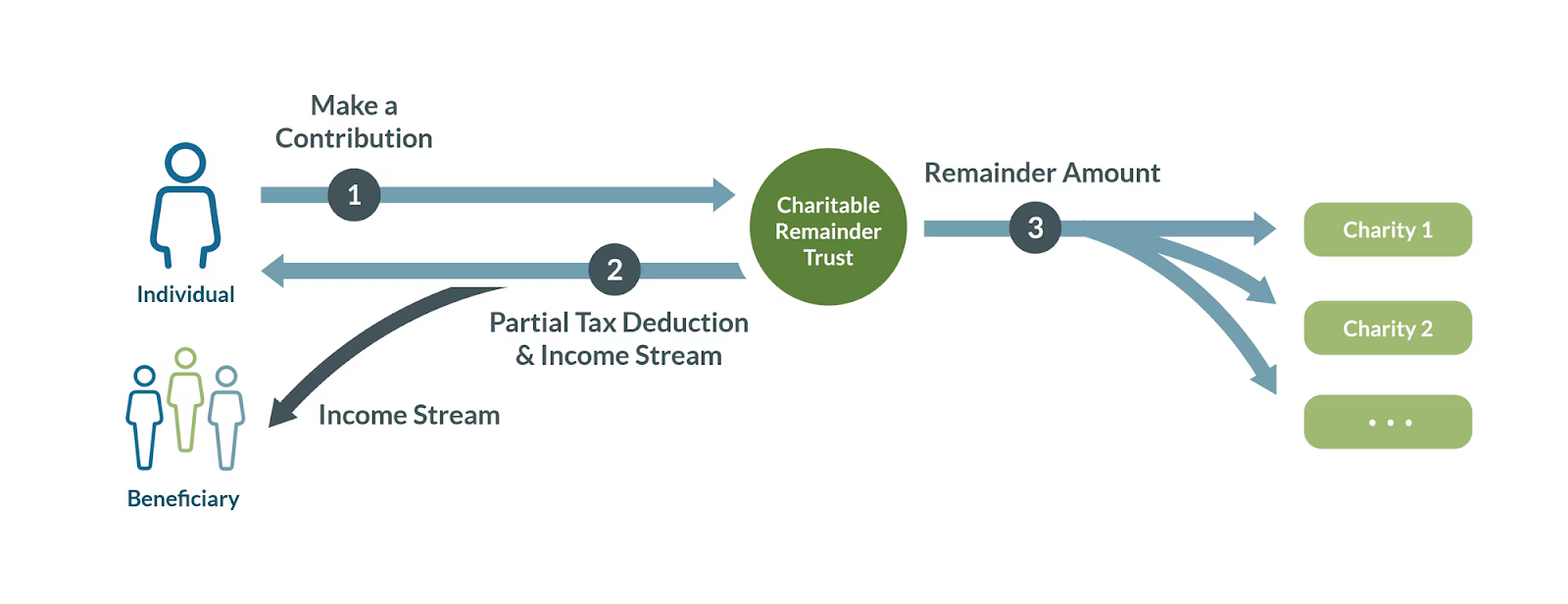
Charitable Remainder Trust (CRT)
- Best for: Large gifts and income planning
- Tax benefit: Partial deduction and capital gains avoidance
- Drawbacks: Complex setup and ongoing costs
A Graph Explaining Contributions to Charitable Remainder Trusts (CRTs)
Bitcoin Bequest in an Estate Plan
- Best for: Charitable giving at death
- Tax benefit: Estate tax deduction and income tax avoidance
- Drawbacks: No lifetime benefit
Platforms that provide integrated bitcoin services can simplify charitable giving alongside retirement and investment planning.
What Should You Consider Before Making a Bitcoin IRA Charitable Donation?
Before making a Bitcoin IRA charitable donation, consider whether this strategy aligns with your overall financial goals.
Think about your current and future tax brackets. If you expect lower tax rates later, delaying distributions may make sense. If you are currently in a high-income year, QCDs can help reduce taxable income.
Key Decision Factors
- Age and RMD status: Are distributions required now?
- Tax bracket: Will the QCD meaningfully reduce your taxes?
- Bitcoin appreciation: Has your IRA bitcoin increased significantly in value?
- Heirs: Would heirs benefit more from inheriting IRA assets?
- Charitable intent: Is philanthropy a true priority?
- IRA sustainability: Will donating affect retirement security?
Charitable donations are permanent. Make sure you have adequate income and liquid assets before committing IRA funds. Many advisors recommend maintaining two to three years of living expenses in accessible accounts before making large charitable gifts.
Frequently Asked Questions
Can I donate bitcoin from my Roth IRA to charity?
Yes, you can donate bitcoin from a Roth IRA to charity. However, you receive no tax benefit because Roth distributions are already tax-free. This approach makes sense only for pure philanthropic reasons, not tax planning.
Do Bitcoin IRA charitable donations count toward my Required Minimum Distribution?
Yes. QCDs from traditional IRAs count toward your RMD requirement for the year. This allows you to meet distribution obligations without generating taxable income.
What is the maximum I can donate from my IRA to charity each year?
The annual QCD limit is $100,000 per taxpayer. Married couples filing jointly may each donate up to $100,000 from their own IRAs, for a combined total of $200,000 per year.
Can I donate bitcoin from my 401(k) directly to charity?
No. QCDs cannot be made directly from 401(k), 403(b), or 457 plans. Assets must first be rolled into a traditional IRA.
Do I need a qualified appraisal for Bitcoin IRA charitable donations?
No. Formal appraisals are not required for bitcoin donations under $5,000. Exchange-based fair market value at the time of donation is sufficient.
What happens if my IRA custodian cannot process bitcoin donations?
If your custodian cannot transfer bitcoin directly, you may need to convert bitcoin to cash within the IRA and then complete the QCD. This preserves QCD treatment but removes the benefit of donating appreciated bitcoin.
Can I claim a charitable deduction for a Bitcoin IRA QCD?
No. You cannot claim a charitable deduction for a QCD. The tax benefit comes from excluding the distribution from taxable income.
How quickly must the charity convert donated bitcoin?
There is no legal requirement to convert bitcoin immediately. Many charities choose to convert within 24 to 48 hours to reduce price volatility.
Can I split my RMD between a QCD and a taxable distribution?
Yes. You may satisfy part of your RMD through a QCD and take the remainder as a taxable distribution.
What documentation should I receive from the charity?
The charity must provide written acknowledgment that includes the organization’s name, donation date, value or quantity of bitcoin donated, and confirmation that no goods or services were received in exchange.
Conclusion
Bitcoin IRA charitable donations offer a powerful tax-planning strategy for individuals age 70½ and older with RMD obligations. By transferring bitcoin directly from a traditional IRA to a qualified charity through a QCD, donors can satisfy distribution requirements while excluding the transfer from taxable income.
This strategy is especially effective when bitcoin has appreciated significantly within the IRA. It allows donors to support charitable causes while avoiding ordinary income tax rates that may reach 37% federally.
Key Considerations Before Proceeding
- Ensure the transfer goes directly from the IRA custodian to the charity
- Verify the charity qualifies for QCD treatment and can accept bitcoin
- Complete the transfer by December 31
- Maintain thorough documentation
For those managing Bitcoin IRAs and seeking to integrate charitable giving with tax-efficient retirement planning, explore Rhino Bitcoin’s self-directed Bitcoin IRA options.
References
- Internal Revenue Service. “Charitable Contributions from IRAs.” IRS.gov.
https://www.irs.gov/retirement-plans/charitable-donations-from-iras - Internal Revenue Service. “Publication 590-B: Distributions from Individual Retirement Arrangements.” IRS.gov.
https://www.irs.gov/publications/p590b - Internal Revenue Service. “Notice 2014-21: Virtual Currency Guidance.” IRS.gov.
https://www.irs.gov/pub/irs-drop/n-14-21.pdf - Fidelity Charitable. “Donating Bitcoin and Other Cryptocurrencies.” FidelityCharitable.org.
- Bitcoin.org. “Bitcoin Developer Documentation.” Bitcoin.org.
https://bitcoin.org/en/developer-documentation
Important Disclaimers
Disclaimer: Educational information only. Not financial, legal, medical, or tax advice.
Risk Warnings: All investments carry risk, including loss of principal. Past performance is not indicative of future results. Bitcoin is volatile and may not be suitable for all investors.
Conflicts of Interest: Rhino Bitcoin provides Bitcoin financial services. This content is educational and may reference our products.
.png)
.png)