
Fractional Reserve Alternative: Bitcoin As Full Reserve Banking Solution
Bitcoin replaces fractional reserve banking with a full reserve system, offering verifiable transparency, self-custody, and financial sovereignty.
Buy Bitcoin with Zero Fees with Rhino
The most secure way to stack sats. Simple, fast, and zero trading fees.
Bitcoin offers a full reserve alternative to traditional fractional reserve banking. Unlike conventional banks, which lend out depositor funds while keeping only a small portion in reserve, Bitcoin works differently.
Bitcoin operates on a full reserve system. Every bitcoin is fully accounted for on the blockchain. This core difference makes Bitcoin an attractive banking alternative for people who want transparency, control, and verifiable ownership of their money.
Key Summary: Bitcoin’s full reserve system ensures every unit is verifiable on-chain. This removes the fractional lending risks found in traditional banking and gives users transparent, self-custodied financial sovereignty.
Key Takeaways:
- Bitcoin operates as a full reserve system with transparent blockchain verification
- Traditional banks use fractional reserves and lend customer deposits
- Self-custody Bitcoin removes counterparty risk from fractional banking
- Bitcoin banking alternatives combine full reserve principles with modern financial services
What Is Fractional Reserve Banking?
Fractional reserve banking is a system where banks keep only part of customer deposits in reserve. The remaining funds are loaned out to borrowers.
Commercial banks usually hold reserve ratios between 3% and 10%. This means 90–97% of deposits are lent out rather than held in cash.
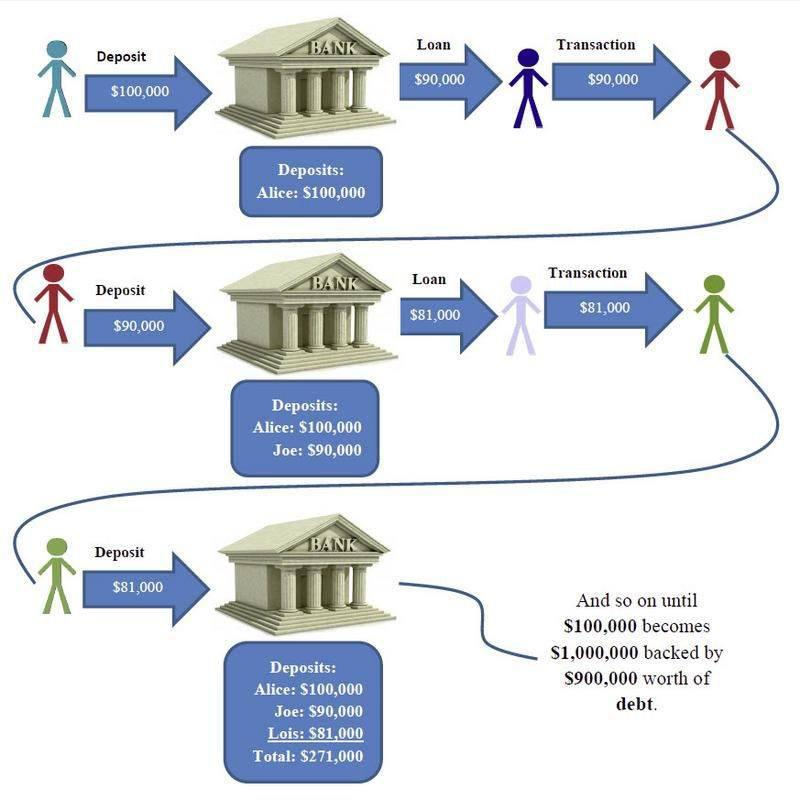
This system creates a money supply multiplier. For example, when Bank A lends $90 from a $100 deposit, that $90 often becomes a deposit at Bank B. Bank B may then lend $81, and the process continues. As a result, the original $100 can turn into several hundred dollars in the broader economy.
Fractional Reserve Banking: A banking system where financial institutions keep only a fraction of customer deposits in reserve while lending the majority to earn profits. This structure creates systemic risk during bank runs, when many depositors try to withdraw funds at the same time. Learn more
In the United States, the Federal Reserve sets reserve requirements for banks. As of March 2020, the reserve requirement ratio was reduced to zero percent for all depository institutions. This change gave banks even more freedom to lend customer deposits.
A Simple Illustration on How Fractional Reserve Banking Works
How Does Bitcoin Function as Full Reserve Money?
Bitcoin functions as full reserve money because every bitcoin exists transparently on the blockchain. Bitcoin cannot be created through lending or credit expansion.
When you hold bitcoin in self-custody, you own the actual asset. You are not holding a claim or IOU from a bank or institution.
The Bitcoin network also has a fixed supply. The maximum supply is capped at 21 million coins. No central authority can increase this amount. New bitcoin is issued on a predictable schedule through mining, with a halving event roughly every four years. As of December 2024, about 19.5 million bitcoin have been mined.
This full reserve nature also applies to Bitcoin banking alternatives. Platforms that offer Bitcoin financial services can prove their reserves using cryptographic methods. These proofs show exactly how much bitcoin the platform holds compared to customer liabilities. This level of transparency is not possible with traditional fractional reserve banking.
Key elements of Bitcoin’s full reserve model include:
- Blockchain verification: Every transaction is recorded on a public, immutable ledger
- Fixed supply cap: The total supply cannot exceed 21 million coins
- Proof of reserves: Cryptographic signatures prove ownership without exposing private keys
- Self-custody options: Users can verify their holdings without trusting intermediaries
For a deeper explanation of how Bitcoin enables new banking models, see our complete guide to Bitcoin self-custody banking.
Why Does Fractional Reserve Banking Create Risk?
Fractional reserve banking introduces structural risks that Bitcoin’s full reserve model avoids. One major issue is maturity mismatch.
Banks borrow short-term through deposits. At the same time, they lend long-term through mortgages and business loans. This mismatch creates vulnerability when many depositors want access to their money at once.
Bank runs happen when confidence breaks down and depositors try to withdraw funds simultaneously. Because banks only hold a fraction of deposits, they cannot meet large withdrawal demands without selling assets at a loss or seeking emergency funding.
Historical examples show how serious these risks can be:
- 2008 Financial Crisis: Bank failures tied to subprime mortgages required a $700 billion TARP bailout
- Silicon Valley Bank collapse (2023): Rapid withdrawals forced asset sales, leading to a $1.8 billion loss
- Cyprus bail-in (2013): The government seized deposits above €100,000 to recapitalize banks
In the U.S., the Federal Deposit Insurance Corporation (FDIC) insures deposits up to $250,000 per depositor, per institution. However, the FDIC’s Deposit Insurance Fund held about $128 billion as of mid-2024. This covers less than 1.3% of insured deposits. During major crises, government intervention is often required to prevent wider failures.
What Are Bitcoin Banking Alternatives?
Bitcoin banking alternatives offer financial services without using fractional reserve practices. These platforms allow users to buy, store, and use bitcoin while maintaining transparency around reserves and custody.
Modern Bitcoin financial platforms blend familiar banking features with Bitcoin’s full reserve principles. Users can access services such as bill payments, lending, and debit cards. At the same time, they benefit from blockchain transparency and stronger asset control.
Bitcoin Banking Alternative: A financial platform that delivers traditional banking services using Bitcoin infrastructure and full reserve principles. These platforms often include self-custody options, Lightning Network integration, and cryptographic proof of reserves. Learn more
Core features of Bitcoin banking alternatives include:
- Full reserve operations: Customer bitcoin is not lent without explicit consent
- Proof of reserves: Platforms cryptographically verify holdings
- Self-custody options: Users control private keys through multi-signature setups
- Lightning Network integration: Fast, low-fee transactions for daily use
- Transparent operations: On-chain verification of activity
Platforms like Rhino Bitcoin provide services such as trading, Lightning payments, bill pay, Bitcoin-backed loans, and Bitcoin IRAs. These services operate without rehypothecating customer assets.
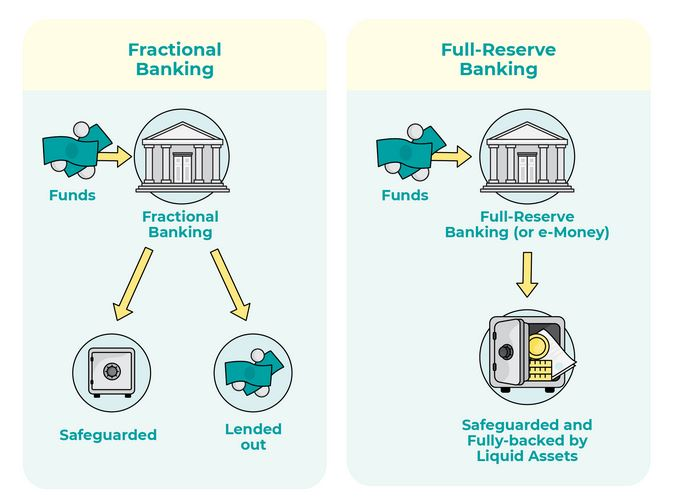
Fractional Reserve vs Full Reserve Banking
How Do Bitcoin-Backed Loans Differ from Traditional Lending?
Bitcoin-backed loans allow users to access liquidity without selling their bitcoin. Borrowers pledge bitcoin as collateral and receive loans in fiat currency or stablecoins.
This structure lets users keep bitcoin exposure while gaining spending power.
Traditional bank loans work differently. When a bank issues a $100,000 mortgage, it creates new money through fractional lending. Only a portion of that amount is backed by reserves. Bitcoin-backed loans, by contrast, use existing capital secured by verifiable Bitcoin collateral.
Key differences between Bitcoin-backed loans and traditional lending include:
Collateralization
- Bitcoin loans: Over-collateralized and verified on the blockchain
- Traditional loans: Often under-collateralized or unsecured
Credit requirements
- Bitcoin loans: No credit checks, since collateral secures the loan
- Traditional loans: Extensive credit and income verification
Liquidation risk
- Bitcoin loans: Automatic liquidation if collateral value falls below set thresholds, typically 50–70% LTV
- Traditional loans: Foreclosure or repossession through legal processes
Speed and accessibility
- Bitcoin loans: Fast approval based on collateral value
- Traditional loans: Longer approval times and heavy documentation
Bitcoin-backed lending platforms maintain full reserves because they lend their own capital or funds from users who explicitly agree to lending programs. This differs from fractional reserve banks, which lend demand deposits without individual consent.
What Security Advantages Does Full Reserve Bitcoin Banking Offer?
Full reserve Bitcoin banking removes counterparty risk found in fractional systems. When users hold bitcoin in self-custody or use provably full-reserve platforms, their assets cannot be lent, rehypothecated, or used without permission.
Multi-signature security setups provide strong protection while preserving user control. In a common 2-of-3 setup, two out of three keys are required to move funds. The user controls two keys, while the platform holds one for recovery.
Security comparison: Full Reserve Bitcoin vs. Traditional Banking
Full Reserve Bitcoin Banking:
- Pros: Proof of reserves, self-custody options, no bank run risk, blockchain transparency, user-controlled keys
- Cons: User responsibility for key management, price volatility, smaller insurance programs, evolving regulation
- Best For: Users seeking financial sovereignty and transparency
Traditional Fractional Reserve Banking:
- Pros: FDIC insurance up to $250,000, established regulations, stable fiat value, minimal user security responsibility
- Cons: Bank run risk, bail-ins for large deposits, no proof of reserves, asset rehypothecation, surveillance
- Best For: Users prioritizing convenience and fiat stability
Bitcoin’s security is built on 256-bit elliptic curve cryptography. This provides security comparable to a 128-bit symmetric key, which would require more computing power than exists globally to break by brute force. This level of mathematical security exceeds that of traditional banking systems.
How Can You Transition from Traditional Banking to Bitcoin Alternatives?
Moving from traditional banking to Bitcoin alternatives works best with a gradual approach. This helps maintain financial stability while learning new tools.
Many users keep their traditional bank account for everyday expenses. At the same time, they allocate part of their savings to Bitcoin. This hybrid strategy allows experimentation without disrupting normal payments.
Practical transition steps include:
- Open a Bitcoin platform account: Choose a platform with trading, Lightning payments, and bill pay
- Start small with regular purchases: Use dollar-cost averaging on a weekly or monthly basis
- Learn self-custody: Practice with small amounts before moving larger balances
- Test Lightning payments: Make small transactions to understand speed and fees
- Shift bill payments gradually: Use Bitcoin-powered bill pay for recurring expenses
- Explore Bitcoin-backed loans: Access liquidity without selling bitcoin
Understanding the differences between Bitcoin wallets and Lightning wallets helps ensure a smoother adoption process. Lightning integration enables instant payments suited for daily use.
For international users, learning about cross-border payments with Lightning Network highlights major advantages over traditional wires, including fast settlement and low fees.
What Regulatory Considerations Apply to Bitcoin Banking Alternatives?
Bitcoin banking alternatives operate under changing regulatory frameworks. These rules vary by country and region.
In the United States, several agencies oversee different aspects of Bitcoin financial services. The Financial Crimes Enforcement Network (FinCEN) requires platforms classified as money services businesses to follow Know Your Customer (KYC) and Anti-Money Laundering (AML) rules. The Securities and Exchange Commission (SEC) regulates Bitcoin investment products but generally does not treat bitcoin itself as a security.
State regulations add complexity. New York’s BitLicense imposes strict compliance rules. Wyoming, on the other hand, has created favorable frameworks, including special purpose depository institution (SPDI) charters.
Key regulatory considerations include:
- Federal tax treatment: The IRS treats bitcoin as property subject to capital gains tax
- Banking integration: Some platforms partner with FDIC-insured banks for fiat custody
- Consumer protection: Protection varies; some platforms offer insurance, others rely on self-custody
- Regulatory clarity: Ongoing legislation may bring clearer frameworks
Users should confirm that Bitcoin platforms follow applicable regulations and security standards. Reputable platforms clearly disclose custody practices, insurance coverage, and compliance policies.
Frequently Asked Questions
What does fractional reserve mean in banking?
Fractional reserve banking means banks keep only part of customer deposits in reserve while lending the rest. Most banks hold 3–10% in reserve and lend the remaining 90–97%.
Is Bitcoin truly full reserve?
Yes. Every bitcoin exists on the blockchain and cannot be created through lending. The supply is capped at 21 million coins.
Can Bitcoin banking platforms lend my bitcoin?
Reputable platforms do not lend customers’ bitcoin without clear consent. Proof of reserves and self-custody options help ensure user control.
How does proof of reserves work?
Proof of reserves uses cryptographic signatures to show that a platform controls certain bitcoin addresses. Auditors can verify that assets match or exceed liabilities.
What happens if a Bitcoin platform fails?
With self-custody, users can recover funds using their private keys. Custodial platforms may offer insurance, but coverage varies and is usually lower than FDIC protection.
Are Bitcoin-backed loans safer than traditional loans?
They remove fractional reserve risk but introduce price volatility risk. Proper loan-to-value management is essential.
Do I need to report Bitcoin banking transactions to the IRS?
Yes. Bitcoin transactions are taxable events. Users must report capital gains and losses and track cost basis.
Can I get a Bitcoin debit card without fractional reserve risk?
Yes, if the platform maintains proof of reserves. These cards convert bitcoin to fiat at the point of sale without relying on fractional lending.
Conclusion
Bitcoin offers a transparent, full reserve alternative to fractional reserve banking. Every unit is verifiable on the blockchain and cannot be created through lending. This design removes risks such as bank runs, bail-ins, and unchecked credit expansion.
Bitcoin banking alternatives pair full reserve principles with practical financial tools. Features like Lightning payments, bill pay, and Bitcoin-backed loans allow users to operate outside the fractional reserve system while retaining usability.
Key considerations when choosing a Bitcoin banking alternative include:
- Confirm proof of reserves and self-custody options
- Understand custody and counterparty risk
- Balance convenience with financial sovereignty
- Start small while learning best security practices
For users ready to explore full reserve banking with Bitcoin, explore Rhino Bitcoin’s comprehensive platform offering Lightning integration, self-custody options, and Bitcoin financial services without rehypothecating customer assets.
References
- Federal Reserve Board. Reserve Requirements. Board of Governors of the Federal Reserve System. https://www.federalreserve.gov/monetarypolicy/reservereq.htm
- Federal Deposit Insurance Corporation. Quarterly Banking Profile – Second Quarter 2024. FDIC. https://www.fdic.gov/
- Financial Crimes Enforcement Network. Application of FinCEN’s Regulations to Persons Administering, Exchanging, or Using Virtual Currencies. U.S. Department of the Treasury. https://www.fincen.gov/
- Internal Revenue Service. Notice 2014-21: IRS Virtual Currency Guidance. IRS. https://www.irs.gov/
- Wikipedia. Fractional-reserve banking. Wikimedia Foundation. https://en.wikipedia.org/wiki/Fractional-reserve_banking
Important Disclaimers
Disclaimer: Educational information only. Not financial, legal, medical, or tax advice.
Risk Warnings: All investments involve risk, including loss of principal. Past performance does not predict future results. Bitcoin is volatile and may not suit all investors.
Conflicts of Interest: Rhino Bitcoin provides Bitcoin financial services. This content is educational and may reference company products.
.png)
.png)