
Bitcoin Dominance: The Market’s March Toward Monetary Truth
Bitcoin dominance: Has it topped? Analyze BTC's current market share within the broader cryptocurrency market.
Buy Bitcoin with Zero Fees with Rhino
The most secure way to stack sats. Simple, fast, and zero trading fees.
With Bitcoin’s market cap dominance at a high for this cycle, the message is clear - Bitcoin is indisputably the monetary foundation upon which the entire digital asset ecosystem rests.
While many crypto investors expecting this to be a temporary phenomenon, Bitcoin maximalists seem to think otherwise, as Bitcoin’s superior monetary properties continue to drive its dominance ever higher.
The Dominance Metric That Matters: Bitcoin vs. The Pretenders
Traditional Bitcoin dominance calculations suffer from a fundamental flaw. They treat stablecoins (‘crypto dollars’ that are typically pegged 1:1 with fiat such as USD) as competition to Bitcoin when they are actually complementary infrastructure. Think of a grand old cathedral being built brick by brick over time - Bitcoin would be the foundation, the walls and the materials, whereas stablecoins would be the scaffolding that help accelerate the end goal of hyper-bitcoinization.
When we exclude the $255 billion stablecoin market (representing ~7% of total crypto market cap) from the dominance calculation, Bitcoin’s true position becomes starkly clear: Bitcoin commands nearly 75% dominance against speculative altcoins.
The market has quietly sorted itself into three distinct categories, namely:
- Bitcoin: The monetary standard (~63% of total market cap)
- Stablecoins: The transactional layer (~7% of total market cap)
- Everything else: Speculative experiments (~30% of total market cap)
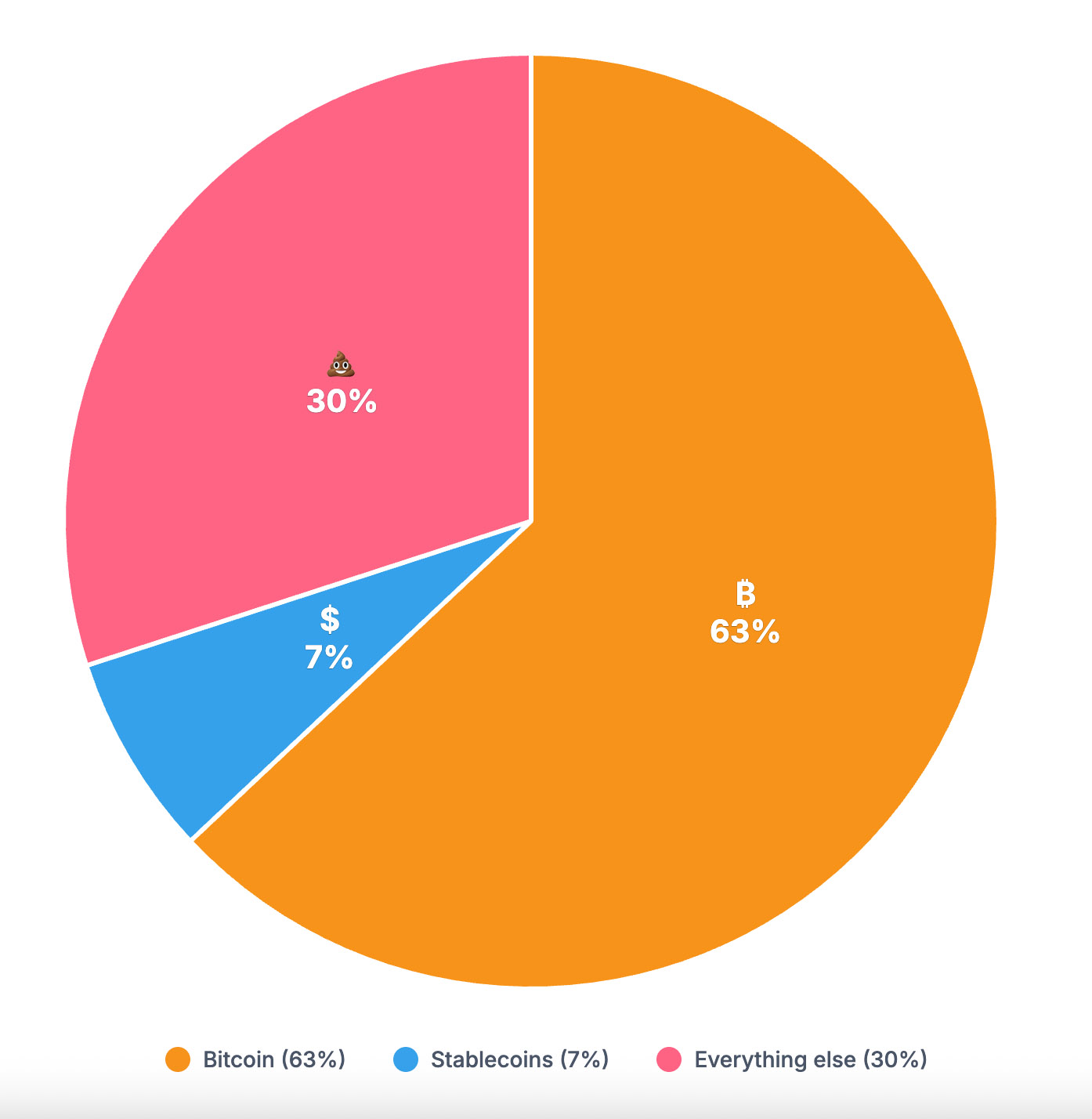
Combining Bitcoin and stablecoins shows that over two thirds of the crypto market value now sits in assets serving monetary functions, either as a store of value (bitcoin) or medium of exchange (bitcoin and stablecoins). This marks a crucial evolution from the casino-like speculation of previous cycles toward a mature monetary ecosystem with bitcoin emerging as the apex asset.
Institutional Validation
The primary catalyst behind Bitcoin's recent dominance surge is not retail FOMO, and the data proves it. As the Google Trends chart below shows, Bitcoin search interest currently sits at a modest 21, dramatically lower than the 100+ levels that marked the peak of the previous bull run in 2017.

This muted retail interest makes Bitcoin's dominance surge all the more remarkable. What we're witnessing is institutional recognition of Bitcoin's unique monetary properties driving both price and market share gains.
Institutional capital flows have pushed bitcoin’s price to new all-time highs above $120,000 while simultaneously driving BTC dominance to multi-year highs.
The data is compelling:
- Bitcoin ETFs attracted over $1.2 billion in net inflows in July 2025 alone, while Ethereum (“Eth”) ETFs experienced mixed flows with periods of net outflows, underscoring a strong institutional bias toward Bitcoin.
- Most public companies in the digital asset sector keep adding bitcoin to their balance sheets, but rarely altcoins. Strategy’s ongoing $42 billion bitcoin acquisition strategy exemplifies this, and due to its early success the company expanded it by unveiling the “42/42 Plan” to raise a total of $84 billion (divided evenly between equity and fixed-income instruments) by 2027 for further bitcoin accumulation.
- Leveraged bitcoin equities, such as mining stocks and bitcoin-centric public firms, have gained traction as institutional exposure tools. These often align with or exceed bitcoin’s price movements, offering traditional investors leveraged upside (and downside) exposure to bitcoin without direct asset ownership.
- Regulatory clarity for bitcoin far outpaces that of altcoins, as it is treated as a commodity rather than subjected to securities regulations.
This bullish institutional bias could mean Bitcoin is at the beginning of a permanent passive bid into superior money. Translation: Bitcoin now has a floor under its dominance that did not exist in previous cycles.
Why This Cycle Won’t Mirror 2017 or 2021
Market observers watching for BTC dominance to crash from current levels (~63%) are fighting a losing war. The classic altseason’ narrative, where dominance plummets from around 70% to ~40% as retail investors chase the next shiny object, assumes a market structure that no longer exists.
Consider the evidence:
- 2017: Dominance fell from 85% to 38% during the ICO bubble.
- 2021: Dominance dropped from 70% to 40% during the DeFi/NFT mania.
- 2025: Dominance has risen from 47% to over 63% during institutional adoption.
The pattern has shifted. Each cycle, Bitcoin’s market dominance has risen progressively (33% in 2018, 40% in 2021), a trend likely to persist as institutional capital creates a sustained demand for bitcoin absent in prior eras.
Yes, people do enjoy gambling. It is part of human nature, so another altcoin season is not impossible. There will always be a wave of retail investors hoping to 10x their investments off a meme coin/token or AI related narrative such as $DOGE or $TAO.
But the twist this time is that much of the capital that used to flood into altcoins is now getting absorbed by bitcoin treasury companies. Publicly traded Bitcoin plays, sometimes called LBEs (Leveraged Bitcoin Equities) are soaking up a lot of the capital and attention. And it’s upsetting many of the usual suspects.
‘Crypto bros’ will likely continue whining that Bitcoin-only firms are stealing their thunder, but for most people it is easier to trust a company holding bitcoin on their balance sheet than it is to roll the dice on a token that promises “utility” but delivers dilution and rug pulls.
So while we could see another short-lived altcoin rally, the deck is stacked differently now as Treasury-focused BTC firms, ETFs, and institutional vehicles continue to suck the air out of the room.
The Stablecoin Revolution
The crypto industry has produced numerous grifts and vaporware in the past (you can find a robust, ongoing list here). Yet, buried in that wreckage sits one genuinely useful innovation: stablecoins. Over $255 billion now sits allocated towards these fiat-pegged tokens, representing crypto's most meaningful contribution to real-world commerce beyond Bitcoin itself.
Stablecoins succeeded where thousands of altcoins failed because they solved an actual problem: providing digital payments infrastructure without the volatility that makes most crypto unusable for daily transactions.
But stablecoins aren't competing with Bitcoin. They are validating Bitcoin's monetary thesis while serving as the transactional layer that Bitcoin's base layer cannot efficiently provide to people who can’t handle the short term volatility in their day to day life.
Stablecoins are a bridge, an essential infrastructure that lets the digital economy function while Bitcoin matures into its rightful role as the global reserve asset.
It is the market maturing, growing out of its casino phase and into something resembling real monetary infrastructure. The crypto industry has finally produced something useful, and the market sentiment has shifted, rewarding that utility with large scale adoption and enhanced regulatory clarity.
The Monetary Singularity
The maximalist thesis is not that Bitcoin will hit 100% dominance, but rather that Bitcoin will achieve monetary singularity within the broader crypto ecosystem. Just as the internet converged on standard protocols, digital money will converge on the asset with the best monetary properties: absolute scarcity, decentralization, security, and neutrality.
Bitcoin meets these criteria. No altcoin does.
The evidence for bitcoin being the world’s best money is clear:
- Scarcity: Bitcoin’s 21 million cap is absolute; altcoins regularly inflate their supplies.
- Decentralization: Bitcoin has no central authority; altcoins have founders, foundations, and premines.
- Security: Bitcoin’s hash rate dwarfs all competitors; altcoins routinely suffer attacks.
- Neutrality: Bitcoin treats all users equally; altcoins often have special privileges for insiders.
This is why Bitcoin's dominance will continue rising while altcoins fade into irrelevance.
The Inevitable Conclusion
Bitcoin dominance is a real-time measurement of the market's journey toward monetary truth. The current Bitcoin dominance chart representing 63% BTC dominance, combined with 7% stablecoins, shows a market that has clearly already chosen its monetary foundation. The remaining 30% in speculative altcoins is the vestige of an earlier, more primitive phase of crypto development.
The trend is clear: Bitcoin's superior monetary properties are being recognized by institutions, regulators, and investors worldwide. Each cycle, Bitcoin reclaims more market share from the altcoin experiments that inevitably fail to deliver on their promises.
The market has spoken, and its message is clear: There is Bitcoin, and there is everything else. And everything else is losing.
For those who understand this reality, the path forward is simple: accumulate bitcoin, ignore the noise, and prepare for a future where Bitcoin's dominance is the new monetary reality.
.png)
.png)