
Bitcoin Geographically Distributed Keys: Security & Custody Banking Guide
Learn how geographically distributed Bitcoin keys eliminate single points of failure and protect against theft, disasters, and seizure.
Buy Bitcoin with Zero Fees with Rhino
The most secure way to stack sats. Simple, fast, and zero trading fees.
Geographically distributed keys are a security model where Bitcoin private key components are stored in multiple physical locations. This prevents any single point of failure from compromising your bitcoin holdings.
This approach combines cryptographic key splitting with geographic separation. Together, these protect against theft, natural disasters, regulatory seizure, and physical attacks.
Key Summary: Geographically distributed keys split Bitcoin private keys across multiple physical locations. No single location can access funds on its own, which protects against theft, disasters, and jurisdictional risks.
Key Takeaways:
- Geographic distribution removes single points of failure in Bitcoin security
- Multi-signature wallets make distributed key models practical
- Strong security requires careful planning around locations and signing thresholds
- This approach protects against physical threats and jurisdictional risks
Why Geographic Distribution Matters for Bitcoin Security
Geographic distribution addresses a core weakness in Bitcoin custody: physical concentration of access.
When all key components exist in one place, that location becomes a single point of failure. It is then exposed to multiple threat vectors at the same time.
Bitcoin security depends on protecting private keys at all costs. Unlike traditional banking, Bitcoin transactions cannot be reversed. Once a transaction is confirmed, it is final.
If an attacker gains access to your private keys, they can transfer your bitcoin permanently. There is no recovery process or recourse.
The risks of centralized key storage include:
- Physical theft: Home invasions, office break-ins, and targeted attacks against known Bitcoin holders
- Natural disasters: Fires, floods, or earthquakes that destroy backup devices and seed phrases
- Jurisdictional seizure: Government confiscation or court orders affecting assets in one location
- Insider threats: Family members, employees, or associates with physical access
- Coercion attacks: Physical threats that force key holders to surrender access
Geographic distribution reduces these risks. Compromising one location does not provide access to funds.
For a broader overview of Bitcoin custody best practices, see our complete Bitcoin security guide.
How Multi-Signature Wallets Enable Geographic Distribution
Multi-signature (multisig) wallets provide the cryptographic foundation for geographic key distribution.
A multisig wallet requires multiple private keys to approve a transaction. You can customize how many signatures are needed by setting a threshold.
Multi-signature wallet: A Bitcoin wallet that requires multiple private keys to authorize transactions. These wallets are usually configured as m-of-n (for example, 2-of-3 means any 2 of 3 keys are required). Learn more about multisig
Common multisig configurations include:
- 2-of-3: Three keys total, any two required (strong balance of security and accessibility)
- 3-of-5: Five keys total, any three required (higher security with more redundancy)
- 2-of-2: Two keys total, both required (simple but no redundancy if one key is lost)
- 3-of-3: Three keys total, all required (maximum security with higher loss risk)
The 2-of-3 setup has become the industry standard for individual custody.
It provides strong security because no single key grants access. It also offers redundancy, since losing one key does not lock you out. At the same time, it remains flexible. You can keep one key nearby for routine use and store the others remotely.
Multisig wallets also generate extended public keys (xpubs). These allow you to monitor addresses and balances without spending authority. You can check your holdings from anywhere while keeping signing keys distributed.
Strategic Location Selection for Distributed Keys
Choosing where to store distributed keys requires careful planning.
You must balance physical security, accessibility, jurisdictional diversity, and operational practicality. Poor location choices can weaken the entire security model.
Primary location considerations:
- Jurisdictional diversity: Store keys in different legal jurisdictions to reduce the risk of government seizure
- Physical security: Use bank safe deposit boxes, private vaults, or secure home safes in different cities
- Natural disaster exposure: Avoid placing multiple keys in the same flood zone, earthquake region, or fire-prone area
- Accessibility balance: Keep at least one key reasonably accessible for regular transactions
- Trusted contacts: Consider trusted individuals in different locations, with proper legal protections
In a typical 2-of-3 setup, a practical distribution might look like this:
- One key in a home safe for regular access
- One key in a bank safe deposit box in a different city
- One key with a trusted family member or attorney in another state or country
International distribution adds another layer of protection. Keeping one key in another country helps reduce exposure to domestic regulatory changes, civil unrest, or capital controls.
However, international storage increases complexity. Access, travel, and legal considerations must be planned carefully.
Implementation Methods for Geographic Key Distribution
There are several ways to implement geographic distribution. Each method involves trade-offs between security, complexity, and ease of use.
The right approach depends on your technical skill, the size of your holdings, and your threat model.
Hardware Wallet Distribution
The simplest method uses multiple hardware wallets in a multisig setup.
Each hardware wallet stores one private key. These devices can be placed in different physical locations. Popular options such as Coldcard, Ledger, and Trezor support multisig configurations.
This method is user-friendly and effective. It maintains geographic separation without requiring advanced technical knowledge.
You can spend funds using any authorized subset of devices. You do not need to gather all hardware wallets in one place.
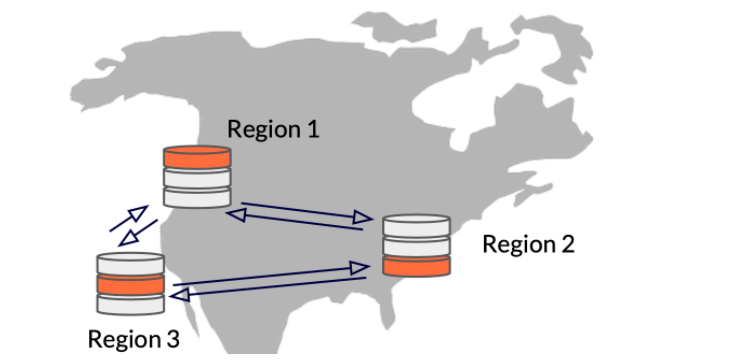
In Geographically Distributed Storage Every Key is Stored in a Separate Location
Seed Phrase Splitting with Shamir's Secret Sharing
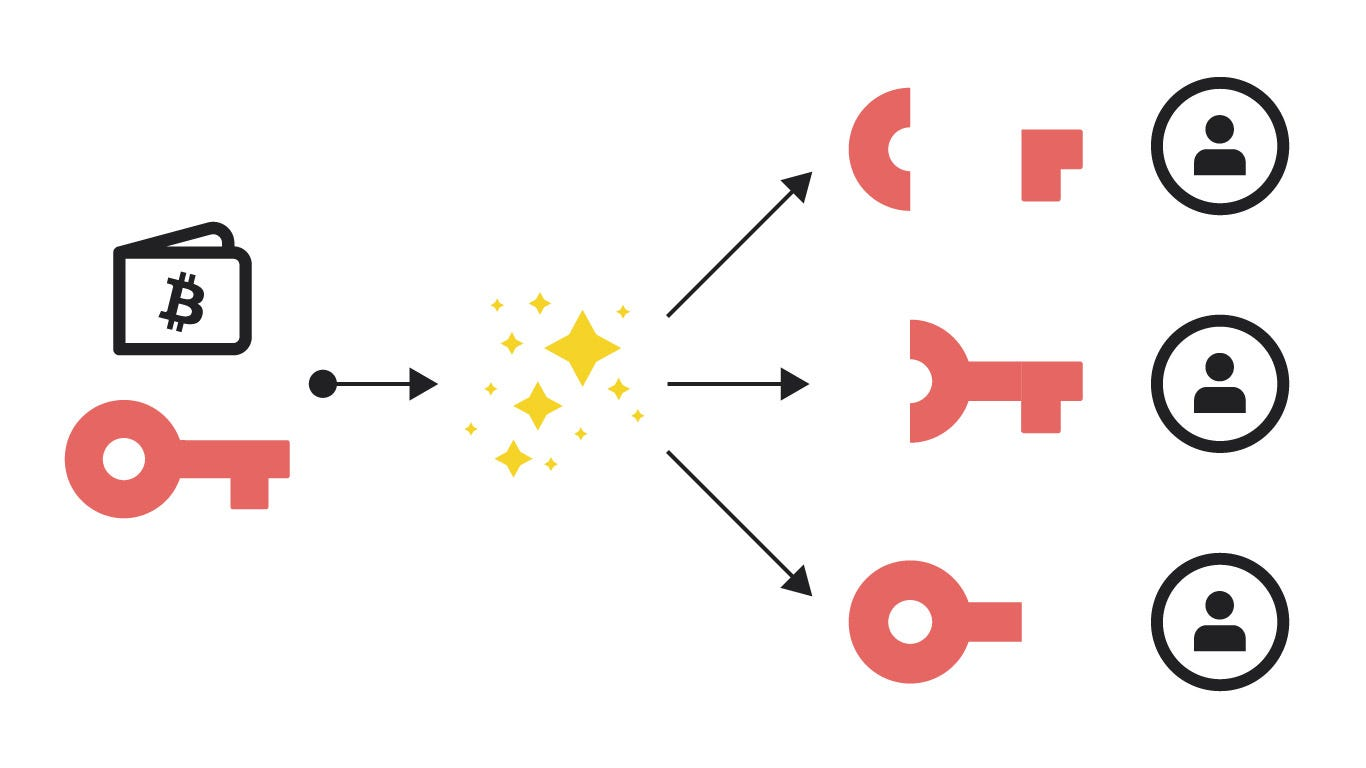
Shamir's Secret Sharing (SSS) splits a seed phrase into multiple cryptographic shares.
A set threshold is required to reconstruct the original seed. Individual shares reveal nothing on their own.
For example, a 5-share setup with a 3-of-5 threshold allows recovery using any three shares. Possessing only one or two shares provides zero information.
Shamir's Secret Sharing: A cryptographic algorithm that splits a secret into multiple parts. A minimum number of shares can reconstruct the original, while fewer shares reveal nothing. Learn more
SSS offers strong mathematical guarantees, but it requires careful handling.
Unlike multisig, losing shares below the threshold makes recovery impossible. There is no partial access or fallback.
SSS is also more difficult for beneficiaries to understand. Recovery procedures are more complex than standard multisig setups.
Institutional Custody with Geographic Vault Distribution
For large holdings or institutional needs, professional custody providers offer geographically distributed vault services.
These providers store keys or key components in hardened facilities across multiple jurisdictions. Many use Hardware Security Modules (HSMs) in geographically separated data centers.
Enterprise solutions often add extra layers of protection. These may include biometric authentication, time locks, and multi-party computation.
Some platforms offer self-custody options combined with institutional-grade security. This allows users to maintain control while benefiting from professional infrastructure.
Operational Security for Distributed Key Systems
Geographic distribution only works if operational security preserves separation.
Many failures occur because of simple mistakes that recreate single points of failure.
Critical operational security practices:
- Never photograph all keys: Photos stored on internet-connected devices defeat geographic separation
- Avoid digital storage: Do not store seed phrases in cloud services, email, or digital notes, even if encrypted
- Keep locations private: Avoid publicly discussing key locations or security details
- Use encrypted communication: Coordinate with trusted key holders using end-to-end encrypted channels
- Test recovery regularly: Confirm you can access and use keys from distributed locations
- Document carefully: Create beneficiary instructions without revealing specific key locations or values
Human error is often the weakest link.
Family members or trusted contacts who hold keys need basic security guidance. At the same time, they should not have enough information to become targets themselves.
Give clear instructions for their role, but limit knowledge of the overall system value and other key locations.
Legal and Estate Planning Considerations
Geographic distribution introduces unique estate planning challenges.
Without proper documentation, distributed keys can become permanently inaccessible if you become incapacitated or pass away.
Effective estate planning for distributed Bitcoin custody includes:
- Clear documentation: Written instructions explaining the multisig setup, thresholds, and key locations, stored securely with your will
- Trusted executor: Someone with enough technical knowledge to carry out recovery
- Legal structures: Trusts or legal entities that hold keys with defined succession rules
- Gradual disclosure: Information revealed to beneficiaries only when necessary
- Professional guidance: Estate attorneys experienced with digital assets and Bitcoin custody
Some Bitcoin holders use time-locked transactions or smart contract mechanisms. These can automatically move funds if not periodically renewed.
While powerful, these tools require a deep understanding of Bitcoin scripting and careful implementation.
Comparing Distribution Models
Different distribution models fit different needs, risk profiles, and skill levels.
Understanding the trade-offs helps you choose the right approach.
Comparison: Geographic Distribution Models
Simple 2-of-3 Multisig with Hardware Wallets
- Pros: User-friendly, widely supported, easy to test, strong balance of security and access
- Cons: Requires multiple hardware wallets, devices can fail, beneficiaries need basic technical knowledge
- Best For: Individual holders with moderate to large holdings
Shamir's Secret Sharing
- Pros: Strong mathematical guarantees, shares reveal nothing individually, flexible thresholds
- Cons: Complex recovery, limited wallet support, permanent loss risk below threshold
- Best For: Technical users comfortable with complexity
Shamir’s Secret Sharing Requires N out of M Shares to Reconstruct the Key
Institutional Multi-Jurisdiction Custody
- Pros: Professional security, regulatory compliance, insurance options, easier inheritance
- Cons: Ongoing fees, reliance on third parties, possible KYC requirements
- Best For: Large holdings and institutional investors
Hybrid Self-Custody with Geographic Distribution
- Pros: Combines convenience with strong security, user-controlled, integrated services
- Cons: Requires understanding the platform’s security model
- Best For: Users seeking institutional-grade security with self-custody
Common Pitfalls and How to Avoid Them
Even well-designed systems can fail due to implementation errors.
Being aware of common pitfalls helps prevent mistakes.
Key management mistakes:
- Insufficient testing: Funding a system before verifying access from all locations
- Poor documentation: Lack of clear instructions for recovery and inheritance
- Correlated locations: Storing multiple keys in areas exposed to the same risks
- Accessibility issues: Making keys so remote that regular use becomes impractical
- Single points of knowledge: Only one person fully understands the system
Always start with small test amounts.
Send test transactions. Practice recovery from different locations. Confirm that everything works before securing large holdings.
This testing phase often reveals issues that planning alone does not uncover.
Frequently Asked Questions
What is the minimum number of locations for effective geographic distribution?
Three locations provide strong security and redundancy. A 2-of-3 multisig allows loss of one location without losing access to funds.
Can I use bank safe deposit boxes for geographic distribution?
Yes. Safe deposit boxes offer physical protection and fire resistance. However, they fall under government jurisdiction, so they should be combined with other locations.
How do I access my bitcoin if keys are stored far away?
With multisig, you only need access to the threshold number of keys. Keep one key nearby and store others remotely for routine access.
What happens if I lose one key in a 2-of-3 setup?
You can still access funds with the remaining two keys. Create a new 2-of-3 wallet and redistribute keys to restore redundancy.
Should I tell family members where keys are stored?
Family should know the system exists and where documentation is located. Specific locations and values should be revealed through formal estate planning.
How often should I test access to distributed keys?
Test access at least once per year, or after major life changes. Confirm all locations remain secure and accessible.
Can geographic distribution protect against government seizure?
Multiple jurisdictions make seizure more difficult. However, legal compliance is still important, and avoiding lawful obligations creates additional risks.
What is the difference between multisig and Shamir's Secret Sharing?
Multisig enforces multiple signatures at the Bitcoin protocol level. Shamir’s Secret Sharing reconstructs a single key before the Bitcoin network is involved.
Moving Forward with Geographic Key Distribution
Geographic distribution is one of the most effective ways to eliminate single points of failure in Bitcoin custody.
By combining multisig security with physical separation, you reduce exposure to many threat vectors at once.
To move forward:
- Evaluate your personal threat model
- Choose a method that fits your technical comfort and holdings
- Select locations that balance security, access, and jurisdictional diversity
- Maintain strong operational security
- Prepare clear estate planning documentation
- Test everything with small amounts first
For users seeking institutional-grade security with geographic distribution and integrated Bitcoin services, explore Rhino Bitcoin's comprehensive platform. It combines self-custody options with Lightning payments, Bitcoin-backed loans, and Bitcoin IRA accounts.
References
- Bitcoin.org. “Multi-signature.” Bitcoin.org Glossary. https://bitcoin.org/en/glossary/multisig
- Shamir, Adi. “How to Share a Secret.” Communications of the ACM, 1979. https://en.wikipedia.org/wiki/Shamir%27s_Secret_Sharing
- National Institute of Standards and Technology. “FIPS 140-2 Security Requirements for Cryptographic Modules.” NIST Computer Security Resource Center. https://csrc.nist.gov/publications/detail/fips/140/2/final
- Antonopoulos, Andreas M. Mastering Bitcoin: Programming the Open Blockchain. O’Reilly Media, 2017.
- Lopp, Jameson. “A Modest Privacy Protection Proposal.” Bitcoin Magazine, 2020. https://bitcoinmagazine.com
Important Disclaimers
Disclaimer: Educational information only. Not financial, legal, medical, or tax advice.
Risk Warnings: All investments involve risk, including loss of principal. Past performance does not predict future results. Bitcoin is volatile and may not be suitable for all investors.
Conflicts of Interest: Rhino Bitcoin provides Bitcoin financial services. This content is educational and may reference our products.
.png)
.png)