
Bitcoin BIP32 Hierarchical Wallets: Security & Custody Guide For Bitcoin Banking
BIP32 introduced hierarchical deterministic wallets, enabling unlimited Bitcoin addresses from one seed phrase with stronger security, privacy, and easy recovery.

Buy Bitcoin with Zero Fees with Rhino
The most secure way to stack sats. Simple, fast, and zero trading fees.
Bitcoin BIP32 (Bitcoin Improvement Proposal 32) introduced hierarchical deterministic (HD) wallets.
This standard made it possible to generate many Bitcoin addresses from a single seed phrase.
Before BIP32, users had to back up each private key individually.
With HD wallets, one recovery phrase protects everything.
This change dramatically improved Bitcoin security and usability.
Users can now manage unlimited addresses while maintaining just one backup.
Key Summary:
BIP32 hierarchical wallets generate unlimited Bitcoin addresses from one master seed. This allows better organization, simpler backups, and improved privacy by avoiding address reuse.
Key Takeaways
- One seed phrase can generate billions of unique Bitcoin addresses
- Backup and recovery are simplified to a single 12–24 word phrase
- Wallets can be organized into accounts and sub-accounts
- Privacy improves because address reuse is no longer necessary
What Are Hierarchical Deterministic Wallets?
Hierarchical deterministic wallets generate Bitcoin addresses in a tree-like structure.
All addresses come from a single master seed.
Older wallets worked differently.
They created random, unrelated addresses, each with its own private key.
HD wallets use mathematical derivation instead.
Every key comes from one source, which creates a predictable hierarchy.
How the Hierarchy Works
The structure is similar to a family tree.
- The master seed sits at the top
- Parent keys are derived from the seed
- Child keys are derived from parent keys
- Each level can create more child keys
Each level serves a purpose.
Wallets can separate personal funds, business accounts, or different use cases.
Hierarchical Deterministic (HD) Wallet:
A Bitcoin wallet that generates all private keys and addresses from a single master seed using mathematical derivation, forming an organized tree of keys.
HD Wallets Derive Addresses and Keys from a Seed Phrase
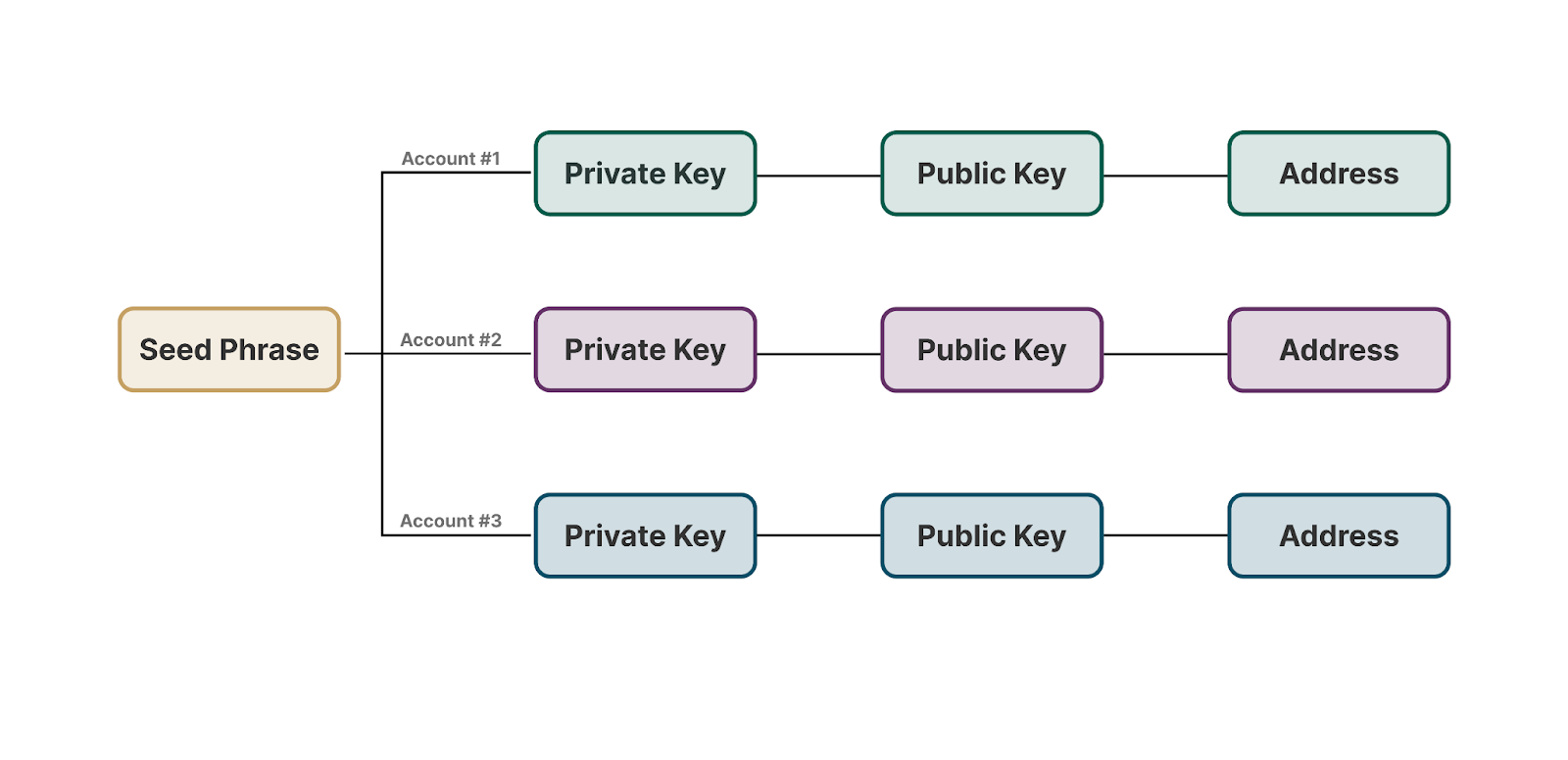
Why HD Wallets Matter for Recovery
Recovery is where HD wallets shine.
Older wallets required backing up every private key.
Losing even one key could mean losing funds.
HD wallets only require the original seed phrase.
That phrase can restore the full wallet, including:
- All derived addresses
- Account structure
- Transaction history
Most wallets use 12 to 24 words for this backup.
For a deeper look at wallet protection, see our complete Bitcoin security guide.
How Does BIP32 Work?
BIP32 defines how wallets derive keys in a predictable way.
The process begins with a master seed.
This seed usually comes from a 12–24 word mnemonic phrase.
From that seed, the wallet generates:
- A master private key
- A master chain code
Together, these form the root of the wallet.
Address Capacity
From the master key, a wallet can derive:
- 2³¹ hardened child keys
- 2³¹ normal (non-hardened) child keys
Each child key can generate more children.
This creates effectively unlimited addresses.
The derivation process is one-way.
You can derive child keys from a parent, but not the reverse.
Key Derivation Steps
The BIP32 process includes:
- Master seed generation:
The root of the key tree, created from entropy and hashing - Extended key creation:
Combines a key with a chain code - Child key derivation:
Uses HMAC-SHA512 with an index number - Hardened vs normal derivation:
Hardened keys prevent certain attack scenarios
Hardened vs Normal Derivation
This distinction exists for security reasons.
- Normal derivation uses the parent public key
- Hardened derivation uses the parent private key
A risk exists with normal derivation.
If someone gets a child private key and the parent public key, they can calculate sibling keys.
This is known as the extended public key attack.
Hardened derivation prevents this.
It requires the parent private key, which attackers cannot calculate.
Most wallets follow a hybrid approach:
- Hardened derivation for account-level keys
- Normal derivation for address generation
What Is the BIP32 Derivation Path?
A derivation path describes how to reach a specific key.
It looks similar to a file path:
m/44'/0'/0'/0/0
Each number represents a level in the hierarchy.
Path Structure Explained
- m — The master key
- Purpose — Wallet standard (44', 49', 84')
- Coin type — Bitcoin or testnet
- Account — Separates accounts
- Change — External (0) or internal (1)
- Address index — The specific address
Hardened Indicators
An apostrophe (') means hardened derivation.
Example:
m/44'/0'/0'
This path uses hardened derivation for:
- Purpose
- Coin type
- Account
Change and address index levels usually remain non-hardened.
This allows wallets to generate addresses without private keys.
Derivation Path:
A standardized notation that defines the exact route through a wallet’s hierarchy to reach a Bitcoin address.
BIP32 Specification
How Do BIP44, BIP49, and BIP84 Build on BIP32?
BIP32 created the technical foundation.
It did not define how wallets should organize addresses.
That role belongs to:
- BIP44
- BIP49
- BIP84
These standards define consistent derivation paths.
They ensure wallets remain interoperable.
Why These Standards Matter
Bitcoin address formats evolved over time.
Each BIP corresponds to a different address type.
Standardization allows you to restore a seed phrase in any compatible wallet and recover the same funds.
Comparison: Address Standards
BIP44 — Legacy P2PKH
- Purpose: 44'
- Address format: Starts with “1”
- Path: m/44'/0'/0'/0/0
- Best for: Maximum compatibility, higher fees
BIP49 — SegWit Wrapped (P2SH-P2WPKH)
- Purpose: 49'
- Address format: Starts with “3”
- Path: m/49'/0'/0'/0/0
- Best for: Fee savings with broader compatibility
BIP84 — Native SegWit (Bech32)
- Purpose: 84'
- Address format: Starts with “bc1”
- Path: m/84'/0'/0'/0/0
- Best for: Lowest fees and error resistance
Modern wallets usually scan all three paths during recovery.
This ensures no funds are missed.
Why Do Hierarchical Wallets Improve Privacy?
HD wallets make address reuse unnecessary.
Users can generate a new address for every transaction.
This prevents outsiders from linking payments together.
The Problem With Address Reuse
When an address is reused:
- All transactions become public
- Balances can be calculated
- Payment patterns are visible
- Identity links become possible
How HD Wallets Improve Privacy
HD wallets use several mechanisms:
- Automatic address generation after each use
- Separate change addresses to avoid linkage
- Account separation for different purposes
- Gap limit scanning to avoid lost funds
Extended Public Keys and Privacy
HD wallets can derive extended public keys (xpubs).
An xpub allows address generation without private keys.
This enables:
- Watch-only wallets
- E-commerce deposit systems
- Accounting access
However, xpubs reveal all derived addresses.
They should be treated as sensitive data.
What Are Extended Keys (xPub, xPriv)?
Extended keys combine a normal key with a chain code.
- xpriv can derive private and public keys
- xpub can derive public keys only
This separation enables powerful use cases.
Public Keys can be Derived from Extended Public Key Without Knowledge of Private Keys
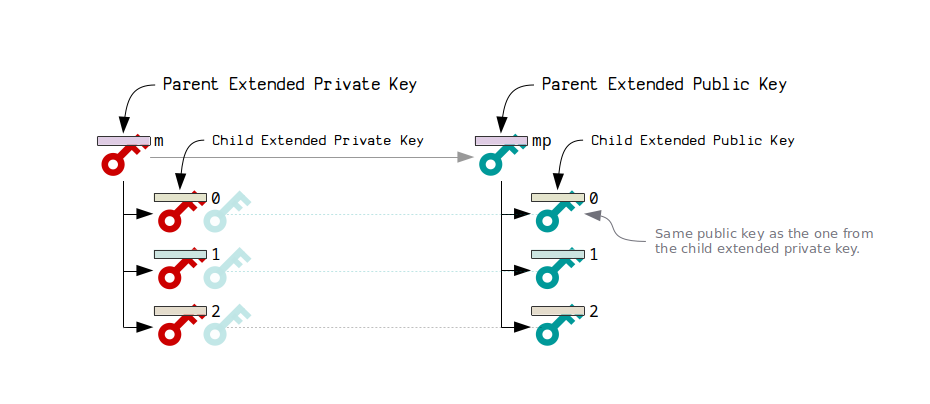
Practical Use of xPubs
With an xpub, you can:
- Generate receiving addresses
- Monitor balances
- Avoid exposing private keys
Platforms like Rhino Bitcoin use this design.
Private keys remain in cold storage.
Extended Public Key (xPub):
A public key paired with a chain code that allows child address derivation without private keys.
Bitcoin.org Extended Keys
Extended Key Prefixes
Common prefixes include:
- xpub / xprv — Legacy
- ypub / yprv — BIP49
- zpub / zprv — BIP84
- tpub / tprv — Testnet
Security Considerations
- xPriv exposure: Total loss of funds
- xPub exposure: Full address and history visibility
- xPub + child private key: Parent key compromise
This risk is why account-level derivation should always be hardened.
How Do Multi-Signature Wallets Use BIP32?
Multisig wallets require multiple keys to approve transactions.
Common setups include:
- 2-of-3
- 3-of-5
Each participant uses their own HD wallet.
How Multisig HD Wallets Work
- Each signer creates a separate seed phrase
- Participants share xpubs only
- No private keys are shared
Addresses are derived by combining child keys from each xpub at the same index.
Benefits of This Approach
- Unlimited multisig addresses
- Independent backups
- Flexible recovery
- Standardized restoration
Several BIPs define multisig structures:
- BIP45 (legacy)
- BIP48 (modern)
- BIP87 (descriptor wallets)
What Are Descriptor Wallets and Output Descriptors?
Descriptors provide a precise way to define wallet behavior.
They specify:
- Address type
- Derivation path
- Script structure
- Multisig rules
Traditional wallets relied on assumptions.
This caused interoperability issues.
Why Descriptors Matter
A descriptor contains all required information.
Example:
wpkh([fingerprint/84'/0'/0']xpub.../0/*)
This clearly defines:
- Address type
- Key origin
- Scan range
Multisig descriptors define:
- Thresholds
- Key sorting
- All cosigner xpubs
Bitcoin Core now defaults to descriptor wallets.
Many hardware wallets support descriptor exports.
How Should You Back Up HD Wallets?
The most important backup is the seed phrase.
This phrase controls the entire wallet.
It must be protected from loss and theft.
Backup Best Practices
- Use metal backups
- Store copies in different locations
- Add a BIP39 passphrase
- Consider seed splitting methods
Paper degrades.
Digital backups add attack surfaces.
Beyond the Seed Phrase
Seeds restore keys, but not metadata.
Consider backing up:
- Derivation paths
- Descriptors
- Account labels
Multisig wallets require additional backups.
Each participant must back up their seed.
The multisig configuration must also be preserved.
Test Your Backups
Do not wait for an emergency.
Periodically restore your wallet on a secondary device.
Confirm addresses and balances appear correctly.
Frequently Asked Questions
What is the difference between BIP32 and BIP39?
BIP39 defines the mnemonic phrase.
BIP32 defines how keys are derived from it.
Can I use the same seed phrase in different wallets?
Yes, if they support the same standards.
Some wallets use custom paths.
What happens if I exceed the gap limit?
Wallets scan 20 unused addresses by default.
Increase the gap limit to recover missing addresses.
How do I identify my derivation path?
Check wallet settings or export an xpub.
The prefix indicates the standard used.
Can hardware wallets use BIP32?
Yes.
All modern hardware wallets use BIP32 internally.
What is an extended public key fingerprint?
It is a short identifier derived from a master public key.
It helps distinguish wallets in multisig setups.
Should I use hardened derivation?
Yes for account-level keys.
Normal derivation is suitable only for address indices.
How do I migrate from a non-HD wallet?
Create a new HD wallet.
Send funds to it via standard transactions.
Can I recover addresses without knowing the path?
Technically yes, but it is difficult.
Wallets usually scan standard paths automatically.
What is the BIP39 passphrase?
An optional password added to the mnemonic.
It creates a completely different wallet hierarchy.
Conclusion
BIP32 HD wallets significantly improved Bitcoin custody.
They enable:
- Simple backups
- Better privacy
- Advanced setups like multisig
Key Implementation Priorities
- Secure seed backups
- Use BIP84 for modern wallets
- Protect extended keys
- Test recovery before storing large amounts
To explore secure self-custody solutions, explore Rhino Bitcoin’s self-custody options with multi-signature protection.
References
- Bitcoin Improvement Proposal 32 (BIP32):
https://github.com/bitcoin/bips/blob/master/bip-0032.mediawiki - Bitcoin Improvement Proposal 39 (BIP39):
https://github.com/bitcoin/bips/blob/master/bip-0039.mediawiki - Bitcoin Improvement Proposal 44 (BIP44):
https://github.com/bitcoin/bips/blob/master/bip-0044.mediawiki - Bitcoin Core Descriptors:
https://github.com/bitcoin/bitcoin/blob/master/doc/descriptors.md - Bitcoin.org Wallet Developer Guide:
https://developer.bitcoin.org/devguide/wallets.html
Important Disclaimers
Disclaimer: Educational information only. Not financial, legal, medical, or tax advice.
Risk Warnings: Bitcoin is volatile and involves risk. Past performance does not guarantee future results.
Conflicts of Interest: Rhino Bitcoin provides Bitcoin financial services. This content may reference its products.
.png)
.png)